

The Star of Mexuar
This monumental work, 'The Star of Mexuar, represents a milestone in the career of José Cabrera Lozano, where the millennial tradition of the Alhambra merges with the cutting edge of digital art. Inspired by the 'lacería' (interlacing) tilework of the Mexuar—the oldest and most historically charged hall of the Nasrid Palace—this piece stands as a profound study of symmetry and light. The composition orbits around a sixteen-pointed star, a polygon of exceptional geometric complexity that symbolizes the center of the universe in Islamic cosmology. This star, bathed in a vibrant cobalt blue, acts as a spiritual sun from which lines of force emanate infinitely, creating a visual rhythm that oscillates between mathematical order and visual poetry.

The Sun of Thought
In 'The Sun of Thought,' José Cabrera Lozano reveals the radiant heart of the Hall of Comares. This work is distinguished by a golden core that acts as a metaphysical sun, from which the complexity of the ordered universe unfolds. It is a representation of the 'mishkat' or the niche of light, a spiritual concept where divine light is refracted into geometric shapes to become comprehensible to the human eye. The gaze is magnetically drawn toward the amber center, then navigates the intricate paths of turquoise and carmine surrounding it. Every white line that crosses and rises is a testament to mathematical perfection, an echo of the prayers carved in stone at the Alhambra. This piece invites serenity; it is a visual refuge where the viewer can find balance. It is not just a pattern; it is a narrative about the unity of being and the multiplicity of existence, captured with a digital sharpness that honors tradition while embracing advanced technology.
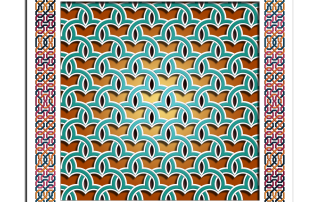
The Threshold of Dawn: Chromatic Arabesque of the Wine Gate
To contemplate 'The Threshold of Dawn: Chromatic Arabesques of the Wine Gate' is to witness the perfect intersection between the solidity of Nasrid military architecture and the lyrical volatility of its mural decoration. Inspired by the remnants of polychrome wall paintings that once adorned the interior arches of the emblematic Wine Gate (Puerta del Vino) in Granada's Alhambra, this digital masterpiece by José Cabrera Lozano rescues a symphony of sinuous shapes and infinite interlacing from the depths of time, elevating them into a contemporary dimension of unparalleled vividness. The central field of the composition simulates a rhythmic wave of interlaced polylobed arches, where deep terracotta tones and gradient ochres evoke the warmth of Andalusian clay and the sunset light bathing the fortress walls. Above this earthly foundation, vibrant emerald and turquoise ribbons meander like mystical vines, embodying the continuous flow of life and water. The magnificent outer border surrounding the piece acts as a guardian of order—a polychromatic, micro-geometric labyrinth where threads of pink, blue, orange, and white intertwine in absolute mathematical rigor. This artwork suspends the viewer in a state of pure aesthetic contemplation, transforming a historic mural fragment into a gateway to the eternal.

The Weave of Paradise
In 'The Weave of Paradise,' José Cabrera Lozano invites us to cross a threshold where time stands still. Inspired by the Patio de las Doncellas of the Royal Alcázar of Seville, this work is not a mere reproduction of Andalusian legacy, but a spiritual re-reading of its essence. Here, geometry acts as an echo of the divine; each white line is a thread of light searching for the infinite above a void of deep shadows. The author rescues the mysticism of the Mudejar, where horror vacui is not fear of the void, but a celebration of fullness. Observing the piece, the viewer is immersed in a hypnotic dance of star polygons that seem to pulse. The digital shadows, applied with a precision that only cutting-edge technique allows, endow the interlacing with an organic, almost tactile three-dimensionality. It is as if Mediterranean light had filtered through an invisible lattice, projecting the order of the cosmos onto matter. This work represents absolute balance: the meeting between mathematical rigor and aesthetic emotion, offering a visual sanctuary for introspection and peace within modern chaos.

The Whisper of the Alhambra
This work is an ode to the contemplative stillness of Nasrid palaces. José Cabrera Lozano successfully captures the vibration of the Mexuar, the space where justice and administration met under the gaze of absolute mathematical order. The interlaced patterns (lacería) are not mere ornaments here; they are a web that catches light and shadow, a metaphor for the cosmos where every eight-pointed star is a center of spiritual gravity. The viewer's gaze gets lost in a labyrinth of white lines that flow with the precision of a celestial river, interconnecting fragments of deep blue, turquoise, and golden ochres. It is a 'horror vacui' that does not overwhelm but invites silence. The dark background acts as the primordial void, allowing the geometry to emerge with almost tactile force, reminding us that eternity resides in rhythmic repetition.
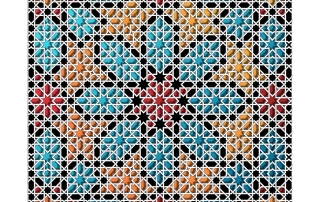
Whispers of Orange Blossom and Stone
There is a silent melody emanating from the walls of the Royal Alcázar, a whisper that only the attentive eye can hear. 'Whispers of Orange Blossom and Stone' is the capture of that moment of revelation. José Cabrera Lozano delivers not just a pattern, but a fragment of Andalusian memory, where each interlaced line is a trace of the breeze crossing the courtyard. The work breathes through its colors: the blue that recalls the stagnant water in the pools and the warm tones that evoke the stone bathed by the afternoon sun. It is not just art; it is a portal to an era where beauty was the language of the sacred. In this artwork, complexity becomes a caress, inviting the viewer on an introspective journey where time seems to stand still among the shadows cast by centuries.

This monumental work, 'The Star of Mexuar, represents a milestone in the career of José Cabrera Lozano, where the millennial tradition of the Alhambra merges with the cutting edge of digital art. Inspired by the 'lacería' (interlacing) tilework of the Mexuar—the oldest and most historically charged hall of the Nasrid Palace—this piece stands as a profound study of symmetry and light. The composition orbits around a sixteen-pointed star, a polygon of exceptional geometric complexity that symbolizes the center of the universe in Islamic cosmology. This star, bathed in a vibrant cobalt blue, acts as a spiritual sun from which lines of force emanate infinitely, creating a visual rhythm that oscillates between mathematical order and visual poetry.

In 'The Sun of Thought,' José Cabrera Lozano reveals the radiant heart of the Hall of Comares. This work is distinguished by a golden core that acts as a metaphysical sun, from which the complexity of the ordered universe unfolds. It is a representation of the 'mishkat' or the niche of light, a spiritual concept where divine light is refracted into geometric shapes to become comprehensible to the human eye. The gaze is magnetically drawn toward the amber center, then navigates the intricate paths of turquoise and carmine surrounding it. Every white line that crosses and rises is a testament to mathematical perfection, an echo of the prayers carved in stone at the Alhambra. This piece invites serenity; it is a visual refuge where the viewer can find balance. It is not just a pattern; it is a narrative about the unity of being and the multiplicity of existence, captured with a digital sharpness that honors tradition while embracing advanced technology.

To contemplate 'The Threshold of Dawn: Chromatic Arabesques of the Wine Gate' is to witness the perfect intersection between the solidity of Nasrid military architecture and the lyrical volatility of its mural decoration. Inspired by the remnants of polychrome wall paintings that once adorned the interior arches of the emblematic Wine Gate (Puerta del Vino) in Granada's Alhambra, this digital masterpiece by José Cabrera Lozano rescues a symphony of sinuous shapes and infinite interlacing from the depths of time, elevating them into a contemporary dimension of unparalleled vividness. The central field of the composition simulates a rhythmic wave of interlaced polylobed arches, where deep terracotta tones and gradient ochres evoke the warmth of Andalusian clay and the sunset light bathing the fortress walls. Above this earthly foundation, vibrant emerald and turquoise ribbons meander like mystical vines, embodying the continuous flow of life and water. The magnificent outer border surrounding the piece acts as a guardian of order—a polychromatic, micro-geometric labyrinth where threads of pink, blue, orange, and white intertwine in absolute mathematical rigor. This artwork suspends the viewer in a state of pure aesthetic contemplation, transforming a historic mural fragment into a gateway to the eternal.

In 'The Weave of Paradise,' José Cabrera Lozano invites us to cross a threshold where time stands still. Inspired by the Patio de las Doncellas of the Royal Alcázar of Seville, this work is not a mere reproduction of Andalusian legacy, but a spiritual re-reading of its essence. Here, geometry acts as an echo of the divine; each white line is a thread of light searching for the infinite above a void of deep shadows. The author rescues the mysticism of the Mudejar, where horror vacui is not fear of the void, but a celebration of fullness. Observing the piece, the viewer is immersed in a hypnotic dance of star polygons that seem to pulse. The digital shadows, applied with a precision that only cutting-edge technique allows, endow the interlacing with an organic, almost tactile three-dimensionality. It is as if Mediterranean light had filtered through an invisible lattice, projecting the order of the cosmos onto matter. This work represents absolute balance: the meeting between mathematical rigor and aesthetic emotion, offering a visual sanctuary for introspection and peace within modern chaos.

This work is an ode to the contemplative stillness of Nasrid palaces. José Cabrera Lozano successfully captures the vibration of the Mexuar, the space where justice and administration met under the gaze of absolute mathematical order. The interlaced patterns (lacería) are not mere ornaments here; they are a web that catches light and shadow, a metaphor for the cosmos where every eight-pointed star is a center of spiritual gravity. The viewer's gaze gets lost in a labyrinth of white lines that flow with the precision of a celestial river, interconnecting fragments of deep blue, turquoise, and golden ochres. It is a 'horror vacui' that does not overwhelm but invites silence. The dark background acts as the primordial void, allowing the geometry to emerge with almost tactile force, reminding us that eternity resides in rhythmic repetition.

There is a silent melody emanating from the walls of the Royal Alcázar, a whisper that only the attentive eye can hear. 'Whispers of Orange Blossom and Stone' is the capture of that moment of revelation. José Cabrera Lozano delivers not just a pattern, but a fragment of Andalusian memory, where each interlaced line is a trace of the breeze crossing the courtyard. The work breathes through its colors: the blue that recalls the stagnant water in the pools and the warm tones that evoke the stone bathed by the afternoon sun. It is not just art; it is a portal to an era where beauty was the language of the sacred. In this artwork, complexity becomes a caress, inviting the viewer on an introspective journey where time seems to stand still among the shadows cast by centuries.
