

The Garden of Stars
Contemplating this artwork transcends mere visual observation; it is an act of immersion into the architectural memory of Al-Andalus, encoded through the contemporary lens of JC Geometric Patterns. In 'Stars of Al-Andalus', the echoes of the legendary Maiden's Courtyard in the Royal Alcázar of Seville are presented not as a static relic, but as a pulsating entity. The infinite, immaculate white threads weave a network of stars that capture the duality of the universe: the earthly and the divine. The vibrant cyan acts as a visual sigh of the flowing water that gives life to Andalusian gardens, a liquid freshness that masterfully contrasts with the warmth of red and ochre, reminiscent of the southern sun striking the historical brick, plaster, and tile. Every geometric intersection is a syllable in a visual poem speaking of cosmic order. The carefully curated color palette, enhanced by digitally cast shadows, endows the composition with a hypnotic three-dimensionality. It is a meditation on time, where Islamic sacred geometry reveals itself as a universal and imperishable language. The artwork invites the viewer to lose themselves in its labyrinths of light and shadow, finding in its symmetrical repetition a space for inner silence and spiritual reflection.

The Geometry of the Nasrid Splendor: The Golden Algorithm of the Barca
To contemplate 'The Infinite Echo of the Mexuar: Lattices of Divine Transit' is to step across a threshold where time is suspended and matter dissolves into pure mathematical vibration. Inspired by the majestic zócalo (dado) of the Sala de la Barca in Granada's Alhambra, this digital masterpiece by José Cabrera Lozano transcends mere historical reproduction to become a mystical bridge between the earthly plane and the infinitude of the cosmos. The interlacing pattern, born from the strict rigor of Islamic sacred geometry, traces an eternal dance of black and white ribbons that cross without beginning or end, embodying the Sufi concept of *Tawhid*—unity in multiplicity. The polygonal spaces are flooded with a superb color palette: deep teals evoke the Andalusian sky and the reflective waters of the courtyard, while the pink stars and warm golden-amber centerpieces act as skylights for the soul, drawing the gaze toward an inner illumination. Each intersection is a knot of consciousness; each repetition, a visual mantra inducing contemplation and serenity. The artist successfully captures the sacred atmosphere of the Nasrid palaces, where the air itself seems imbued with poetry and mysticism. This is not simple decorative design; it is a spiritual cartography that celebrates the perfect symmetry of the universe and the transit of the soul toward absolute beauty.

The Hearbeat of Stone
There is a silent music in the repetition of form, a melody that José Cabrera Lozano has rescued from the walls of the Royal Alcázar to project it into the future. In 'The Heartbeat of Stone', the Maiden’s Courtyard is liberated from its historical weight to become an ethereal dance. The eight-pointed stars are not just figures; they are pulsations of a civilization that understood the cosmos as a perfect fabric. The deep cyan evokes the night sky over Seville, while the solar reds and yellows act as sparks of light that breathe life into the structure. Each white line is a path inviting us to rediscover universal harmony, merging the master craftsmanship of the past with the digital purity of the present.

The Heart of Order: Geometry in Suspension
In this piece, José Cabrera Lozano invites us to contemplate the precise moment when a mathematical idea materializes. 'The Heart of Order' is not just a representation of sacred geometry; it is an exploration of void and structure. By leaving the underlying construction grid exposed, the artist unveils the secrets of Nasrid design, allowing the viewer to participate in the genesis of form. Polychrome elements in royal garnet, cobalt blue, and pure white appear to levitate above the medium, creating a sense of suspension that defies gravity. The empty center of the composition acts as a focal point of serenity, a reminder that at the heart of all complexity lies a point of silence and absolute balance. Eight-pointed stars expand rhythmically toward the edges, guiding the gaze on a journey of technical and spiritual discovery. It is a work that celebrates the transparency of the creative process, turning technical drawing into a visual gem of timeless elegance. Owning this piece is owning the soul of design, a tribute to the perfection that rules both the cosmos and the art of Al-Andalus.

The Infinite Echo of the Mexuar: Lattices of Divine Transit
To contemplate 'The Infinite Echo of the Mexuar: Lattices of Divine Transit' is to step across a threshold where time is suspended and matter dissolves into pure mathematical vibration. Inspired by the majestic zócalo (dado) of the Sala de la Barca in Granada's Alhambra, this digital masterpiece by José Cabrera Lozano transcends mere historical reproduction to become a mystical bridge between the earthly plane and the infinitude of the cosmos. The interlacing pattern, born from the strict rigor of Islamic sacred geometry, traces an eternal dance of black and white ribbons that cross without beginning or end, embodying the Sufi concept of *Tawhid*—unity in multiplicity. The polygonal spaces are flooded with a superb color palette: deep teals evoke the Andalusian sky and the reflective waters of the courtyard, while the pink stars and warm golden-amber centerpieces act as skylights for the soul, drawing the gaze toward an inner illumination. Each intersection is a knot of consciousness; each repetition, a visual mantra inducing contemplation and serenity. The artist successfully captures the sacred atmosphere of the Nasrid palaces, where the air itself seems imbued with poetry and mysticism. This is not simple decorative design; it is a spiritual cartography that celebrates the perfect symmetry of the universe and the transit of the soul toward absolute beauty.

The Labyrinth of Light
In 'The Labyrinth of Light', José Cabrera Lozano immerses us in a mathematical dance of divine proportions. This work does not merely emulate the decorative art of the Alhambra but decomposes and reconstructs it under a contemporary light. The viewer faces a crossroads of white ribbons that, like Ariadne's threads, guide us through a vibrant space of color and shadow. The centrality of the composition, marked by a cruciform structure emerging from the star pattern, suggests a meeting point between the human and the divine. The warm tones of orange and ochre evoke the sunset over the alcazaba walls, while flashes of turquoise and magenta bring a freshness that breaks geometric rigidity. It is a work that speaks of patience, order, and the beauty that arises when logic and creativity are seamlessly intertwined. Each intersection is a reminder of the interconnection of all things, a visual representation of the universal harmony that Cabrera Lozano has successfully distilled into an image of absolute purity.
The Lattice of Paradise: Echoes of Ancestral Geometry
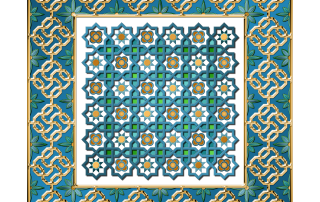
This work by José Cabrera Lozano manifests as a visual meditation on order and infinity. At the heart of the piece, an intricate network of turquoise bands intertwines in a perpetual dance, evoking the celestial gardens of Islamic tradition where water and geometry flow in harmony. The viewer is invited to lose themselves in the 'Khatam', the eight-pointed star that serves as a spiritual anchor, representing the expansion of knowledge and the connection between the four cardinal points and their intermediates. The color palette, dominated by deep turquoise and accents of ochre and gold, suggests a transition between the twilight sky and the light of enlightenment. It is not merely a static image; it is a geometric organism that breathes through its digital shadows. Each line has been drawn with the precision of an architect and the sensitivity of a poet, seeking not only aesthetic beauty but the resonance of the universal laws that govern nature. Contemplating 'The Lattice of Paradise', we face the paradox of sacred geometry: the ability of the finite—a paper surface—to contain the representation of the infinite. It is a reminder that, in the chaos of the modern world, there is an underlying structure of peace and balance that can be decoded through art. This piece acts as a temporal bridge, rescuing design techniques from the Alhambra and projecting them into the future through the mastery of cutting-edge digital tools, consolidating Cabrera Lozano as a contemporary guardian of visual harmony.

The Maidens’ Labyrinth
In the heart of the Real Alcázar of Seville, the Courtyard of the Maidens (Patio de las Doncellas) breathes an elegance that has captivated generations. This work by José Cabrera Lozano rescues the vibrant geometry of its tiled plinth, transforming glazed clay into a visual experience of infinite depth. The piece manifests as a labyrinth of interlaced shapes where light seems to filter through a digital lattice, revealing a universe of colors that are the very signature of Mudejar Seville: intense turquoises, deep magentas, and golden ochres. Contemplating 'The Maidens' Labyrinth', the viewer does not merely observe a pattern; they immerse themselves in the history of a palace where water and geometry merge to create an earthly paradise. The deep blue network of arches acts as a frame of order over the polychrome burst of the background, inviting meditation on the balance between structure and creative freedom. Each digital 'tile' is an echo of the craftsmen who, centuries ago, hand-cut each piece to honor beauty. This work is a bridge bringing that devotion to the present, allowing the majesty of the Alcázar to inhabit contemporary spaces with unprecedented freshness and clarity. Si el espectador se acerca, descubrirá que cada "azulejo" digital alberga en su interior su propia micro-trama geométrica tallada, revelando capas de significado que invitan a una contemplación casi meditativa. Es un tributo absoluto a la genialidad de los artesanos andalusíes, resucitado a través de la luz de la pantalla y la precisión milimétrica del vector. 'Puerta de la Justicia' no es una simple reproducción; es una exégesis visual que desentraña el alma matemática de Granada.
The Mirror of the Eternity
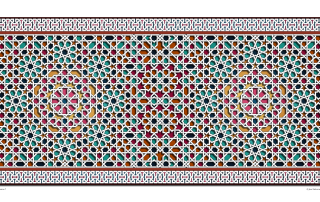
To contemplate 'The Mirror of Eternity' is to embark on a meditative journey into the heart of Nasrid cosmology, a space where visual beauty acts as a bridge to the ineffable. Inspired by the legendary panels of the Alhambra's Comares Hall, this artwork transcends mere ornamentation to stand as a portal of profound spiritual resonance. Through a horizontal layout that evokes the infinite, the composition reveals a duplicated cosmos, governed by two majestic twelve-pointed stars operating as radiant suns of vital energy. These central figures are not static; they beat rhythmically, expanding their influence through an intricate network of uninterrupted lacework. In Islamic philosophy, this continuity without beginning or end symbolizes the eternal journey of the soul and the indissoluble interconnection of all facets of creation under an unalterable divine order. The chromatic palette is a poetic tribute to the elemental forces of the Andalusian universe. Deep cobalt blues and turquoises immerse us in the contemplation of crystalline waters and the celestial vault, suggesting purification and protection. Meanwhile, crimson reds and golden ochre tones anchor the vision to fertile earth and regal splendor, blending the earthly with the heavenly. The duplicated arrangement of the elements creates a harmonic echo, a silent dialogue that invites the viewer to find their own inner balance. 'The Mirror of Eternity' is essentially a crystallized mantra in sacred geometry; a contained breath that pacifies the mind, elevates the spirit, and transforms any environment into a true sanctuary of order, symmetry, and timeless contemplation.

The Reflection of the Eternal
In 'Patio de las Doncellas: The Reflection of the Eternal,' José Cabrera Lozano invites us to a visual introspection in the heart of Sevillian Mudejar art. This work is not merely a reproduction, but a luminous deconstruction of infinity. The network of interlacing stars—descendants of sacred mathematics—floats above an abyss of color that pays homage to the Andalusian heritage. The turquoise evokes the water flowing through the courtyard's canals, the orange captures the midday sun over the bricks, and the crimson pulses with the passion of a thousand-year history. The white lattice, suspended in an ethereal three-dimensionality, symbolizes the light of reason ordering the chaos of the sensible world. It is a dance of forms with no beginning or end, designed to inhabit silence and elevate the spirit towards the contemplation of universal order.

Contemplating this artwork transcends mere visual observation; it is an act of immersion into the architectural memory of Al-Andalus, encoded through the contemporary lens of JC Geometric Patterns. In 'Stars of Al-Andalus', the echoes of the legendary Maiden's Courtyard in the Royal Alcázar of Seville are presented not as a static relic, but as a pulsating entity. The infinite, immaculate white threads weave a network of stars that capture the duality of the universe: the earthly and the divine. The vibrant cyan acts as a visual sigh of the flowing water that gives life to Andalusian gardens, a liquid freshness that masterfully contrasts with the warmth of red and ochre, reminiscent of the southern sun striking the historical brick, plaster, and tile. Every geometric intersection is a syllable in a visual poem speaking of cosmic order. The carefully curated color palette, enhanced by digitally cast shadows, endows the composition with a hypnotic three-dimensionality. It is a meditation on time, where Islamic sacred geometry reveals itself as a universal and imperishable language. The artwork invites the viewer to lose themselves in its labyrinths of light and shadow, finding in its symmetrical repetition a space for inner silence and spiritual reflection.

To contemplate 'The Infinite Echo of the Mexuar: Lattices of Divine Transit' is to step across a threshold where time is suspended and matter dissolves into pure mathematical vibration. Inspired by the majestic zócalo (dado) of the Sala de la Barca in Granada's Alhambra, this digital masterpiece by José Cabrera Lozano transcends mere historical reproduction to become a mystical bridge between the earthly plane and the infinitude of the cosmos. The interlacing pattern, born from the strict rigor of Islamic sacred geometry, traces an eternal dance of black and white ribbons that cross without beginning or end, embodying the Sufi concept of *Tawhid*—unity in multiplicity. The polygonal spaces are flooded with a superb color palette: deep teals evoke the Andalusian sky and the reflective waters of the courtyard, while the pink stars and warm golden-amber centerpieces act as skylights for the soul, drawing the gaze toward an inner illumination. Each intersection is a knot of consciousness; each repetition, a visual mantra inducing contemplation and serenity. The artist successfully captures the sacred atmosphere of the Nasrid palaces, where the air itself seems imbued with poetry and mysticism. This is not simple decorative design; it is a spiritual cartography that celebrates the perfect symmetry of the universe and the transit of the soul toward absolute beauty.

There is a silent music in the repetition of form, a melody that José Cabrera Lozano has rescued from the walls of the Royal Alcázar to project it into the future. In 'The Heartbeat of Stone', the Maiden’s Courtyard is liberated from its historical weight to become an ethereal dance. The eight-pointed stars are not just figures; they are pulsations of a civilization that understood the cosmos as a perfect fabric. The deep cyan evokes the night sky over Seville, while the solar reds and yellows act as sparks of light that breathe life into the structure. Each white line is a path inviting us to rediscover universal harmony, merging the master craftsmanship of the past with the digital purity of the present.

In this piece, José Cabrera Lozano invites us to contemplate the precise moment when a mathematical idea materializes. 'The Heart of Order' is not just a representation of sacred geometry; it is an exploration of void and structure. By leaving the underlying construction grid exposed, the artist unveils the secrets of Nasrid design, allowing the viewer to participate in the genesis of form. Polychrome elements in royal garnet, cobalt blue, and pure white appear to levitate above the medium, creating a sense of suspension that defies gravity. The empty center of the composition acts as a focal point of serenity, a reminder that at the heart of all complexity lies a point of silence and absolute balance. Eight-pointed stars expand rhythmically toward the edges, guiding the gaze on a journey of technical and spiritual discovery. It is a work that celebrates the transparency of the creative process, turning technical drawing into a visual gem of timeless elegance. Owning this piece is owning the soul of design, a tribute to the perfection that rules both the cosmos and the art of Al-Andalus.

To contemplate 'The Infinite Echo of the Mexuar: Lattices of Divine Transit' is to step across a threshold where time is suspended and matter dissolves into pure mathematical vibration. Inspired by the majestic zócalo (dado) of the Sala de la Barca in Granada's Alhambra, this digital masterpiece by José Cabrera Lozano transcends mere historical reproduction to become a mystical bridge between the earthly plane and the infinitude of the cosmos. The interlacing pattern, born from the strict rigor of Islamic sacred geometry, traces an eternal dance of black and white ribbons that cross without beginning or end, embodying the Sufi concept of *Tawhid*—unity in multiplicity. The polygonal spaces are flooded with a superb color palette: deep teals evoke the Andalusian sky and the reflective waters of the courtyard, while the pink stars and warm golden-amber centerpieces act as skylights for the soul, drawing the gaze toward an inner illumination. Each intersection is a knot of consciousness; each repetition, a visual mantra inducing contemplation and serenity. The artist successfully captures the sacred atmosphere of the Nasrid palaces, where the air itself seems imbued with poetry and mysticism. This is not simple decorative design; it is a spiritual cartography that celebrates the perfect symmetry of the universe and the transit of the soul toward absolute beauty.

In 'The Labyrinth of Light', José Cabrera Lozano immerses us in a mathematical dance of divine proportions. This work does not merely emulate the decorative art of the Alhambra but decomposes and reconstructs it under a contemporary light. The viewer faces a crossroads of white ribbons that, like Ariadne's threads, guide us through a vibrant space of color and shadow. The centrality of the composition, marked by a cruciform structure emerging from the star pattern, suggests a meeting point between the human and the divine. The warm tones of orange and ochre evoke the sunset over the alcazaba walls, while flashes of turquoise and magenta bring a freshness that breaks geometric rigidity. It is a work that speaks of patience, order, and the beauty that arises when logic and creativity are seamlessly intertwined. Each intersection is a reminder of the interconnection of all things, a visual representation of the universal harmony that Cabrera Lozano has successfully distilled into an image of absolute purity.

This work by José Cabrera Lozano manifests as a visual meditation on order and infinity. At the heart of the piece, an intricate network of turquoise bands intertwines in a perpetual dance, evoking the celestial gardens of Islamic tradition where water and geometry flow in harmony. The viewer is invited to lose themselves in the 'Khatam', the eight-pointed star that serves as a spiritual anchor, representing the expansion of knowledge and the connection between the four cardinal points and their intermediates. The color palette, dominated by deep turquoise and accents of ochre and gold, suggests a transition between the twilight sky and the light of enlightenment. It is not merely a static image; it is a geometric organism that breathes through its digital shadows. Each line has been drawn with the precision of an architect and the sensitivity of a poet, seeking not only aesthetic beauty but the resonance of the universal laws that govern nature. Contemplating 'The Lattice of Paradise', we face the paradox of sacred geometry: the ability of the finite—a paper surface—to contain the representation of the infinite. It is a reminder that, in the chaos of the modern world, there is an underlying structure of peace and balance that can be decoded through art. This piece acts as a temporal bridge, rescuing design techniques from the Alhambra and projecting them into the future through the mastery of cutting-edge digital tools, consolidating Cabrera Lozano as a contemporary guardian of visual harmony.

In the heart of the Real Alcázar of Seville, the Courtyard of the Maidens (Patio de las Doncellas) breathes an elegance that has captivated generations. This work by José Cabrera Lozano rescues the vibrant geometry of its tiled plinth, transforming glazed clay into a visual experience of infinite depth. The piece manifests as a labyrinth of interlaced shapes where light seems to filter through a digital lattice, revealing a universe of colors that are the very signature of Mudejar Seville: intense turquoises, deep magentas, and golden ochres. Contemplating 'The Maidens' Labyrinth', the viewer does not merely observe a pattern; they immerse themselves in the history of a palace where water and geometry merge to create an earthly paradise. The deep blue network of arches acts as a frame of order over the polychrome burst of the background, inviting meditation on the balance between structure and creative freedom. Each digital 'tile' is an echo of the craftsmen who, centuries ago, hand-cut each piece to honor beauty. This work is a bridge bringing that devotion to the present, allowing the majesty of the Alcázar to inhabit contemporary spaces with unprecedented freshness and clarity. Si el espectador se acerca, descubrirá que cada "azulejo" digital alberga en su interior su propia micro-trama geométrica tallada, revelando capas de significado que invitan a una contemplación casi meditativa. Es un tributo absoluto a la genialidad de los artesanos andalusíes, resucitado a través de la luz de la pantalla y la precisión milimétrica del vector. 'Puerta de la Justicia' no es una simple reproducción; es una exégesis visual que desentraña el alma matemática de Granada.

To contemplate 'The Mirror of Eternity' is to embark on a meditative journey into the heart of Nasrid cosmology, a space where visual beauty acts as a bridge to the ineffable. Inspired by the legendary panels of the Alhambra's Comares Hall, this artwork transcends mere ornamentation to stand as a portal of profound spiritual resonance. Through a horizontal layout that evokes the infinite, the composition reveals a duplicated cosmos, governed by two majestic twelve-pointed stars operating as radiant suns of vital energy. These central figures are not static; they beat rhythmically, expanding their influence through an intricate network of uninterrupted lacework. In Islamic philosophy, this continuity without beginning or end symbolizes the eternal journey of the soul and the indissoluble interconnection of all facets of creation under an unalterable divine order. The chromatic palette is a poetic tribute to the elemental forces of the Andalusian universe. Deep cobalt blues and turquoises immerse us in the contemplation of crystalline waters and the celestial vault, suggesting purification and protection. Meanwhile, crimson reds and golden ochre tones anchor the vision to fertile earth and regal splendor, blending the earthly with the heavenly. The duplicated arrangement of the elements creates a harmonic echo, a silent dialogue that invites the viewer to find their own inner balance. 'The Mirror of Eternity' is essentially a crystallized mantra in sacred geometry; a contained breath that pacifies the mind, elevates the spirit, and transforms any environment into a true sanctuary of order, symmetry, and timeless contemplation.

In 'Patio de las Doncellas: The Reflection of the Eternal,' José Cabrera Lozano invites us to a visual introspection in the heart of Sevillian Mudejar art. This work is not merely a reproduction, but a luminous deconstruction of infinity. The network of interlacing stars—descendants of sacred mathematics—floats above an abyss of color that pays homage to the Andalusian heritage. The turquoise evokes the water flowing through the courtyard's canals, the orange captures the midday sun over the bricks, and the crimson pulses with the passion of a thousand-year history. The white lattice, suspended in an ethereal three-dimensionality, symbolizes the light of reason ordering the chaos of the sensible world. It is a dance of forms with no beginning or end, designed to inhabit silence and elevate the spirit towards the contemplation of universal order.