

The Interlaced Cosmos of Mexuar: Lapis Lazuli over Gold (Methacrylate)
This monumental work, 'Lapis Lazuli Sky over Gold: The Interlaced Cosmos of Mexuar', stands as a threshold for contemplation. José Cabrera Lozano not only reinterprets Nasrid lacería, but he endows it with a contemporary spiritual pulse. The white interlacing, like a river of living water, flows incessantly, reminding us that in sacred geometry, every line is a path and every intersection a destination. The composition presents two visions: one, a centralized radiant sun where unity (tawhid) is the focal point; the other, an infinite expansion where the complexity of the forms multiplies towards the unreachability of infinity. It is a dialogue between mathematical rigidity and mystical emotion, a choreography of forms that seem to breathe over an abyss of black velvet. The colors are palpable jewels: the blue of the sky, the turquoise of the water, the ochre of the earth, and the gold of the divine. The profound black is the primal void, the initial mystery that serves as a stage for this expanding cosmos to manifest. The work is an invitation to silence, a bridge connecting the Andalusian past with the digital present, reminding us that beauty is, above all, an act of faith. It is the Andalusian cosmos at its finest, a 'zenith of the Andalusian jewel'. From a technical perspective, the work is a masterful exploration of high-fidelity digital composition. The geometry is based on a complex system of Nasrid zillij, where the modules pivot between 8, and 16-point bases, organized on an underlying grid. The central variation focuses on a radiant 8-point star that governs the radial symmetry, while the expanding variation multiplies the quadrangular modules, showcasing the infinity of the pattern. The use of color is crucial. Cabrera Lozano employs texturing algorithms to emulate the mineral nature of stone and enameled ceramics, creating a subtle but perceptible three-dimensional relief. The white lacería, with a macro-relief, stands out against the absolute black. The choice of Fine Art Hahnemühle William Turner (310 gr/m2) paper is fundamental to this process. Its matte surface, with a pronounced mold-made texture, allows the black pigments to achieve absolute density, an 'infinite black' that serves as a primordial stage upon which the turquoise and ochre colors seem to float. This tactile and visual experience changes according to the ambient light, revealing hidden layers of depth. Ambient Suggestions Given its magnificent nature and cultural heritage, this piece is ideal for spaces of prestige and authority. It is the ideal choice for the main salon of a superyacht, where the geometric theme and deep blue connect with the marine environment. Similarly, in the lobby of a five-star hotel with historical roots, or in executive offices where technical sophistication must go hand-in-hand with a profound cultural narrative. Framing: A floating frame (shadow box) with a dark or matte charcoal wood molding is suggested to let the work breathe. It is crucial to use anti-reflective museum glass with UV protection to preserve the texture of the paper and the depth of the blacks.
The Interlaced Cosmos of Mexuar: Lapis Lazuli Sky over Gold (Original)
This monumental work, 'Lapis Lazuli Sky over Gold: The Interlaced Cosmos of Mexuar', stands as a threshold for contemplation. José Cabrera Lozano not only reinterprets Nasrid lacería, but he endows it with a contemporary spiritual pulse. The white interlacing, like a river of living water, flows incessantly, reminding us that in sacred geometry, every line is a path and every intersection a destination. The composition presents two visions: one, a centralized radiant sun where unity (tawhid) is the focal point; the other, an infinite expansion where the complexity of the forms multiplies towards the unreachability of infinity. It is a dialogue between mathematical rigidity and mystical emotion, a choreography of forms that seem to breathe over an abyss of black velvet. The colors are palpable jewels: the blue of the sky, the turquoise of the water, the ochre of the earth, and the gold of the divine. The profound black is the primal void, the initial mystery that serves as a stage for this expanding cosmos to manifest. The work is an invitation to silence, a bridge connecting the Andalusian past with the digital present, reminding us that beauty is, above all, an act of faith. It is the Andalusian cosmos at its finest, a 'zenith of the Andalusian jewel'. From a technical perspective, the work is a masterful exploration of high-fidelity digital composition. The geometry is based on a complex system of Nasrid zillij, where the modules pivot between 8, and 16-point bases, organized on an underlying grid. The central variation focuses on a radiant 8-point star that governs the radial symmetry, while the expanding variation multiplies the quadrangular modules, showcasing the infinity of the pattern. The use of color is crucial. Cabrera Lozano employs texturing algorithms to emulate the mineral nature of stone and enameled ceramics, creating a subtle but perceptible three-dimensional relief. The white lacería, with a macro-relief, stands out against the absolute black. The choice of Fine Art Hahnemühle William Turner (310 gr/m2) paper is fundamental to this process. Its matte surface, with a pronounced mold-made texture, allows the black pigments to achieve absolute density, an 'infinite black' that serves as a primordial stage upon which the turquoise and ochre colors seem to float. This tactile and visual experience changes according to the ambient light, revealing hidden layers of depth. Ambient Suggestions Given its magnificent nature and cultural heritage, this piece is ideal for spaces of prestige and authority. It is the ideal choice for the main salon of a superyacht, where the geometric theme and deep blue connect with the marine environment. Similarly, in the lobby of a five-star hotel with historical roots, or in executive offices where technical sophistication must go hand-in-hand with a profound cultural narrative. Framing: A floating frame (shadow box) with a dark or matte charcoal wood molding is suggested to let the work breathe. It is crucial to use anti-reflective museum glass with UV protection to preserve the texture of the paper and the depth of the blacks.

The Interlaced Cosmos of Mexuar: The Star of Mexuar (Methacrylate)
This monumental work, 'The Star of Mexuar, represents a milestone in the career of José Cabrera Lozano, where the millennial tradition of the Alhambra merges with the cutting edge of digital art. Inspired by the 'lacería' (interlacing) tilework of the Mexuar—the oldest and most historically charged hall of the Nasrid Palace—this piece stands as a profound study of symmetry and light. The composition orbits around a sixteen-pointed star, a polygon of exceptional geometric complexity that symbolizes the center of the universe in Islamic cosmology. This star, bathed in a vibrant cobalt blue, acts as a spiritual sun from which lines of force emanate infinitely, creating a visual rhythm that oscillates between mathematical order and visual poetry. From a technical standpoint, Cabrera Lozano transcends two-dimensionality through the use of texturing algorithms that mimic the porosity of carved plaster and the mineral density of lapis lazuli. Each white 'ribbon' or interlaced knot has been modeled with subtle variations in shadow and light, generating a depth that tricks the eye, making the work appear as a bas-relief sculpture. The choice of Hahnemühle William Turner Fine Art paper (310 gsm) is fundamental to this process. Its matte surface, with a pronounced yet refined mold-made texture, allows the black pigments to achieve absolute density—an 'infinite black' that serves as a primal void upon which the turquoises and ochres seem to float. The absence of optical brighteners in the paper ensures that the warmth of the work remains unchanged, offering a tactile and visual experience that shifts according to the ambient light. It is a piece that is not just observed; it is inhabited through the gaze, discovering in every intersection a new detail of Granada's heritage reinterpreted for the 21st century. Ambient Suggestions Given the scale and visual power of this piece, it demands an environment that dialogues with its sophistication. We recommend installation in spaces with high ceilings and controlled lighting. A 'shadow box' framing with an ebonized wood or matte charcoal molding would allow the William Turner paper to breathe, highlighting its handcrafted edges. This work is ideal for the main salon of a superyacht, where the geometric theme and deep blue connect with the marine surroundings. Similarly, in a luxury hotel lobby or a high-level executive boardroom, the work conveys a message of order, history, and technological vision.
The Interlaced Cosmos of Mexuar: The Star of Mexuar (Original)
This monumental work, 'The Star of Mexuar, represents a milestone in the career of José Cabrera Lozano, where the millennial tradition of the Alhambra merges with the cutting edge of digital art. Inspired by the 'lacería' (interlacing) tilework of the Mexuar—the oldest and most historically charged hall of the Nasrid Palace—this piece stands as a profound study of symmetry and light. The composition orbits around a sixteen-pointed star, a polygon of exceptional geometric complexity that symbolizes the center of the universe in Islamic cosmology. This star, bathed in a vibrant cobalt blue, acts as a spiritual sun from which lines of force emanate infinitely, creating a visual rhythm that oscillates between mathematical order and visual poetry. From a technical standpoint, Cabrera Lozano transcends two-dimensionality through the use of texturing algorithms that mimic the porosity of carved plaster and the mineral density of lapis lazuli. Each white 'ribbon' or interlaced knot has been modeled with subtle variations in shadow and light, generating a depth that tricks the eye, making the work appear as a bas-relief sculpture. The choice of Hahnemühle William Turner Fine Art paper (310 gsm) is fundamental to this process. Its matte surface, with a pronounced yet refined mold-made texture, allows the black pigments to achieve absolute density—an 'infinite black' that serves as a primal void upon which the turquoises and ochres seem to float. The absence of optical brighteners in the paper ensures that the warmth of the work remains unchanged, offering a tactile and visual experience that shifts according to the ambient light. It is a piece that is not just observed; it is inhabited through the gaze, discovering in every intersection a new detail of Granada's heritage reinterpreted for the 21st century. Ambient Suggestions Given the scale and visual power of this piece, it demands an environment that dialogues with its sophistication. We recommend installation in spaces with high ceilings and controlled lighting. A 'shadow box' framing with an ebonized wood or matte charcoal molding would allow the William Turner paper to breathe, highlighting its handcrafted edges. This work is ideal for the main salon of a superyacht, where the geometric theme and deep blue connect with the marine surroundings. Similarly, in a luxury hotel lobby or a high-level executive boardroom, the work conveys a message of order, history, and technological vision.

The Interlaced Cosmos of Mexuar: The Whisper of Mexuar (Original)
This work is an ode to the contemplative stillness of Nasrid palaces. José Cabrera Lozano successfully captures the vibration of the Mexuar, the space where justice and administration met under the gaze of absolute mathematical order. The interlaced patterns (lacería) are not mere ornaments here; they are a web that catches light and shadow, a metaphor for the cosmos where every eight-pointed star is a center of spiritual gravity. The viewer's gaze gets lost in a labyrinth of white lines that flow with the precision of a celestial river, interconnecting fragments of deep blue, turquoise, and golden ochres. It is a 'horror vacui' that does not overwhelm but invites silence. The dark background acts as the primordial void, allowing the geometry to emerge with almost tactile force, reminding us that eternity resides in rhythmic repetition. Technically, 'The Whisper of the Alhambra' represents the pinnacle of digital geometric reconstruction. The pattern is based on a complex network of star polygons radiating from a 8-point center, one of the most challenging structures in Islamic geometry. The application of digital textures in the rendering gives the piece a visual depth that simulates the relief of stucco and glazed ceramics. The chosen support, Hahnemühle William Turner 310 gsm paper, is essential to the aesthetic experience. Its matte surface and genuine mould-made texture accentuate the density of the blacks and the saturation of the pigments, providing a three-dimensionality that shifts according to the ambient light. The absence of optical brighteners ensures that the work maintains its chromatic integrity for decades, complying with the ISO 9706 museum permanence standard. Ambient Suggestions This piece demands a space that allows for introspection. It is ideal for luxury hotel suites, main salons on contemporary yachts, or corporate offices where an image of sophistication, order, and cultural heritage is desired. We recommend a minimalist frame with museum-quality (anti-reflective) glass and a floating mount that allows the irregular texture of the William Turner paper's edges to be appreciated.
The Interlaced Cosmos of Mexuar: The Wishper of Mexuar (Methacrylate)
This work is an ode to the contemplative stillness of Nasrid palaces. José Cabrera Lozano successfully captures the vibration of the Mexuar, the space where justice and administration met under the gaze of absolute mathematical order. The interlaced patterns (lacería) are not mere ornaments here; they are a web that catches light and shadow, a metaphor for the cosmos where every eight-pointed star is a center of spiritual gravity. The viewer's gaze gets lost in a labyrinth of white lines that flow with the precision of a celestial river, interconnecting fragments of deep blue, turquoise, and golden ochres. It is a 'horror vacui' that does not overwhelm but invites silence. The dark background acts as the primordial void, allowing the geometry to emerge with almost tactile force, reminding us that eternity resides in rhythmic repetition. Technically, 'The Whisper of the Alhambra' represents the pinnacle of digital geometric reconstruction. The pattern is based on a complex network of star polygons radiating from a 8-point center, one of the most challenging structures in Islamic geometry. The application of digital textures in the rendering gives the piece a visual depth that simulates the relief of stucco and glazed ceramics. The chosen support, Hahnemühle William Turner 310 gsm paper, is essential to the aesthetic experience. Its matte surface and genuine mould-made texture accentuate the density of the blacks and the saturation of the pigments, providing a three-dimensionality that shifts according to the ambient light. The absence of optical brighteners ensures that the work maintains its chromatic integrity for decades, complying with the ISO 9706 museum permanence standard. Ambient Suggestions This piece demands a space that allows for introspection. It is ideal for luxury hotel suites, main salons on contemporary yachts, or corporate offices where an image of sophistication, order, and cultural heritage is desired. We recommend a minimalist frame with museum-quality (anti-reflective) glass and a floating mount that allows the irregular texture of the William Turner paper's edges to be appreciated.

The Labyrinth of Light
In 'The Labyrinth of Light', José Cabrera Lozano immerses us in a mathematical dance of divine proportions. This work does not merely emulate the decorative art of the Alhambra but decomposes and reconstructs it under a contemporary light. The viewer faces a crossroads of white ribbons that, like Ariadne's threads, guide us through a vibrant space of color and shadow. The centrality of the composition, marked by a cruciform structure emerging from the star pattern, suggests a meeting point between the human and the divine. The warm tones of orange and ochre evoke the sunset over the alcazaba walls, while flashes of turquoise and magenta bring a freshness that breaks geometric rigidity. It is a work that speaks of patience, order, and the beauty that arises when logic and creativity are seamlessly intertwined. Each intersection is a reminder of the interconnection of all things, a visual representation of the universal harmony that Cabrera Lozano has successfully distilled into an image of absolute purity.
The Lattice of Paradise: Echoes of Ancestral Geometry
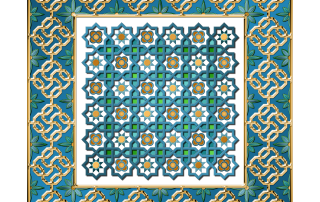
This work by José Cabrera Lozano manifests as a visual meditation on order and infinity. At the heart of the piece, an intricate network of turquoise bands intertwines in a perpetual dance, evoking the celestial gardens of Islamic tradition where water and geometry flow in harmony. The viewer is invited to lose themselves in the 'Khatam', the eight-pointed star that serves as a spiritual anchor, representing the expansion of knowledge and the connection between the four cardinal points and their intermediates. The color palette, dominated by deep turquoise and accents of ochre and gold, suggests a transition between the twilight sky and the light of enlightenment. It is not merely a static image; it is a geometric organism that breathes through its digital shadows. Each line has been drawn with the precision of an architect and the sensitivity of a poet, seeking not only aesthetic beauty but the resonance of the universal laws that govern nature. Contemplating 'The Lattice of Paradise', we face the paradox of sacred geometry: the ability of the finite—a paper surface—to contain the representation of the infinite. It is a reminder that, in the chaos of the modern world, there is an underlying structure of peace and balance that can be decoded through art. This piece acts as a temporal bridge, rescuing design techniques from the Alhambra and projecting them into the future through the mastery of cutting-edge digital tools, consolidating Cabrera Lozano as a contemporary guardian of visual harmony.
The Lattice of Paradise: Echoes of Ancestral Geometry (Methacrylate)
This work by José Cabrera Lozano manifests as a visual meditation on order and infinity. At the heart of the piece, an intricate network of turquoise bands intertwines in a perpetual dance, evoking the celestial gardens of Islamic tradition where water and geometry flow in harmony. The viewer is invited to lose themselves in the 'Khatam', the eight-pointed star that serves as a spiritual anchor, representing the expansion of knowledge and the connection between the four cardinal points and their intermediates. The color palette, dominated by deep turquoise and accents of ochre and gold, suggests a transition between the twilight sky and the light of enlightenment. It is not merely a static image; it is a geometric organism that breathes through its digital shadows. Each line has been drawn with the precision of an architect and the sensitivity of a poet, seeking not only aesthetic beauty but the resonance of the universal laws that govern nature. Contemplating 'The Lattice of Paradise', we face the paradox of sacred geometry: the ability of the finite—a paper surface—to contain the representation of the infinite. It is a reminder that, in the chaos of the modern world, there is an underlying structure of peace and balance that can be decoded through art. This piece acts as a temporal bridge, rescuing design techniques from the Alhambra and projecting them into the future through the mastery of cutting-edge digital tools, consolidating Cabrera Lozano as a contemporary guardian of visual harmony.
The Lattice of Paradise: Echoes of Ancestral Geometry (Original)
This work by José Cabrera Lozano manifests as a visual meditation on order and infinity. At the heart of the piece, an intricate network of turquoise bands intertwines in a perpetual dance, evoking the celestial gardens of Islamic tradition where water and geometry flow in harmony. The viewer is invited to lose themselves in the 'Khatam', the eight-pointed star that serves as a spiritual anchor, representing the expansion of knowledge and the connection between the four cardinal points and their intermediates. The color palette, dominated by deep turquoise and accents of ochre and gold, suggests a transition between the twilight sky and the light of enlightenment. It is not merely a static image; it is a geometric organism that breathes through its digital shadows. Each line has been drawn with the precision of an architect and the sensitivity of a poet, seeking not only aesthetic beauty but the resonance of the universal laws that govern nature. Contemplating 'The Lattice of Paradise', we face the paradox of sacred geometry: the ability of the finite—a paper surface—to contain the representation of the infinite. It is a reminder that, in the chaos of the modern world, there is an underlying structure of peace and balance that can be decoded through art. This piece acts as a temporal bridge, rescuing design techniques from the Alhambra and projecting them into the future through the mastery of cutting-edge digital tools, consolidating Cabrera Lozano as a contemporary guardian of visual harmony.

This monumental work, 'Lapis Lazuli Sky over Gold: The Interlaced Cosmos of Mexuar', stands as a threshold for contemplation. José Cabrera Lozano not only reinterprets Nasrid lacería, but he endows it with a contemporary spiritual pulse. The white interlacing, like a river of living water, flows incessantly, reminding us that in sacred geometry, every line is a path and every intersection a destination. The composition presents two visions: one, a centralized radiant sun where unity (tawhid) is the focal point; the other, an infinite expansion where the complexity of the forms multiplies towards the unreachability of infinity. It is a dialogue between mathematical rigidity and mystical emotion, a choreography of forms that seem to breathe over an abyss of black velvet. The colors are palpable jewels: the blue of the sky, the turquoise of the water, the ochre of the earth, and the gold of the divine. The profound black is the primal void, the initial mystery that serves as a stage for this expanding cosmos to manifest. The work is an invitation to silence, a bridge connecting the Andalusian past with the digital present, reminding us that beauty is, above all, an act of faith. It is the Andalusian cosmos at its finest, a 'zenith of the Andalusian jewel'. From a technical perspective, the work is a masterful exploration of high-fidelity digital composition. The geometry is based on a complex system of Nasrid zillij, where the modules pivot between 8, and 16-point bases, organized on an underlying grid. The central variation focuses on a radiant 8-point star that governs the radial symmetry, while the expanding variation multiplies the quadrangular modules, showcasing the infinity of the pattern. The use of color is crucial. Cabrera Lozano employs texturing algorithms to emulate the mineral nature of stone and enameled ceramics, creating a subtle but perceptible three-dimensional relief. The white lacería, with a macro-relief, stands out against the absolute black. The choice of Fine Art Hahnemühle William Turner (310 gr/m2) paper is fundamental to this process. Its matte surface, with a pronounced mold-made texture, allows the black pigments to achieve absolute density, an 'infinite black' that serves as a primordial stage upon which the turquoise and ochre colors seem to float. This tactile and visual experience changes according to the ambient light, revealing hidden layers of depth. Ambient Suggestions Given its magnificent nature and cultural heritage, this piece is ideal for spaces of prestige and authority. It is the ideal choice for the main salon of a superyacht, where the geometric theme and deep blue connect with the marine environment. Similarly, in the lobby of a five-star hotel with historical roots, or in executive offices where technical sophistication must go hand-in-hand with a profound cultural narrative. Framing: A floating frame (shadow box) with a dark or matte charcoal wood molding is suggested to let the work breathe. It is crucial to use anti-reflective museum glass with UV protection to preserve the texture of the paper and the depth of the blacks.
This monumental work, 'Lapis Lazuli Sky over Gold: The Interlaced Cosmos of Mexuar', stands as a threshold for contemplation. José Cabrera Lozano not only reinterprets Nasrid lacería, but he endows it with a contemporary spiritual pulse. The white interlacing, like a river of living water, flows incessantly, reminding us that in sacred geometry, every line is a path and every intersection a destination. The composition presents two visions: one, a centralized radiant sun where unity (tawhid) is the focal point; the other, an infinite expansion where the complexity of the forms multiplies towards the unreachability of infinity. It is a dialogue between mathematical rigidity and mystical emotion, a choreography of forms that seem to breathe over an abyss of black velvet. The colors are palpable jewels: the blue of the sky, the turquoise of the water, the ochre of the earth, and the gold of the divine. The profound black is the primal void, the initial mystery that serves as a stage for this expanding cosmos to manifest. The work is an invitation to silence, a bridge connecting the Andalusian past with the digital present, reminding us that beauty is, above all, an act of faith. It is the Andalusian cosmos at its finest, a 'zenith of the Andalusian jewel'. From a technical perspective, the work is a masterful exploration of high-fidelity digital composition. The geometry is based on a complex system of Nasrid zillij, where the modules pivot between 8, and 16-point bases, organized on an underlying grid. The central variation focuses on a radiant 8-point star that governs the radial symmetry, while the expanding variation multiplies the quadrangular modules, showcasing the infinity of the pattern. The use of color is crucial. Cabrera Lozano employs texturing algorithms to emulate the mineral nature of stone and enameled ceramics, creating a subtle but perceptible three-dimensional relief. The white lacería, with a macro-relief, stands out against the absolute black. The choice of Fine Art Hahnemühle William Turner (310 gr/m2) paper is fundamental to this process. Its matte surface, with a pronounced mold-made texture, allows the black pigments to achieve absolute density, an 'infinite black' that serves as a primordial stage upon which the turquoise and ochre colors seem to float. This tactile and visual experience changes according to the ambient light, revealing hidden layers of depth. Ambient Suggestions Given its magnificent nature and cultural heritage, this piece is ideal for spaces of prestige and authority. It is the ideal choice for the main salon of a superyacht, where the geometric theme and deep blue connect with the marine environment. Similarly, in the lobby of a five-star hotel with historical roots, or in executive offices where technical sophistication must go hand-in-hand with a profound cultural narrative. Framing: A floating frame (shadow box) with a dark or matte charcoal wood molding is suggested to let the work breathe. It is crucial to use anti-reflective museum glass with UV protection to preserve the texture of the paper and the depth of the blacks.

This monumental work, 'The Star of Mexuar, represents a milestone in the career of José Cabrera Lozano, where the millennial tradition of the Alhambra merges with the cutting edge of digital art. Inspired by the 'lacería' (interlacing) tilework of the Mexuar—the oldest and most historically charged hall of the Nasrid Palace—this piece stands as a profound study of symmetry and light. The composition orbits around a sixteen-pointed star, a polygon of exceptional geometric complexity that symbolizes the center of the universe in Islamic cosmology. This star, bathed in a vibrant cobalt blue, acts as a spiritual sun from which lines of force emanate infinitely, creating a visual rhythm that oscillates between mathematical order and visual poetry. From a technical standpoint, Cabrera Lozano transcends two-dimensionality through the use of texturing algorithms that mimic the porosity of carved plaster and the mineral density of lapis lazuli. Each white 'ribbon' or interlaced knot has been modeled with subtle variations in shadow and light, generating a depth that tricks the eye, making the work appear as a bas-relief sculpture. The choice of Hahnemühle William Turner Fine Art paper (310 gsm) is fundamental to this process. Its matte surface, with a pronounced yet refined mold-made texture, allows the black pigments to achieve absolute density—an 'infinite black' that serves as a primal void upon which the turquoises and ochres seem to float. The absence of optical brighteners in the paper ensures that the warmth of the work remains unchanged, offering a tactile and visual experience that shifts according to the ambient light. It is a piece that is not just observed; it is inhabited through the gaze, discovering in every intersection a new detail of Granada's heritage reinterpreted for the 21st century. Ambient Suggestions Given the scale and visual power of this piece, it demands an environment that dialogues with its sophistication. We recommend installation in spaces with high ceilings and controlled lighting. A 'shadow box' framing with an ebonized wood or matte charcoal molding would allow the William Turner paper to breathe, highlighting its handcrafted edges. This work is ideal for the main salon of a superyacht, where the geometric theme and deep blue connect with the marine surroundings. Similarly, in a luxury hotel lobby or a high-level executive boardroom, the work conveys a message of order, history, and technological vision.
This monumental work, 'The Star of Mexuar, represents a milestone in the career of José Cabrera Lozano, where the millennial tradition of the Alhambra merges with the cutting edge of digital art. Inspired by the 'lacería' (interlacing) tilework of the Mexuar—the oldest and most historically charged hall of the Nasrid Palace—this piece stands as a profound study of symmetry and light. The composition orbits around a sixteen-pointed star, a polygon of exceptional geometric complexity that symbolizes the center of the universe in Islamic cosmology. This star, bathed in a vibrant cobalt blue, acts as a spiritual sun from which lines of force emanate infinitely, creating a visual rhythm that oscillates between mathematical order and visual poetry. From a technical standpoint, Cabrera Lozano transcends two-dimensionality through the use of texturing algorithms that mimic the porosity of carved plaster and the mineral density of lapis lazuli. Each white 'ribbon' or interlaced knot has been modeled with subtle variations in shadow and light, generating a depth that tricks the eye, making the work appear as a bas-relief sculpture. The choice of Hahnemühle William Turner Fine Art paper (310 gsm) is fundamental to this process. Its matte surface, with a pronounced yet refined mold-made texture, allows the black pigments to achieve absolute density—an 'infinite black' that serves as a primal void upon which the turquoises and ochres seem to float. The absence of optical brighteners in the paper ensures that the warmth of the work remains unchanged, offering a tactile and visual experience that shifts according to the ambient light. It is a piece that is not just observed; it is inhabited through the gaze, discovering in every intersection a new detail of Granada's heritage reinterpreted for the 21st century. Ambient Suggestions Given the scale and visual power of this piece, it demands an environment that dialogues with its sophistication. We recommend installation in spaces with high ceilings and controlled lighting. A 'shadow box' framing with an ebonized wood or matte charcoal molding would allow the William Turner paper to breathe, highlighting its handcrafted edges. This work is ideal for the main salon of a superyacht, where the geometric theme and deep blue connect with the marine surroundings. Similarly, in a luxury hotel lobby or a high-level executive boardroom, the work conveys a message of order, history, and technological vision.

This work is an ode to the contemplative stillness of Nasrid palaces. José Cabrera Lozano successfully captures the vibration of the Mexuar, the space where justice and administration met under the gaze of absolute mathematical order. The interlaced patterns (lacería) are not mere ornaments here; they are a web that catches light and shadow, a metaphor for the cosmos where every eight-pointed star is a center of spiritual gravity. The viewer's gaze gets lost in a labyrinth of white lines that flow with the precision of a celestial river, interconnecting fragments of deep blue, turquoise, and golden ochres. It is a 'horror vacui' that does not overwhelm but invites silence. The dark background acts as the primordial void, allowing the geometry to emerge with almost tactile force, reminding us that eternity resides in rhythmic repetition. Technically, 'The Whisper of the Alhambra' represents the pinnacle of digital geometric reconstruction. The pattern is based on a complex network of star polygons radiating from a 8-point center, one of the most challenging structures in Islamic geometry. The application of digital textures in the rendering gives the piece a visual depth that simulates the relief of stucco and glazed ceramics. The chosen support, Hahnemühle William Turner 310 gsm paper, is essential to the aesthetic experience. Its matte surface and genuine mould-made texture accentuate the density of the blacks and the saturation of the pigments, providing a three-dimensionality that shifts according to the ambient light. The absence of optical brighteners ensures that the work maintains its chromatic integrity for decades, complying with the ISO 9706 museum permanence standard. Ambient Suggestions This piece demands a space that allows for introspection. It is ideal for luxury hotel suites, main salons on contemporary yachts, or corporate offices where an image of sophistication, order, and cultural heritage is desired. We recommend a minimalist frame with museum-quality (anti-reflective) glass and a floating mount that allows the irregular texture of the William Turner paper's edges to be appreciated.
This work is an ode to the contemplative stillness of Nasrid palaces. José Cabrera Lozano successfully captures the vibration of the Mexuar, the space where justice and administration met under the gaze of absolute mathematical order. The interlaced patterns (lacería) are not mere ornaments here; they are a web that catches light and shadow, a metaphor for the cosmos where every eight-pointed star is a center of spiritual gravity. The viewer's gaze gets lost in a labyrinth of white lines that flow with the precision of a celestial river, interconnecting fragments of deep blue, turquoise, and golden ochres. It is a 'horror vacui' that does not overwhelm but invites silence. The dark background acts as the primordial void, allowing the geometry to emerge with almost tactile force, reminding us that eternity resides in rhythmic repetition. Technically, 'The Whisper of the Alhambra' represents the pinnacle of digital geometric reconstruction. The pattern is based on a complex network of star polygons radiating from a 8-point center, one of the most challenging structures in Islamic geometry. The application of digital textures in the rendering gives the piece a visual depth that simulates the relief of stucco and glazed ceramics. The chosen support, Hahnemühle William Turner 310 gsm paper, is essential to the aesthetic experience. Its matte surface and genuine mould-made texture accentuate the density of the blacks and the saturation of the pigments, providing a three-dimensionality that shifts according to the ambient light. The absence of optical brighteners ensures that the work maintains its chromatic integrity for decades, complying with the ISO 9706 museum permanence standard. Ambient Suggestions This piece demands a space that allows for introspection. It is ideal for luxury hotel suites, main salons on contemporary yachts, or corporate offices where an image of sophistication, order, and cultural heritage is desired. We recommend a minimalist frame with museum-quality (anti-reflective) glass and a floating mount that allows the irregular texture of the William Turner paper's edges to be appreciated.

In 'The Labyrinth of Light', José Cabrera Lozano immerses us in a mathematical dance of divine proportions. This work does not merely emulate the decorative art of the Alhambra but decomposes and reconstructs it under a contemporary light. The viewer faces a crossroads of white ribbons that, like Ariadne's threads, guide us through a vibrant space of color and shadow. The centrality of the composition, marked by a cruciform structure emerging from the star pattern, suggests a meeting point between the human and the divine. The warm tones of orange and ochre evoke the sunset over the alcazaba walls, while flashes of turquoise and magenta bring a freshness that breaks geometric rigidity. It is a work that speaks of patience, order, and the beauty that arises when logic and creativity are seamlessly intertwined. Each intersection is a reminder of the interconnection of all things, a visual representation of the universal harmony that Cabrera Lozano has successfully distilled into an image of absolute purity.

This work by José Cabrera Lozano manifests as a visual meditation on order and infinity. At the heart of the piece, an intricate network of turquoise bands intertwines in a perpetual dance, evoking the celestial gardens of Islamic tradition where water and geometry flow in harmony. The viewer is invited to lose themselves in the 'Khatam', the eight-pointed star that serves as a spiritual anchor, representing the expansion of knowledge and the connection between the four cardinal points and their intermediates. The color palette, dominated by deep turquoise and accents of ochre and gold, suggests a transition between the twilight sky and the light of enlightenment. It is not merely a static image; it is a geometric organism that breathes through its digital shadows. Each line has been drawn with the precision of an architect and the sensitivity of a poet, seeking not only aesthetic beauty but the resonance of the universal laws that govern nature. Contemplating 'The Lattice of Paradise', we face the paradox of sacred geometry: the ability of the finite—a paper surface—to contain the representation of the infinite. It is a reminder that, in the chaos of the modern world, there is an underlying structure of peace and balance that can be decoded through art. This piece acts as a temporal bridge, rescuing design techniques from the Alhambra and projecting them into the future through the mastery of cutting-edge digital tools, consolidating Cabrera Lozano as a contemporary guardian of visual harmony.
This work by José Cabrera Lozano manifests as a visual meditation on order and infinity. At the heart of the piece, an intricate network of turquoise bands intertwines in a perpetual dance, evoking the celestial gardens of Islamic tradition where water and geometry flow in harmony. The viewer is invited to lose themselves in the 'Khatam', the eight-pointed star that serves as a spiritual anchor, representing the expansion of knowledge and the connection between the four cardinal points and their intermediates. The color palette, dominated by deep turquoise and accents of ochre and gold, suggests a transition between the twilight sky and the light of enlightenment. It is not merely a static image; it is a geometric organism that breathes through its digital shadows. Each line has been drawn with the precision of an architect and the sensitivity of a poet, seeking not only aesthetic beauty but the resonance of the universal laws that govern nature. Contemplating 'The Lattice of Paradise', we face the paradox of sacred geometry: the ability of the finite—a paper surface—to contain the representation of the infinite. It is a reminder that, in the chaos of the modern world, there is an underlying structure of peace and balance that can be decoded through art. This piece acts as a temporal bridge, rescuing design techniques from the Alhambra and projecting them into the future through the mastery of cutting-edge digital tools, consolidating Cabrera Lozano as a contemporary guardian of visual harmony.
This work by José Cabrera Lozano manifests as a visual meditation on order and infinity. At the heart of the piece, an intricate network of turquoise bands intertwines in a perpetual dance, evoking the celestial gardens of Islamic tradition where water and geometry flow in harmony. The viewer is invited to lose themselves in the 'Khatam', the eight-pointed star that serves as a spiritual anchor, representing the expansion of knowledge and the connection between the four cardinal points and their intermediates. The color palette, dominated by deep turquoise and accents of ochre and gold, suggests a transition between the twilight sky and the light of enlightenment. It is not merely a static image; it is a geometric organism that breathes through its digital shadows. Each line has been drawn with the precision of an architect and the sensitivity of a poet, seeking not only aesthetic beauty but the resonance of the universal laws that govern nature. Contemplating 'The Lattice of Paradise', we face the paradox of sacred geometry: the ability of the finite—a paper surface—to contain the representation of the infinite. It is a reminder that, in the chaos of the modern world, there is an underlying structure of peace and balance that can be decoded through art. This piece acts as a temporal bridge, rescuing design techniques from the Alhambra and projecting them into the future through the mastery of cutting-edge digital tools, consolidating Cabrera Lozano as a contemporary guardian of visual harmony.
