

The Maidens’ Labyrinth
In the heart of the Real Alcázar of Seville, the Courtyard of the Maidens (Patio de las Doncellas) breathes an elegance that has captivated generations. This work by José Cabrera Lozano rescues the vibrant geometry of its tiled plinth, transforming glazed clay into a visual experience of infinite depth. The piece manifests as a labyrinth of interlaced shapes where light seems to filter through a digital lattice, revealing a universe of colors that are the very signature of Mudejar Seville: intense turquoises, deep magentas, and golden ochres. Contemplating 'The Maidens' Labyrinth', the viewer does not merely observe a pattern; they immerse themselves in the history of a palace where water and geometry merge to create an earthly paradise. The deep blue network of arches acts as a frame of order over the polychrome burst of the background, inviting meditation on the balance between structure and creative freedom. Each digital 'tile' is an echo of the craftsmen who, centuries ago, hand-cut each piece to honor beauty. This work is a bridge bringing that devotion to the present, allowing the majesty of the Alcázar to inhabit contemporary spaces with unprecedented freshness and clarity. Si el espectador se acerca, descubrirá que cada "azulejo" digital alberga en su interior su propia micro-trama geométrica tallada, revelando capas de significado que invitan a una contemplación casi meditativa. Es un tributo absoluto a la genialidad de los artesanos andalusíes, resucitado a través de la luz de la pantalla y la precisión milimétrica del vector. 'Puerta de la Justicia' no es una simple reproducción; es una exégesis visual que desentraña el alma matemática de Granada.
The Maidens’ Labyrinth: Sevillian Polychromy (Methacrylate)
In the heart of the Real Alcázar of Seville, the Courtyard of the Maidens (Patio de las Doncellas) breathes an elegance that has captivated generations. This work by José Cabrera Lozano rescues the vibrant geometry of its tiled plinth, transforming glazed clay into a visual experience of infinite depth. The piece manifests as a labyrinth of interlaced shapes where light seems to filter through a digital lattice, revealing a universe of colors that are the very signature of Mudejar Seville: intense turquoises, deep magentas, and golden ochres. Contemplating 'The Maidens' Labyrinth', the viewer does not merely observe a pattern; they immerse themselves in the history of a palace where water and geometry merge to create an earthly paradise. The deep blue network of arches acts as a frame of order over the polychrome burst of the background, inviting meditation on the balance between structure and creative freedom. Each digital 'tile' is an echo of the craftsmen who, centuries ago, hand-cut each piece to honor beauty. This work is a bridge bringing that devotion to the present, allowing the majesty of the Alcázar to inhabit contemporary spaces with unprecedented freshness and clarity. From a technical perspective, this work represents a milestone in digital volume simulation applied to historical heritage. Cabrera Lozano uses his precision as an Industrial Engineer to deconstruct the original tile network and reconstruct it through high-precision vector shadow layers. The result is an extraordinary trompe-l'œil effect: the upper lattice of arches casts calculated shadows over the polychrome background, giving the piece a three-dimensionality that seems to rise from the physical support. The choice of 310 gsm Hahnemühle William Turner Fine Art paper is critical. Its matte and markedly textured surface interacts with the Giclée print to emulate the porosity and relief of real ceramics. Pigment saturation has been adjusted to maintain the vibrancy of magentas and turquoises, ensuring absolute contrast with the deep blacks of the shadows. Durability under the ISO 9706 standard guarantees that this technical representation of Mudejar art remains unaltered for generations, offering museum-grade archival quality that captures every detail of the original vector design. Ambient Suggestions Due to its rich color palette, a floating frame in dark wood or matte black is recommended to highlight the edges of the Hahnemühle paper. Ideal for stately lobbies, boutique hotels with a historical essence, or designer spaces seeking a visually striking piece that celebrates Spanish heritage.
The Maidens’ Labyrinth: Sevillian Polychromy (Original)
In the heart of the Real Alcázar of Seville, the Courtyard of the Maidens (Patio de las Doncellas) breathes an elegance that has captivated generations. This work by José Cabrera Lozano rescues the vibrant geometry of its tiled plinth, transforming glazed clay into a visual experience of infinite depth. The piece manifests as a labyrinth of interlaced shapes where light seems to filter through a digital lattice, revealing a universe of colors that are the very signature of Mudejar Seville: intense turquoises, deep magentas, and golden ochres. Contemplating 'The Maidens' Labyrinth', the viewer does not merely observe a pattern; they immerse themselves in the history of a palace where water and geometry merge to create an earthly paradise. The deep blue network of arches acts as a frame of order over the polychrome burst of the background, inviting meditation on the balance between structure and creative freedom. Each digital 'tile' is an echo of the craftsmen who, centuries ago, hand-cut each piece to honor beauty. This work is a bridge bringing that devotion to the present, allowing the majesty of the Alcázar to inhabit contemporary spaces with unprecedented freshness and clarity. From a technical perspective, this work represents a milestone in digital volume simulation applied to historical heritage. Cabrera Lozano uses his precision as an Industrial Engineer to deconstruct the original tile network and reconstruct it through high-precision vector shadow layers. The result is an extraordinary trompe-l'œil effect: the upper lattice of arches casts calculated shadows over the polychrome background, giving the piece a three-dimensionality that seems to rise from the physical support. The choice of 310 gsm Hahnemühle William Turner Fine Art paper is critical. Its matte and markedly textured surface interacts with the Giclée print to emulate the porosity and relief of real ceramics. Pigment saturation has been adjusted to maintain the vibrancy of magentas and turquoises, ensuring absolute contrast with the deep blacks of the shadows. Durability under the ISO 9706 standard guarantees that this technical representation of Mudejar art remains unaltered for generations, offering museum-grade archival quality that captures every detail of the original vector design. Ambient Suggestions Due to its rich color palette, a floating frame in dark wood or matte black is recommended to highlight the edges of the Hahnemühle paper. Ideal for stately lobbies, boutique hotels with a historical essence, or designer spaces seeking a visually striking piece that celebrates Spanish heritage.
The Mirror of the Eternity
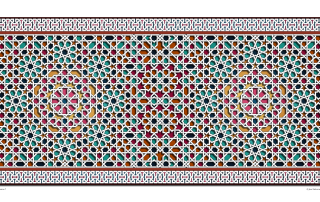
To contemplate 'The Mirror of Eternity' is to embark on a meditative journey into the heart of Nasrid cosmology, a space where visual beauty acts as a bridge to the ineffable. Inspired by the legendary panels of the Alhambra's Comares Hall, this artwork transcends mere ornamentation to stand as a portal of profound spiritual resonance. Through a horizontal layout that evokes the infinite, the composition reveals a duplicated cosmos, governed by two majestic twelve-pointed stars operating as radiant suns of vital energy. These central figures are not static; they beat rhythmically, expanding their influence through an intricate network of uninterrupted lacework. In Islamic philosophy, this continuity without beginning or end symbolizes the eternal journey of the soul and the indissoluble interconnection of all facets of creation under an unalterable divine order. The chromatic palette is a poetic tribute to the elemental forces of the Andalusian universe. Deep cobalt blues and turquoises immerse us in the contemplation of crystalline waters and the celestial vault, suggesting purification and protection. Meanwhile, crimson reds and golden ochre tones anchor the vision to fertile earth and regal splendor, blending the earthly with the heavenly. The duplicated arrangement of the elements creates a harmonic echo, a silent dialogue that invites the viewer to find their own inner balance. 'The Mirror of Eternity' is essentially a crystallized mantra in sacred geometry; a contained breath that pacifies the mind, elevates the spirit, and transforms any environment into a true sanctuary of order, symmetry, and timeless contemplation.

The Reflection of the Eternal
In 'Patio de las Doncellas: The Reflection of the Eternal,' José Cabrera Lozano invites us to a visual introspection in the heart of Sevillian Mudejar art. This work is not merely a reproduction, but a luminous deconstruction of infinity. The network of interlacing stars—descendants of sacred mathematics—floats above an abyss of color that pays homage to the Andalusian heritage. The turquoise evokes the water flowing through the courtyard's canals, the orange captures the midday sun over the bricks, and the crimson pulses with the passion of a thousand-year history. The white lattice, suspended in an ethereal three-dimensionality, symbolizes the light of reason ordering the chaos of the sensible world. It is a dance of forms with no beginning or end, designed to inhabit silence and elevate the spirit towards the contemplation of universal order.
The Reflection of the Eternal (Aluminium)
In 'Patio de las Doncellas: The Reflection of the Eternal,' José Cabrera Lozano invites us to a visual introspection in the heart of Sevillian Mudejar art. This work is not merely a reproduction, but a luminous deconstruction of infinity. The network of interlacing stars—descendants of sacred mathematics—floats above an abyss of color that pays homage to the Andalusian heritage. The turquoise evokes the water flowing through the courtyard's canals, the orange captures the midday sun over the bricks, and the crimson pulses with the passion of a thousand-year history. The white lattice, suspended in an ethereal three-dimensionality, symbolizes the light of reason ordering the chaos of the sensible world. It is a dance of forms with no beginning or end, designed to inhabit silence and elevate the spirit towards the contemplation of universal order. Technically, the work stands out for its vectorial rigor and depth of execution. The pattern is based on a mosaic A1 model from the Royal Alcázar, where the precision of the 'girih' interlacing is enhanced by a masterful calculation of drop shadows that separate the white lattice from the polychrome background. The choice of Hahnemühle William Turner 310 gsm paper is fundamental to the tactile experience: its matte and markedly granular surface absorbs light in a way that the blacks and shadows acquire an almost sculptural density. As a 100% cotton, acid-free paper (museum quality ISO 9706), it guarantees a longevity exceeding a century, maintaining the vibration of the turquoise and ochre pigments without chromatic alteration. The work is a perfect synthesis between the porosity of historical plasterwork and the absolute sharpness of the digital avant-garde. Ambient Suggestions A minimalist box frame in natural oak or satin white is recommended to highlight the purity of the lattice. Ideal spaces: Luxury yacht salons, where the turquoise dialogues with the sea; contemporary boutique hotel lobbies; or executive offices seeking to project order, sophistication, and intellectual rigor.
The Reflection of the Eternal (Original)
In 'Patio de las Doncellas: The Reflection of the Eternal,' José Cabrera Lozano invites us to a visual introspection in the heart of Sevillian Mudejar art. This work is not merely a reproduction, but a luminous deconstruction of infinity. The network of interlacing stars—descendants of sacred mathematics—floats above an abyss of color that pays homage to the Andalusian heritage. The turquoise evokes the water flowing through the courtyard's canals, the orange captures the midday sun over the bricks, and the crimson pulses with the passion of a thousand-year history. The white lattice, suspended in an ethereal three-dimensionality, symbolizes the light of reason ordering the chaos of the sensible world. It is a dance of forms with no beginning or end, designed to inhabit silence and elevate the spirit towards the contemplation of universal order. Technically, the work stands out for its vectorial rigor and depth of execution. The pattern is based on a mosaic A1 model from the Royal Alcázar, where the precision of the 'girih' interlacing is enhanced by a masterful calculation of drop shadows that separate the white lattice from the polychrome background. The choice of Hahnemühle William Turner 310 gsm paper is fundamental to the tactile experience: its matte and markedly granular surface absorbs light in a way that the blacks and shadows acquire an almost sculptural density. As a 100% cotton, acid-free paper (museum quality ISO 9706), it guarantees a longevity exceeding a century, maintaining the vibration of the turquoise and ochre pigments without chromatic alteration. The work is a perfect synthesis between the porosity of historical plasterwork and the absolute sharpness of the digital avant-garde. Ambient Suggestions A minimalist box frame in natural oak or satin white is recommended to highlight the purity of the lattice. Ideal spaces: Luxury yacht salons, where the turquoise dialogues with the sea; contemporary boutique hotel lobbies; or executive offices seeking to project order, sophistication, and intellectual rigor.

The Star of Mexuar
This monumental work, 'The Star of Mexuar, represents a milestone in the career of José Cabrera Lozano, where the millennial tradition of the Alhambra merges with the cutting edge of digital art. Inspired by the 'lacería' (interlacing) tilework of the Mexuar—the oldest and most historically charged hall of the Nasrid Palace—this piece stands as a profound study of symmetry and light. The composition orbits around a sixteen-pointed star, a polygon of exceptional geometric complexity that symbolizes the center of the universe in Islamic cosmology. This star, bathed in a vibrant cobalt blue, acts as a spiritual sun from which lines of force emanate infinitely, creating a visual rhythm that oscillates between mathematical order and visual poetry.

The Sun of Thought
In 'The Sun of Thought,' José Cabrera Lozano reveals the radiant heart of the Hall of Comares. This work is distinguished by a golden core that acts as a metaphysical sun, from which the complexity of the ordered universe unfolds. It is a representation of the 'mishkat' or the niche of light, a spiritual concept where divine light is refracted into geometric shapes to become comprehensible to the human eye. The gaze is magnetically drawn toward the amber center, then navigates the intricate paths of turquoise and carmine surrounding it. Every white line that crosses and rises is a testament to mathematical perfection, an echo of the prayers carved in stone at the Alhambra. This piece invites serenity; it is a visual refuge where the viewer can find balance. It is not just a pattern; it is a narrative about the unity of being and the multiplicity of existence, captured with a digital sharpness that honors tradition while embracing advanced technology.
The Threshold of Dawn: Chromatic Arabesque of the Wine Gate
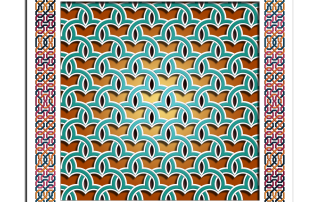
To contemplate 'The Threshold of Dawn: Chromatic Arabesques of the Wine Gate' is to witness the perfect intersection between the solidity of Nasrid military architecture and the lyrical volatility of its mural decoration. Inspired by the remnants of polychrome wall paintings that once adorned the interior arches of the emblematic Wine Gate (Puerta del Vino) in Granada's Alhambra, this digital masterpiece by José Cabrera Lozano rescues a symphony of sinuous shapes and infinite interlacing from the depths of time, elevating them into a contemporary dimension of unparalleled vividness. The central field of the composition simulates a rhythmic wave of interlaced polylobed arches, where deep terracotta tones and gradient ochres evoke the warmth of Andalusian clay and the sunset light bathing the fortress walls. Above this earthly foundation, vibrant emerald and turquoise ribbons meander like mystical vines, embodying the continuous flow of life and water. The magnificent outer border surrounding the piece acts as a guardian of order—a polychromatic, micro-geometric labyrinth where threads of pink, blue, orange, and white intertwine in absolute mathematical rigor. This artwork suspends the viewer in a state of pure aesthetic contemplation, transforming a historic mural fragment into a gateway to the eternal.

In the heart of the Real Alcázar of Seville, the Courtyard of the Maidens (Patio de las Doncellas) breathes an elegance that has captivated generations. This work by José Cabrera Lozano rescues the vibrant geometry of its tiled plinth, transforming glazed clay into a visual experience of infinite depth. The piece manifests as a labyrinth of interlaced shapes where light seems to filter through a digital lattice, revealing a universe of colors that are the very signature of Mudejar Seville: intense turquoises, deep magentas, and golden ochres. Contemplating 'The Maidens' Labyrinth', the viewer does not merely observe a pattern; they immerse themselves in the history of a palace where water and geometry merge to create an earthly paradise. The deep blue network of arches acts as a frame of order over the polychrome burst of the background, inviting meditation on the balance between structure and creative freedom. Each digital 'tile' is an echo of the craftsmen who, centuries ago, hand-cut each piece to honor beauty. This work is a bridge bringing that devotion to the present, allowing the majesty of the Alcázar to inhabit contemporary spaces with unprecedented freshness and clarity. Si el espectador se acerca, descubrirá que cada "azulejo" digital alberga en su interior su propia micro-trama geométrica tallada, revelando capas de significado que invitan a una contemplación casi meditativa. Es un tributo absoluto a la genialidad de los artesanos andalusíes, resucitado a través de la luz de la pantalla y la precisión milimétrica del vector. 'Puerta de la Justicia' no es una simple reproducción; es una exégesis visual que desentraña el alma matemática de Granada.
In the heart of the Real Alcázar of Seville, the Courtyard of the Maidens (Patio de las Doncellas) breathes an elegance that has captivated generations. This work by José Cabrera Lozano rescues the vibrant geometry of its tiled plinth, transforming glazed clay into a visual experience of infinite depth. The piece manifests as a labyrinth of interlaced shapes where light seems to filter through a digital lattice, revealing a universe of colors that are the very signature of Mudejar Seville: intense turquoises, deep magentas, and golden ochres. Contemplating 'The Maidens' Labyrinth', the viewer does not merely observe a pattern; they immerse themselves in the history of a palace where water and geometry merge to create an earthly paradise. The deep blue network of arches acts as a frame of order over the polychrome burst of the background, inviting meditation on the balance between structure and creative freedom. Each digital 'tile' is an echo of the craftsmen who, centuries ago, hand-cut each piece to honor beauty. This work is a bridge bringing that devotion to the present, allowing the majesty of the Alcázar to inhabit contemporary spaces with unprecedented freshness and clarity. From a technical perspective, this work represents a milestone in digital volume simulation applied to historical heritage. Cabrera Lozano uses his precision as an Industrial Engineer to deconstruct the original tile network and reconstruct it through high-precision vector shadow layers. The result is an extraordinary trompe-l'œil effect: the upper lattice of arches casts calculated shadows over the polychrome background, giving the piece a three-dimensionality that seems to rise from the physical support. The choice of 310 gsm Hahnemühle William Turner Fine Art paper is critical. Its matte and markedly textured surface interacts with the Giclée print to emulate the porosity and relief of real ceramics. Pigment saturation has been adjusted to maintain the vibrancy of magentas and turquoises, ensuring absolute contrast with the deep blacks of the shadows. Durability under the ISO 9706 standard guarantees that this technical representation of Mudejar art remains unaltered for generations, offering museum-grade archival quality that captures every detail of the original vector design. Ambient Suggestions Due to its rich color palette, a floating frame in dark wood or matte black is recommended to highlight the edges of the Hahnemühle paper. Ideal for stately lobbies, boutique hotels with a historical essence, or designer spaces seeking a visually striking piece that celebrates Spanish heritage.
In the heart of the Real Alcázar of Seville, the Courtyard of the Maidens (Patio de las Doncellas) breathes an elegance that has captivated generations. This work by José Cabrera Lozano rescues the vibrant geometry of its tiled plinth, transforming glazed clay into a visual experience of infinite depth. The piece manifests as a labyrinth of interlaced shapes where light seems to filter through a digital lattice, revealing a universe of colors that are the very signature of Mudejar Seville: intense turquoises, deep magentas, and golden ochres. Contemplating 'The Maidens' Labyrinth', the viewer does not merely observe a pattern; they immerse themselves in the history of a palace where water and geometry merge to create an earthly paradise. The deep blue network of arches acts as a frame of order over the polychrome burst of the background, inviting meditation on the balance between structure and creative freedom. Each digital 'tile' is an echo of the craftsmen who, centuries ago, hand-cut each piece to honor beauty. This work is a bridge bringing that devotion to the present, allowing the majesty of the Alcázar to inhabit contemporary spaces with unprecedented freshness and clarity. From a technical perspective, this work represents a milestone in digital volume simulation applied to historical heritage. Cabrera Lozano uses his precision as an Industrial Engineer to deconstruct the original tile network and reconstruct it through high-precision vector shadow layers. The result is an extraordinary trompe-l'œil effect: the upper lattice of arches casts calculated shadows over the polychrome background, giving the piece a three-dimensionality that seems to rise from the physical support. The choice of 310 gsm Hahnemühle William Turner Fine Art paper is critical. Its matte and markedly textured surface interacts with the Giclée print to emulate the porosity and relief of real ceramics. Pigment saturation has been adjusted to maintain the vibrancy of magentas and turquoises, ensuring absolute contrast with the deep blacks of the shadows. Durability under the ISO 9706 standard guarantees that this technical representation of Mudejar art remains unaltered for generations, offering museum-grade archival quality that captures every detail of the original vector design. Ambient Suggestions Due to its rich color palette, a floating frame in dark wood or matte black is recommended to highlight the edges of the Hahnemühle paper. Ideal for stately lobbies, boutique hotels with a historical essence, or designer spaces seeking a visually striking piece that celebrates Spanish heritage.

To contemplate 'The Mirror of Eternity' is to embark on a meditative journey into the heart of Nasrid cosmology, a space where visual beauty acts as a bridge to the ineffable. Inspired by the legendary panels of the Alhambra's Comares Hall, this artwork transcends mere ornamentation to stand as a portal of profound spiritual resonance. Through a horizontal layout that evokes the infinite, the composition reveals a duplicated cosmos, governed by two majestic twelve-pointed stars operating as radiant suns of vital energy. These central figures are not static; they beat rhythmically, expanding their influence through an intricate network of uninterrupted lacework. In Islamic philosophy, this continuity without beginning or end symbolizes the eternal journey of the soul and the indissoluble interconnection of all facets of creation under an unalterable divine order. The chromatic palette is a poetic tribute to the elemental forces of the Andalusian universe. Deep cobalt blues and turquoises immerse us in the contemplation of crystalline waters and the celestial vault, suggesting purification and protection. Meanwhile, crimson reds and golden ochre tones anchor the vision to fertile earth and regal splendor, blending the earthly with the heavenly. The duplicated arrangement of the elements creates a harmonic echo, a silent dialogue that invites the viewer to find their own inner balance. 'The Mirror of Eternity' is essentially a crystallized mantra in sacred geometry; a contained breath that pacifies the mind, elevates the spirit, and transforms any environment into a true sanctuary of order, symmetry, and timeless contemplation.

In 'Patio de las Doncellas: The Reflection of the Eternal,' José Cabrera Lozano invites us to a visual introspection in the heart of Sevillian Mudejar art. This work is not merely a reproduction, but a luminous deconstruction of infinity. The network of interlacing stars—descendants of sacred mathematics—floats above an abyss of color that pays homage to the Andalusian heritage. The turquoise evokes the water flowing through the courtyard's canals, the orange captures the midday sun over the bricks, and the crimson pulses with the passion of a thousand-year history. The white lattice, suspended in an ethereal three-dimensionality, symbolizes the light of reason ordering the chaos of the sensible world. It is a dance of forms with no beginning or end, designed to inhabit silence and elevate the spirit towards the contemplation of universal order.
In 'Patio de las Doncellas: The Reflection of the Eternal,' José Cabrera Lozano invites us to a visual introspection in the heart of Sevillian Mudejar art. This work is not merely a reproduction, but a luminous deconstruction of infinity. The network of interlacing stars—descendants of sacred mathematics—floats above an abyss of color that pays homage to the Andalusian heritage. The turquoise evokes the water flowing through the courtyard's canals, the orange captures the midday sun over the bricks, and the crimson pulses with the passion of a thousand-year history. The white lattice, suspended in an ethereal three-dimensionality, symbolizes the light of reason ordering the chaos of the sensible world. It is a dance of forms with no beginning or end, designed to inhabit silence and elevate the spirit towards the contemplation of universal order. Technically, the work stands out for its vectorial rigor and depth of execution. The pattern is based on a mosaic A1 model from the Royal Alcázar, where the precision of the 'girih' interlacing is enhanced by a masterful calculation of drop shadows that separate the white lattice from the polychrome background. The choice of Hahnemühle William Turner 310 gsm paper is fundamental to the tactile experience: its matte and markedly granular surface absorbs light in a way that the blacks and shadows acquire an almost sculptural density. As a 100% cotton, acid-free paper (museum quality ISO 9706), it guarantees a longevity exceeding a century, maintaining the vibration of the turquoise and ochre pigments without chromatic alteration. The work is a perfect synthesis between the porosity of historical plasterwork and the absolute sharpness of the digital avant-garde. Ambient Suggestions A minimalist box frame in natural oak or satin white is recommended to highlight the purity of the lattice. Ideal spaces: Luxury yacht salons, where the turquoise dialogues with the sea; contemporary boutique hotel lobbies; or executive offices seeking to project order, sophistication, and intellectual rigor.
In 'Patio de las Doncellas: The Reflection of the Eternal,' José Cabrera Lozano invites us to a visual introspection in the heart of Sevillian Mudejar art. This work is not merely a reproduction, but a luminous deconstruction of infinity. The network of interlacing stars—descendants of sacred mathematics—floats above an abyss of color that pays homage to the Andalusian heritage. The turquoise evokes the water flowing through the courtyard's canals, the orange captures the midday sun over the bricks, and the crimson pulses with the passion of a thousand-year history. The white lattice, suspended in an ethereal three-dimensionality, symbolizes the light of reason ordering the chaos of the sensible world. It is a dance of forms with no beginning or end, designed to inhabit silence and elevate the spirit towards the contemplation of universal order. Technically, the work stands out for its vectorial rigor and depth of execution. The pattern is based on a mosaic A1 model from the Royal Alcázar, where the precision of the 'girih' interlacing is enhanced by a masterful calculation of drop shadows that separate the white lattice from the polychrome background. The choice of Hahnemühle William Turner 310 gsm paper is fundamental to the tactile experience: its matte and markedly granular surface absorbs light in a way that the blacks and shadows acquire an almost sculptural density. As a 100% cotton, acid-free paper (museum quality ISO 9706), it guarantees a longevity exceeding a century, maintaining the vibration of the turquoise and ochre pigments without chromatic alteration. The work is a perfect synthesis between the porosity of historical plasterwork and the absolute sharpness of the digital avant-garde. Ambient Suggestions A minimalist box frame in natural oak or satin white is recommended to highlight the purity of the lattice. Ideal spaces: Luxury yacht salons, where the turquoise dialogues with the sea; contemporary boutique hotel lobbies; or executive offices seeking to project order, sophistication, and intellectual rigor.

This monumental work, 'The Star of Mexuar, represents a milestone in the career of José Cabrera Lozano, where the millennial tradition of the Alhambra merges with the cutting edge of digital art. Inspired by the 'lacería' (interlacing) tilework of the Mexuar—the oldest and most historically charged hall of the Nasrid Palace—this piece stands as a profound study of symmetry and light. The composition orbits around a sixteen-pointed star, a polygon of exceptional geometric complexity that symbolizes the center of the universe in Islamic cosmology. This star, bathed in a vibrant cobalt blue, acts as a spiritual sun from which lines of force emanate infinitely, creating a visual rhythm that oscillates between mathematical order and visual poetry.

In 'The Sun of Thought,' José Cabrera Lozano reveals the radiant heart of the Hall of Comares. This work is distinguished by a golden core that acts as a metaphysical sun, from which the complexity of the ordered universe unfolds. It is a representation of the 'mishkat' or the niche of light, a spiritual concept where divine light is refracted into geometric shapes to become comprehensible to the human eye. The gaze is magnetically drawn toward the amber center, then navigates the intricate paths of turquoise and carmine surrounding it. Every white line that crosses and rises is a testament to mathematical perfection, an echo of the prayers carved in stone at the Alhambra. This piece invites serenity; it is a visual refuge where the viewer can find balance. It is not just a pattern; it is a narrative about the unity of being and the multiplicity of existence, captured with a digital sharpness that honors tradition while embracing advanced technology.

To contemplate 'The Threshold of Dawn: Chromatic Arabesques of the Wine Gate' is to witness the perfect intersection between the solidity of Nasrid military architecture and the lyrical volatility of its mural decoration. Inspired by the remnants of polychrome wall paintings that once adorned the interior arches of the emblematic Wine Gate (Puerta del Vino) in Granada's Alhambra, this digital masterpiece by José Cabrera Lozano rescues a symphony of sinuous shapes and infinite interlacing from the depths of time, elevating them into a contemporary dimension of unparalleled vividness. The central field of the composition simulates a rhythmic wave of interlaced polylobed arches, where deep terracotta tones and gradient ochres evoke the warmth of Andalusian clay and the sunset light bathing the fortress walls. Above this earthly foundation, vibrant emerald and turquoise ribbons meander like mystical vines, embodying the continuous flow of life and water. The magnificent outer border surrounding the piece acts as a guardian of order—a polychromatic, micro-geometric labyrinth where threads of pink, blue, orange, and white intertwine in absolute mathematical rigor. This artwork suspends the viewer in a state of pure aesthetic contemplation, transforming a historic mural fragment into a gateway to the eternal.