

The Maidens’ Labyrinth: Sevillian Polychromy (Methacrylate)
In the heart of the Real Alcázar of Seville, the Courtyard of the Maidens (Patio de las Doncellas) breathes an elegance that has captivated generations. This work by José Cabrera Lozano rescues the vibrant geometry of its tiled plinth, transforming glazed clay into a visual experience of infinite depth. The piece manifests as a labyrinth of interlaced shapes where light seems to filter through a digital lattice, revealing a universe of colors that are the very signature of Mudejar Seville: intense turquoises, deep magentas, and golden ochres. Contemplating 'The Maidens' Labyrinth', the viewer does not merely observe a pattern; they immerse themselves in the history of a palace where water and geometry merge to create an earthly paradise. The deep blue network of arches acts as a frame of order over the polychrome burst of the background, inviting meditation on the balance between structure and creative freedom. Each digital 'tile' is an echo of the craftsmen who, centuries ago, hand-cut each piece to honor beauty. This work is a bridge bringing that devotion to the present, allowing the majesty of the Alcázar to inhabit contemporary spaces with unprecedented freshness and clarity. From a technical perspective, this work represents a milestone in digital volume simulation applied to historical heritage. Cabrera Lozano uses his precision as an Industrial Engineer to deconstruct the original tile network and reconstruct it through high-precision vector shadow layers. The result is an extraordinary trompe-l'œil effect: the upper lattice of arches casts calculated shadows over the polychrome background, giving the piece a three-dimensionality that seems to rise from the physical support. The choice of 310 gsm Hahnemühle William Turner Fine Art paper is critical. Its matte and markedly textured surface interacts with the Giclée print to emulate the porosity and relief of real ceramics. Pigment saturation has been adjusted to maintain the vibrancy of magentas and turquoises, ensuring absolute contrast with the deep blacks of the shadows. Durability under the ISO 9706 standard guarantees that this technical representation of Mudejar art remains unaltered for generations, offering museum-grade archival quality that captures every detail of the original vector design. Ambient Suggestions Due to its rich color palette, a floating frame in dark wood or matte black is recommended to highlight the edges of the Hahnemühle paper. Ideal for stately lobbies, boutique hotels with a historical essence, or designer spaces seeking a visually striking piece that celebrates Spanish heritage.
The Threshold of Dawn: Chromatic Arabesque of the Wine Gate (Methacrylate)
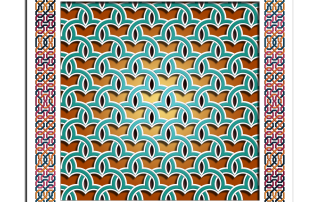
To contemplate 'The Threshold of Dawn: Chromatic Arabesques of the Wine Gate' is to witness the perfect intersection between the solidity of Nasrid military architecture and the lyrical volatility of its mural decoration. Inspired by the remnants of polychrome wall paintings that once adorned the interior arches of the emblematic Wine Gate (Puerta del Vino) in Granada's Alhambra, this digital masterpiece by José Cabrera Lozano rescues a symphony of sinuous shapes and infinite interlacing from the depths of time, elevating them into a contemporary dimension of unparalleled vividness. The central field of the composition simulates a rhythmic wave of interlaced polylobed arches, where deep terracotta tones and gradient ochres evoke the warmth of Andalusian clay and the sunset light bathing the fortress walls. Above this earthly foundation, vibrant emerald and turquoise ribbons meander like mystical vines, embodying the continuous flow of life and water. The magnificent outer border surrounding the piece acts as a guardian of order—a polychromatic, micro-geometric labyrinth where threads of pink, blue, orange, and white intertwine in absolute mathematical rigor. This artwork suspends the viewer in a state of pure aesthetic contemplation, transforming a historic mural fragment into a gateway to the eternal. In terms of design and execution, the artwork achieves a bold balance between the organic fluidity of the central arabesque and the modular rigor of its geometric frame. The central panel consists of a network of ogival arches and curvilinear interlaces outlined in pure white and emerald green, enhanced through digital drop shadows that create a tactile sensation of a layered low-relief. The background fields utilize rich gradients of ochre, sienna, and amber, introducing a focused central luminosity that mimics natural light behavior. The border, conversely, is a marvel of continuous polychromatic linear interlacing based on complex translation and reflection symmetries. The choice of Hahnemühle William Turner 310 gsm Fine Art paper significantly magnifies the visual impact of this piece. The pronounced, mould-made texture of this pure cotton paper interacts beautifully with the terracotta gradients, adding a physical patina that emulates the porous nature of the original Alhambra wall plaster. Furthermore, the complete absence of optical brighteners yields a natural ivory base tone that seamlessly harmonizes the high-frequency chromatic shifts within the border structure. Ambient Suggestions Due to its warmth and curvilinear dynamism, this piece is extraordinary for creating a focal point of sumptuous elegance in high-end residential foyers, premium boutique hotel reception areas, or luxury spa zones aboard superyachts, evoking the soothing heritage of ancient Arab baths. It pairs flawlessly with cream marble, travertine surfaces, or natural stone architectural accents. Framing Suggestions: We strongly recommend a deep-set showcase frame in natural oak or pickled teak. A floating mount will elevate the artwork, accentuating the rich tactile texture of the Hahnemühle paper, protected under museum-grade anti-reflective glass.

In the heart of the Real Alcázar of Seville, the Courtyard of the Maidens (Patio de las Doncellas) breathes an elegance that has captivated generations. This work by José Cabrera Lozano rescues the vibrant geometry of its tiled plinth, transforming glazed clay into a visual experience of infinite depth. The piece manifests as a labyrinth of interlaced shapes where light seems to filter through a digital lattice, revealing a universe of colors that are the very signature of Mudejar Seville: intense turquoises, deep magentas, and golden ochres. Contemplating 'The Maidens' Labyrinth', the viewer does not merely observe a pattern; they immerse themselves in the history of a palace where water and geometry merge to create an earthly paradise. The deep blue network of arches acts as a frame of order over the polychrome burst of the background, inviting meditation on the balance between structure and creative freedom. Each digital 'tile' is an echo of the craftsmen who, centuries ago, hand-cut each piece to honor beauty. This work is a bridge bringing that devotion to the present, allowing the majesty of the Alcázar to inhabit contemporary spaces with unprecedented freshness and clarity. From a technical perspective, this work represents a milestone in digital volume simulation applied to historical heritage. Cabrera Lozano uses his precision as an Industrial Engineer to deconstruct the original tile network and reconstruct it through high-precision vector shadow layers. The result is an extraordinary trompe-l'œil effect: the upper lattice of arches casts calculated shadows over the polychrome background, giving the piece a three-dimensionality that seems to rise from the physical support. The choice of 310 gsm Hahnemühle William Turner Fine Art paper is critical. Its matte and markedly textured surface interacts with the Giclée print to emulate the porosity and relief of real ceramics. Pigment saturation has been adjusted to maintain the vibrancy of magentas and turquoises, ensuring absolute contrast with the deep blacks of the shadows. Durability under the ISO 9706 standard guarantees that this technical representation of Mudejar art remains unaltered for generations, offering museum-grade archival quality that captures every detail of the original vector design. Ambient Suggestions Due to its rich color palette, a floating frame in dark wood or matte black is recommended to highlight the edges of the Hahnemühle paper. Ideal for stately lobbies, boutique hotels with a historical essence, or designer spaces seeking a visually striking piece that celebrates Spanish heritage.

To contemplate 'The Threshold of Dawn: Chromatic Arabesques of the Wine Gate' is to witness the perfect intersection between the solidity of Nasrid military architecture and the lyrical volatility of its mural decoration. Inspired by the remnants of polychrome wall paintings that once adorned the interior arches of the emblematic Wine Gate (Puerta del Vino) in Granada's Alhambra, this digital masterpiece by José Cabrera Lozano rescues a symphony of sinuous shapes and infinite interlacing from the depths of time, elevating them into a contemporary dimension of unparalleled vividness. The central field of the composition simulates a rhythmic wave of interlaced polylobed arches, where deep terracotta tones and gradient ochres evoke the warmth of Andalusian clay and the sunset light bathing the fortress walls. Above this earthly foundation, vibrant emerald and turquoise ribbons meander like mystical vines, embodying the continuous flow of life and water. The magnificent outer border surrounding the piece acts as a guardian of order—a polychromatic, micro-geometric labyrinth where threads of pink, blue, orange, and white intertwine in absolute mathematical rigor. This artwork suspends the viewer in a state of pure aesthetic contemplation, transforming a historic mural fragment into a gateway to the eternal. In terms of design and execution, the artwork achieves a bold balance between the organic fluidity of the central arabesque and the modular rigor of its geometric frame. The central panel consists of a network of ogival arches and curvilinear interlaces outlined in pure white and emerald green, enhanced through digital drop shadows that create a tactile sensation of a layered low-relief. The background fields utilize rich gradients of ochre, sienna, and amber, introducing a focused central luminosity that mimics natural light behavior. The border, conversely, is a marvel of continuous polychromatic linear interlacing based on complex translation and reflection symmetries. The choice of Hahnemühle William Turner 310 gsm Fine Art paper significantly magnifies the visual impact of this piece. The pronounced, mould-made texture of this pure cotton paper interacts beautifully with the terracotta gradients, adding a physical patina that emulates the porous nature of the original Alhambra wall plaster. Furthermore, the complete absence of optical brighteners yields a natural ivory base tone that seamlessly harmonizes the high-frequency chromatic shifts within the border structure. Ambient Suggestions Due to its warmth and curvilinear dynamism, this piece is extraordinary for creating a focal point of sumptuous elegance in high-end residential foyers, premium boutique hotel reception areas, or luxury spa zones aboard superyachts, evoking the soothing heritage of ancient Arab baths. It pairs flawlessly with cream marble, travertine surfaces, or natural stone architectural accents. Framing Suggestions: We strongly recommend a deep-set showcase frame in natural oak or pickled teak. A floating mount will elevate the artwork, accentuating the rich tactile texture of the Hahnemühle paper, protected under museum-grade anti-reflective glass.
