Infinite Mosaic: The Kaleidoscope of Al-Ándalus (Original)
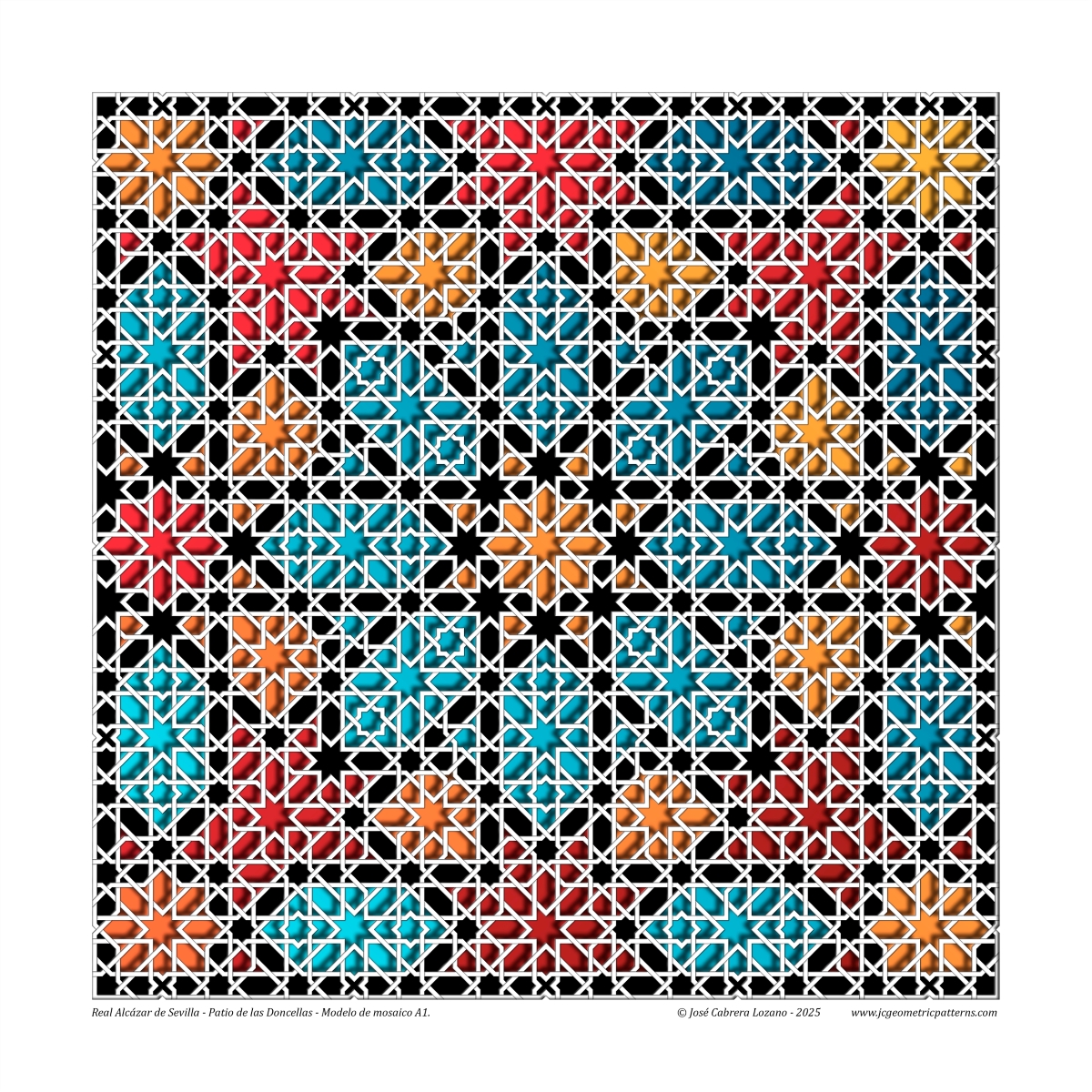
In this masterful work, José Cabrera Lozano immerses us in a chromatic festival that defies the limits of perception. 'Infinite Mosaic' is a celebration of diversity and unity, where hundreds of geometric tesserae engage in a vibrant dialogue about universal order. The piece manifests as an eternal kaleidoscope, capturing the joy and sophistication of Andalusian palaces in an unprecedented display of color and light. Intense reds, electric magentas, deep turquoises, and warm ochres intertwine in a perpetual dance, reminding the viewer that, within the complexity of the multiple, there always resides a structure of absolute harmony. Contemplating this piece, the eye is lost in a labyrinth of stars and polygons that seem to beat with a life of their own. It is not just a pattern; it is a visual meditation on infinity. Each intersection is a meeting between millenary tradition and contemporary audacity, where mathematical design becomes pure visual poetry. The work acts as a portal transporting the soul toward the contemplation of the unlimited, inviting one to find peace at the center of a whirlwind of symmetrical beauty. It is a tribute to the heritage of Al-Andalus, yet projected toward the future through a digital clarity that grants each shape an undeniable aesthetic authority. Owning this work is integrating a fragment of cosmic order into everyday space, a symphony of color that never ceases to reveal new nuances. From a technical standpoint, 'Infinite Mosaic' represents one of the most complex studies of chromatic density and semi-regular tessellation performed by the artist. The composition is based on an 8-fold symmetry grid, where the overlapping of planes and the use of vectorial shadows generate an extraordinary physical three-dimensionality. This digital 'trompe-l'œil' effect is fundamental to the work, allowing each individual element to appear to emerge from the two-dimensional plane with an almost sculptural presence. Precision in shadow calculation ensures that light appears to emanate from the very heart of the geometry, providing a real relief to the human eye. The chosen support for this explosion of color is 310 gsm Hahnemühle William Turner Fine Art paper. Its matte and markedly textured surface is essential to provide the necessary body to the saturated pigments, preventing reflections and allowing the depth of the blacks to highlight the palette's contrast. High-resolution Giclée printing ensures absolute chromatic fidelity, capturing every shadow transition with mathematical sharpness. Longevity is guaranteed under the ISO 9706 standard, meeting the most demanding international museum conservation standards. This work is a marvel of digital engineering applied to art, where vectorial exactness merges with the organic warmth of cotton to create an eternal collector's piece. Ambient Suggestions Due to its high chromatic energy, a minimalist frame in matte black or pure white is recommended to contain the visual impact. A 'floating' mount on a deep passe-partout will highlight the digital relief effect. Ideal for spacious, contemporary design, lofts with high ceilings, or as a focal point in corporate receptions seeking to convey creativity and dynamism.

Lapis Lazuli Sky over Gold
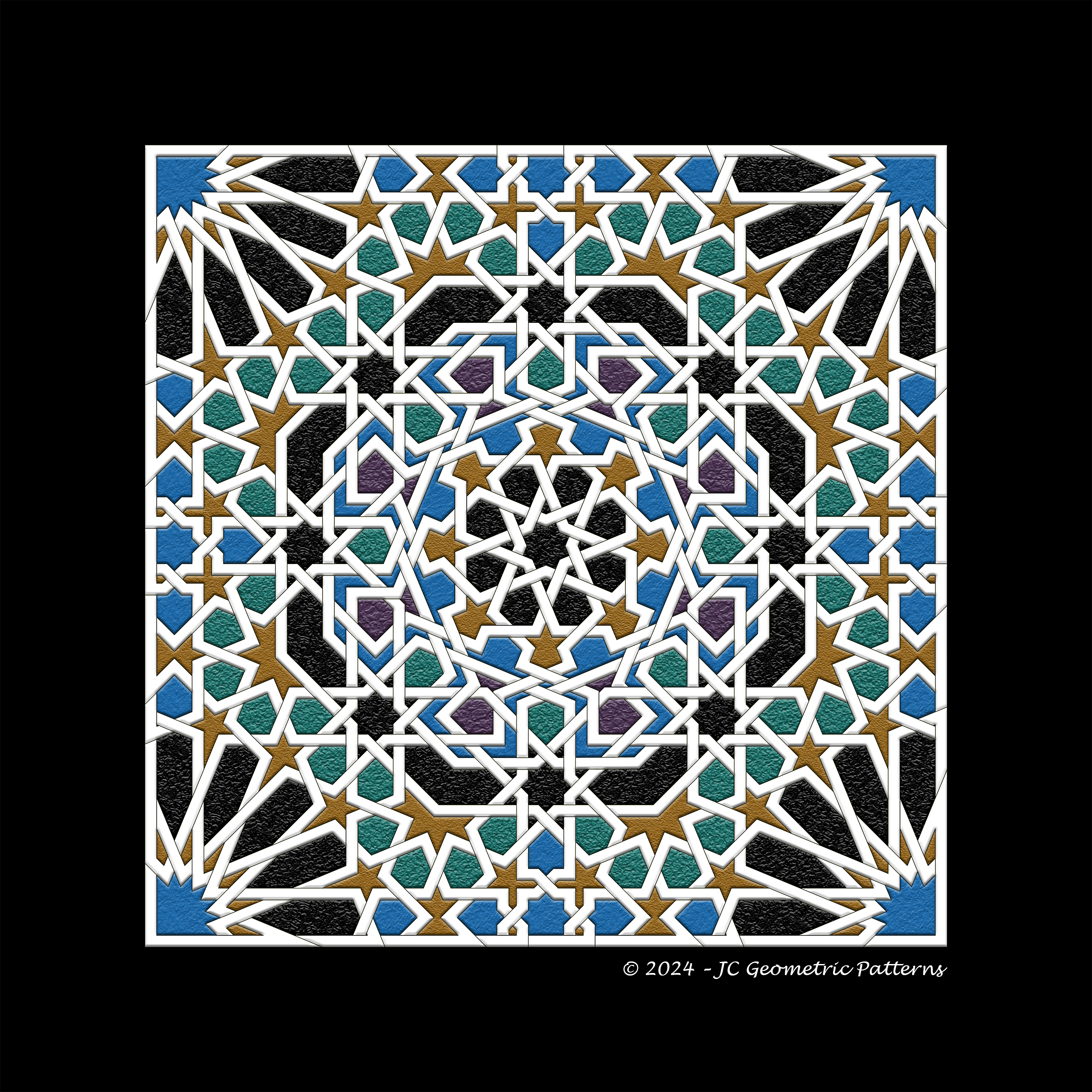
This monumental work, 'Lapis Lazuli Sky over Gold: The Interlaced Cosmos of Mexuar', stands as a threshold for contemplation. José Cabrera Lozano not only reinterprets Nasrid lacería, but he endows it with a contemporary spiritual pulse. The white interlacing, like a river of living water, flows incessantly, reminding us that in sacred geometry, every line is a path and every intersection a destination. The composition presents two visions: one, a centralized radiant sun where unity (tawhid) is the focal point; the other, an infinite expansion where the complexity of the forms multiplies towards the unreachability of infinity. It is a dialogue between mathematical rigidity and mystical emotion, a choreography of forms that seem to breathe over an abyss of black velvet. The colors are palpable jewels: the blue of the sky, the turquoise of the water, the ochre of the earth, and the gold of the divine. The profound black is the primal void, the initial mystery that serves as a stage for this expanding cosmos to manifest. The work is an invitation to silence, a bridge connecting the Andalusian past with the digital present, reminding us that beauty is, above all, an act of faith. It is the Andalusian cosmos at its finest, a 'zenith of the Andalusian jewel'.

Mudejar Trascendence
'Mudejar Trascendence' is a mystical bridge connecting our digital present with the 15th-century Monastery of La Mejorada in Valladolid (1409). Emerging from the quietude of the Hieronymite Order, the Mudejar Chapel represents the triumph of coexistence, where Islamic heritage and craftsmanship elevate a Christian space. This artwork captures that geometric spirituality transcending dogmas, inviting the viewer into profound introspection. The interlaced patterns, expanding endlessly from the eight-pointed star, are not mere ornaments: they are the visual representation of the cosmos, faith, and knowledge. It is a tribute to the skill of the historical craftsman, reimagined today with the absolute precision of the digital age, where light emanates from the center of the pattern to remind us that beauty is a manifestation of the divine on our earthly plane.
Mudejar Trascendence (Methacrylate)
'Mudejar Trascendence' is a mystical bridge connecting our digital present with the 15th-century Monastery of La Mejorada in Valladolid (1409). Emerging from the quietude of the Hieronymite Order, the Mudejar Chapel represents the triumph of coexistence, where Islamic heritage and craftsmanship elevate a Christian space. This artwork captures that geometric spirituality transcending dogmas, inviting the viewer into profound introspection. The interlaced patterns, expanding endlessly from the eight-pointed star, are not mere ornaments: they are the visual representation of the cosmos, faith, and knowledge. It is a tribute to the skill of the historical craftsman, reimagined today with the absolute precision of the digital age, where light emanates from the center of the pattern to remind us that beauty is a manifestation of the divine on our earthly plane. The composition is structured on the rigorous tradition of 'lacería', using a mathematical grid of stars and polygons that generates a hypnotic visual rhythm. The color abandons the austerity of the original wood and stucco to embrace a bold palette: vibrant turquoises, golden ochres, and crimson accents contrasting against abyssal blue backgrounds. Through precise digital shading, a three-dimensional effect (trompe l'œil) is created, challenging the flat surface. The medium is fundamental: printed on Hahnemühle William Turner Fine Art paper (310 gsm), its pronounced matte texture masterfully absorbs light, giving colors a tactile, sculptural richness. The accuracy of Cabrera Lozano's vectors allows for a mathematical cleanliness impossible in ancient times, honoring and updating the architectural legacy. Ambient Suggestions The historical weight and modern execution make it a versatile piece for high-end interior design. It requires framing that respects its volume, preferably shadow boxes or deep box frames in smoked oak or dark walnut. It is a striking work designed to anchor corporate offices, luxury yacht lounge areas, or boutique hotel suite headboards.
Mudejar Trascendence (Original)
'Mudejar Trascendence' is a mystical bridge connecting our digital present with the 15th-century Monastery of La Mejorada in Valladolid (1409). Emerging from the quietude of the Hieronymite Order, the Mudejar Chapel represents the triumph of coexistence, where Islamic heritage and craftsmanship elevate a Christian space. This artwork captures that geometric spirituality transcending dogmas, inviting the viewer into profound introspection. The interlaced patterns, expanding endlessly from the eight-pointed star, are not mere ornaments: they are the visual representation of the cosmos, faith, and knowledge. It is a tribute to the skill of the historical craftsman, reimagined today with the absolute precision of the digital age, where light emanates from the center of the pattern to remind us that beauty is a manifestation of the divine on our earthly plane. The composition is structured on the rigorous tradition of 'lacería', using a mathematical grid of stars and polygons that generates a hypnotic visual rhythm. The color abandons the austerity of the original wood and stucco to embrace a bold palette: vibrant turquoises, golden ochres, and crimson accents contrasting against abyssal blue backgrounds. Through precise digital shading, a three-dimensional effect (trompe l'œil) is created, challenging the flat surface. The medium is fundamental: printed on Hahnemühle William Turner Fine Art paper (310 gsm), its pronounced matte texture masterfully absorbs light, giving colors a tactile, sculptural richness. The accuracy of Cabrera Lozano's vectors allows for a mathematical cleanliness impossible in ancient times, honoring and updating the architectural legacy. Ambient Suggestions The historical weight and modern execution make it a versatile piece for high-end interior design. It requires framing that respects its volume, preferably shadow boxes or deep box frames in smoked oak or dark walnut. It is a striking work designed to anchor corporate offices, luxury yacht lounge areas, or boutique hotel suite headboards.

Patio de las Muñecas – The Whisper of Plasterwork
In this work, José Cabrera Lozano transports us to the most intimate heart of the Royal Alcázar of Seville: the Patio de las Muñecas. The piece is a visual meditation on permanence and change. The plasterwork pattern, which for centuries has silently observed the passing of history, here detaches from its stony support to float in a space of pure light. The color gradient is the true narrative protagonist: it begins in a deep, earthy red, evoking the clay and heat of the Baetica region, gradually ascending towards a vibrant turquoise that recalls both the Sevillian sky and the water of its fountains. It is a geometric dance where repetition does not seek monotony, but infinity. Each intersection of the white lattice is an echo of the Mudejar craftsmen, reinterpreted through a digital lens that exalts the perfection of the stroke. The work invites the viewer into a state of serene contemplation, where the rigor of sacred mathematics merges with the warmth of an emotional palette that breathes life and sophistication.

Ribat-i Mahi: The Guardian of the Road
On the historic Khorasan road, the Ribat-i Mahi caravansarai stands as a testament to Seljuk architectural ingenuity. In this work, José Cabrera Lozano rescues the essence of that millenary refuge, translating the language of Persian brickwork into a digital symphony of light and color. 'Ribat-i Mahi: The Guardian of the Road' is a visual meditation on the traveler's protection and rest. The white grid, robust and protective, intertwines to house cores of color that seem to beat with the energy of ancient markets: solar oranges, oasis greens, and twilight sky blues. The work captures the incessant rhythm of caravans that, under the perfect symmetry of the design, found order amidst the desert. The red dots, strategically placed, act as embers that keep alive the memory of nightly campfires. This is not just a simple pattern; it is a temporal threshold inviting us to rediscover the sophistication of the structures that connected worlds. Cabrera Lozano ensures that the sobriety of the brick turns into a vibrant experience, where geometry is not just form, but a refuge for the spirit in the modern world.
Ribat-I Mahi: The Guardian of the Road (Original)
On the historic Khorasan road, the Ribat-i Mahi caravansarai stands as a testament to Seljuk architectural ingenuity. In this work, José Cabrera Lozano rescues the essence of that millenary refuge, translating the language of Persian brickwork into a digital symphony of light and color. 'Ribat-i Mahi: The Guardian of the Road' is a visual meditation on the traveler's protection and rest. The white grid, robust and protective, intertwines to house cores of color that seem to beat with the energy of ancient markets: solar oranges, oasis greens, and twilight sky blues. The work captures the incessant rhythm of caravans that, under the perfect symmetry of the design, found order amidst the desert. The red dots, strategically placed, act as embers that keep alive the memory of nightly campfires. This is not just a simple pattern; it is a temporal threshold inviting us to rediscover the sophistication of the structures that connected worlds. Cabrera Lozano ensures that the sobriety of the brick turns into a vibrant experience, where geometry is not just form, but a refuge for the spirit in the modern world. Technically, 'Ribat-i Mahi' represents an exhaustive study on three-dimensionality in vector art. The composition is based on a complex orthogonal grid where the overlapping of planes generates a stunning visual relief. Using high-precision drop shadows, the artist achieves a 'trompe-l'œil' effect that makes the white lattice appear to physically rise above the polychrome background. Every intersection has been calculated with engineering rigor to ensure infinite continuity, simulating the solidity of Persian masonry through the clever use of digital light. The Giclée print on 310 gsm Hahnemühle William Turner Fine Art paper is fundamental to the work. Its 100% cotton, matte, and rough texture provides the necessary body for digital shadows to acquire a real tactile quality. The high load of pigments in orange and green tones interacts with the paper's micro-texture, creating a depth that the screen barely suggests. Guaranteed under the ISO 9706 standard, this collector's piece offers museum-grade longevity, ensuring that the sharpness of the design and the vividness of the colors remain unaltered for centuries. Ambient Suggestions A floated frame in ebony or matte black is recommended to highlight the edges of the Hahnemühle paper. Ideal for design studios, executive offices, or hallways seeking to convey a sense of order, welcome, and historical solidity.
Splendor of Humayun
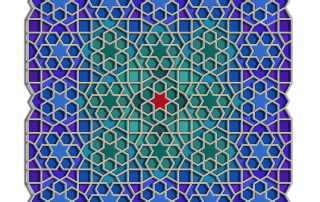
Splendor of Humayun is an ode to the architecture of the soul, a digital transposition of the Mughal grandeur that has defined the Delhi skyline for centuries. At the heart of this piece beats a crimson star, a core of pure energy acting as the origin of all creation. From this vital center, geometry unfolds in layers of turquoise, emerald, and violet, evoking the transition from day to twilight in the gardens of Paradise. José Cabrera Lozano uses the white lattice not merely as a structure, but as a luminous membrane containing the vibration of color. Each line is a path; each intersection, a moment of mathematical clarity. It is a work that invites silent introspection, where the viewer can lose themselves in infinite repetition only to find themselves, ultimately, in the unity of the red center. It is not just a geometric pattern; it is a meditation on the harmony between the earthly and the divine, captured in a moment of chromatic perfection that resonates with the elegance of ancient palaces.
Stars of Al-Ándalus
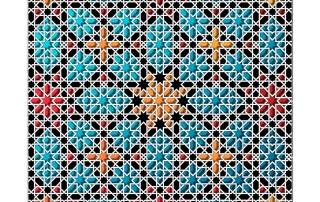
Contemplating this artwork transcends mere visual observation; it is an act of immersion into the architectural memory of Al-Andalus, encoded through the contemporary lens of JC Geometric Patterns. In 'Stars of Al-Andalus', the echoes of the legendary Maiden's Courtyard in the Royal Alcázar of Seville are presented not as a static relic, but as a pulsating entity. The infinite, immaculate white threads weave a network of stars that capture the duality of the universe: the earthly and the divine. The vibrant cyan acts as a visual sigh of the flowing water that gives life to Andalusian gardens, a liquid freshness that masterfully contrasts with the warmth of red and ochre, reminiscent of the southern sun striking the historical brick, plaster, and tile. Every geometric intersection is a syllable in a visual poem speaking of cosmic order. The carefully curated color palette, enhanced by digitally cast shadows, endows the composition with a hypnotic three-dimensionality. It is a meditation on time, where Islamic sacred geometry reveals itself as a universal and imperishable language. The artwork invites the viewer to lose themselves in its labyrinths of light and shadow, finding in its symmetrical repetition a space for inner silence and spiritual reflection.

In this masterful work, José Cabrera Lozano immerses us in a chromatic festival that defies the limits of perception. 'Infinite Mosaic' is a celebration of diversity and unity, where hundreds of geometric tesserae engage in a vibrant dialogue about universal order. The piece manifests as an eternal kaleidoscope, capturing the joy and sophistication of Andalusian palaces in an unprecedented display of color and light. Intense reds, electric magentas, deep turquoises, and warm ochres intertwine in a perpetual dance, reminding the viewer that, within the complexity of the multiple, there always resides a structure of absolute harmony. Contemplating this piece, the eye is lost in a labyrinth of stars and polygons that seem to beat with a life of their own. It is not just a pattern; it is a visual meditation on infinity. Each intersection is a meeting between millenary tradition and contemporary audacity, where mathematical design becomes pure visual poetry. The work acts as a portal transporting the soul toward the contemplation of the unlimited, inviting one to find peace at the center of a whirlwind of symmetrical beauty. It is a tribute to the heritage of Al-Andalus, yet projected toward the future through a digital clarity that grants each shape an undeniable aesthetic authority. Owning this work is integrating a fragment of cosmic order into everyday space, a symphony of color that never ceases to reveal new nuances. From a technical standpoint, 'Infinite Mosaic' represents one of the most complex studies of chromatic density and semi-regular tessellation performed by the artist. The composition is based on an 8-fold symmetry grid, where the overlapping of planes and the use of vectorial shadows generate an extraordinary physical three-dimensionality. This digital 'trompe-l'œil' effect is fundamental to the work, allowing each individual element to appear to emerge from the two-dimensional plane with an almost sculptural presence. Precision in shadow calculation ensures that light appears to emanate from the very heart of the geometry, providing a real relief to the human eye. The chosen support for this explosion of color is 310 gsm Hahnemühle William Turner Fine Art paper. Its matte and markedly textured surface is essential to provide the necessary body to the saturated pigments, preventing reflections and allowing the depth of the blacks to highlight the palette's contrast. High-resolution Giclée printing ensures absolute chromatic fidelity, capturing every shadow transition with mathematical sharpness. Longevity is guaranteed under the ISO 9706 standard, meeting the most demanding international museum conservation standards. This work is a marvel of digital engineering applied to art, where vectorial exactness merges with the organic warmth of cotton to create an eternal collector's piece. Ambient Suggestions Due to its high chromatic energy, a minimalist frame in matte black or pure white is recommended to contain the visual impact. A 'floating' mount on a deep passe-partout will highlight the digital relief effect. Ideal for spacious, contemporary design, lofts with high ceilings, or as a focal point in corporate receptions seeking to convey creativity and dynamism.
This monumental work, 'Lapis Lazuli Sky over Gold: The Interlaced Cosmos of Mexuar', stands as a threshold for contemplation. José Cabrera Lozano not only reinterprets Nasrid lacería, but he endows it with a contemporary spiritual pulse. The white interlacing, like a river of living water, flows incessantly, reminding us that in sacred geometry, every line is a path and every intersection a destination. The composition presents two visions: one, a centralized radiant sun where unity (tawhid) is the focal point; the other, an infinite expansion where the complexity of the forms multiplies towards the unreachability of infinity. It is a dialogue between mathematical rigidity and mystical emotion, a choreography of forms that seem to breathe over an abyss of black velvet. The colors are palpable jewels: the blue of the sky, the turquoise of the water, the ochre of the earth, and the gold of the divine. The profound black is the primal void, the initial mystery that serves as a stage for this expanding cosmos to manifest. The work is an invitation to silence, a bridge connecting the Andalusian past with the digital present, reminding us that beauty is, above all, an act of faith. It is the Andalusian cosmos at its finest, a 'zenith of the Andalusian jewel'.

'Mudejar Trascendence' is a mystical bridge connecting our digital present with the 15th-century Monastery of La Mejorada in Valladolid (1409). Emerging from the quietude of the Hieronymite Order, the Mudejar Chapel represents the triumph of coexistence, where Islamic heritage and craftsmanship elevate a Christian space. This artwork captures that geometric spirituality transcending dogmas, inviting the viewer into profound introspection. The interlaced patterns, expanding endlessly from the eight-pointed star, are not mere ornaments: they are the visual representation of the cosmos, faith, and knowledge. It is a tribute to the skill of the historical craftsman, reimagined today with the absolute precision of the digital age, where light emanates from the center of the pattern to remind us that beauty is a manifestation of the divine on our earthly plane.
'Mudejar Trascendence' is a mystical bridge connecting our digital present with the 15th-century Monastery of La Mejorada in Valladolid (1409). Emerging from the quietude of the Hieronymite Order, the Mudejar Chapel represents the triumph of coexistence, where Islamic heritage and craftsmanship elevate a Christian space. This artwork captures that geometric spirituality transcending dogmas, inviting the viewer into profound introspection. The interlaced patterns, expanding endlessly from the eight-pointed star, are not mere ornaments: they are the visual representation of the cosmos, faith, and knowledge. It is a tribute to the skill of the historical craftsman, reimagined today with the absolute precision of the digital age, where light emanates from the center of the pattern to remind us that beauty is a manifestation of the divine on our earthly plane. The composition is structured on the rigorous tradition of 'lacería', using a mathematical grid of stars and polygons that generates a hypnotic visual rhythm. The color abandons the austerity of the original wood and stucco to embrace a bold palette: vibrant turquoises, golden ochres, and crimson accents contrasting against abyssal blue backgrounds. Through precise digital shading, a three-dimensional effect (trompe l'œil) is created, challenging the flat surface. The medium is fundamental: printed on Hahnemühle William Turner Fine Art paper (310 gsm), its pronounced matte texture masterfully absorbs light, giving colors a tactile, sculptural richness. The accuracy of Cabrera Lozano's vectors allows for a mathematical cleanliness impossible in ancient times, honoring and updating the architectural legacy. Ambient Suggestions The historical weight and modern execution make it a versatile piece for high-end interior design. It requires framing that respects its volume, preferably shadow boxes or deep box frames in smoked oak or dark walnut. It is a striking work designed to anchor corporate offices, luxury yacht lounge areas, or boutique hotel suite headboards.
'Mudejar Trascendence' is a mystical bridge connecting our digital present with the 15th-century Monastery of La Mejorada in Valladolid (1409). Emerging from the quietude of the Hieronymite Order, the Mudejar Chapel represents the triumph of coexistence, where Islamic heritage and craftsmanship elevate a Christian space. This artwork captures that geometric spirituality transcending dogmas, inviting the viewer into profound introspection. The interlaced patterns, expanding endlessly from the eight-pointed star, are not mere ornaments: they are the visual representation of the cosmos, faith, and knowledge. It is a tribute to the skill of the historical craftsman, reimagined today with the absolute precision of the digital age, where light emanates from the center of the pattern to remind us that beauty is a manifestation of the divine on our earthly plane. The composition is structured on the rigorous tradition of 'lacería', using a mathematical grid of stars and polygons that generates a hypnotic visual rhythm. The color abandons the austerity of the original wood and stucco to embrace a bold palette: vibrant turquoises, golden ochres, and crimson accents contrasting against abyssal blue backgrounds. Through precise digital shading, a three-dimensional effect (trompe l'œil) is created, challenging the flat surface. The medium is fundamental: printed on Hahnemühle William Turner Fine Art paper (310 gsm), its pronounced matte texture masterfully absorbs light, giving colors a tactile, sculptural richness. The accuracy of Cabrera Lozano's vectors allows for a mathematical cleanliness impossible in ancient times, honoring and updating the architectural legacy. Ambient Suggestions The historical weight and modern execution make it a versatile piece for high-end interior design. It requires framing that respects its volume, preferably shadow boxes or deep box frames in smoked oak or dark walnut. It is a striking work designed to anchor corporate offices, luxury yacht lounge areas, or boutique hotel suite headboards.

In this work, José Cabrera Lozano transports us to the most intimate heart of the Royal Alcázar of Seville: the Patio de las Muñecas. The piece is a visual meditation on permanence and change. The plasterwork pattern, which for centuries has silently observed the passing of history, here detaches from its stony support to float in a space of pure light. The color gradient is the true narrative protagonist: it begins in a deep, earthy red, evoking the clay and heat of the Baetica region, gradually ascending towards a vibrant turquoise that recalls both the Sevillian sky and the water of its fountains. It is a geometric dance where repetition does not seek monotony, but infinity. Each intersection of the white lattice is an echo of the Mudejar craftsmen, reinterpreted through a digital lens that exalts the perfection of the stroke. The work invites the viewer into a state of serene contemplation, where the rigor of sacred mathematics merges with the warmth of an emotional palette that breathes life and sophistication.

On the historic Khorasan road, the Ribat-i Mahi caravansarai stands as a testament to Seljuk architectural ingenuity. In this work, José Cabrera Lozano rescues the essence of that millenary refuge, translating the language of Persian brickwork into a digital symphony of light and color. 'Ribat-i Mahi: The Guardian of the Road' is a visual meditation on the traveler's protection and rest. The white grid, robust and protective, intertwines to house cores of color that seem to beat with the energy of ancient markets: solar oranges, oasis greens, and twilight sky blues. The work captures the incessant rhythm of caravans that, under the perfect symmetry of the design, found order amidst the desert. The red dots, strategically placed, act as embers that keep alive the memory of nightly campfires. This is not just a simple pattern; it is a temporal threshold inviting us to rediscover the sophistication of the structures that connected worlds. Cabrera Lozano ensures that the sobriety of the brick turns into a vibrant experience, where geometry is not just form, but a refuge for the spirit in the modern world.
On the historic Khorasan road, the Ribat-i Mahi caravansarai stands as a testament to Seljuk architectural ingenuity. In this work, José Cabrera Lozano rescues the essence of that millenary refuge, translating the language of Persian brickwork into a digital symphony of light and color. 'Ribat-i Mahi: The Guardian of the Road' is a visual meditation on the traveler's protection and rest. The white grid, robust and protective, intertwines to house cores of color that seem to beat with the energy of ancient markets: solar oranges, oasis greens, and twilight sky blues. The work captures the incessant rhythm of caravans that, under the perfect symmetry of the design, found order amidst the desert. The red dots, strategically placed, act as embers that keep alive the memory of nightly campfires. This is not just a simple pattern; it is a temporal threshold inviting us to rediscover the sophistication of the structures that connected worlds. Cabrera Lozano ensures that the sobriety of the brick turns into a vibrant experience, where geometry is not just form, but a refuge for the spirit in the modern world. Technically, 'Ribat-i Mahi' represents an exhaustive study on three-dimensionality in vector art. The composition is based on a complex orthogonal grid where the overlapping of planes generates a stunning visual relief. Using high-precision drop shadows, the artist achieves a 'trompe-l'œil' effect that makes the white lattice appear to physically rise above the polychrome background. Every intersection has been calculated with engineering rigor to ensure infinite continuity, simulating the solidity of Persian masonry through the clever use of digital light. The Giclée print on 310 gsm Hahnemühle William Turner Fine Art paper is fundamental to the work. Its 100% cotton, matte, and rough texture provides the necessary body for digital shadows to acquire a real tactile quality. The high load of pigments in orange and green tones interacts with the paper's micro-texture, creating a depth that the screen barely suggests. Guaranteed under the ISO 9706 standard, this collector's piece offers museum-grade longevity, ensuring that the sharpness of the design and the vividness of the colors remain unaltered for centuries. Ambient Suggestions A floated frame in ebony or matte black is recommended to highlight the edges of the Hahnemühle paper. Ideal for design studios, executive offices, or hallways seeking to convey a sense of order, welcome, and historical solidity.
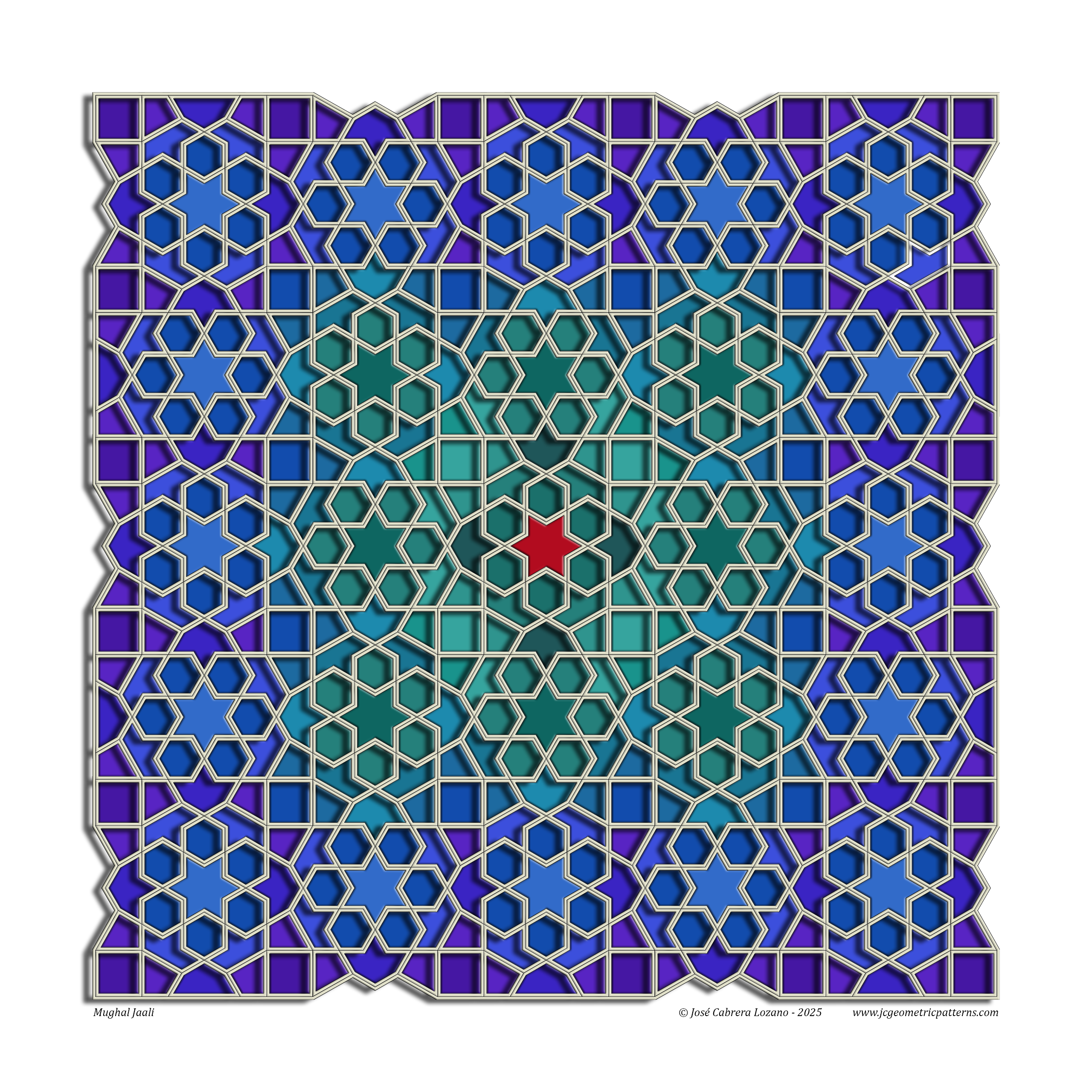
Splendor of Humayun is an ode to the architecture of the soul, a digital transposition of the Mughal grandeur that has defined the Delhi skyline for centuries. At the heart of this piece beats a crimson star, a core of pure energy acting as the origin of all creation. From this vital center, geometry unfolds in layers of turquoise, emerald, and violet, evoking the transition from day to twilight in the gardens of Paradise. José Cabrera Lozano uses the white lattice not merely as a structure, but as a luminous membrane containing the vibration of color. Each line is a path; each intersection, a moment of mathematical clarity. It is a work that invites silent introspection, where the viewer can lose themselves in infinite repetition only to find themselves, ultimately, in the unity of the red center. It is not just a geometric pattern; it is a meditation on the harmony between the earthly and the divine, captured in a moment of chromatic perfection that resonates with the elegance of ancient palaces.
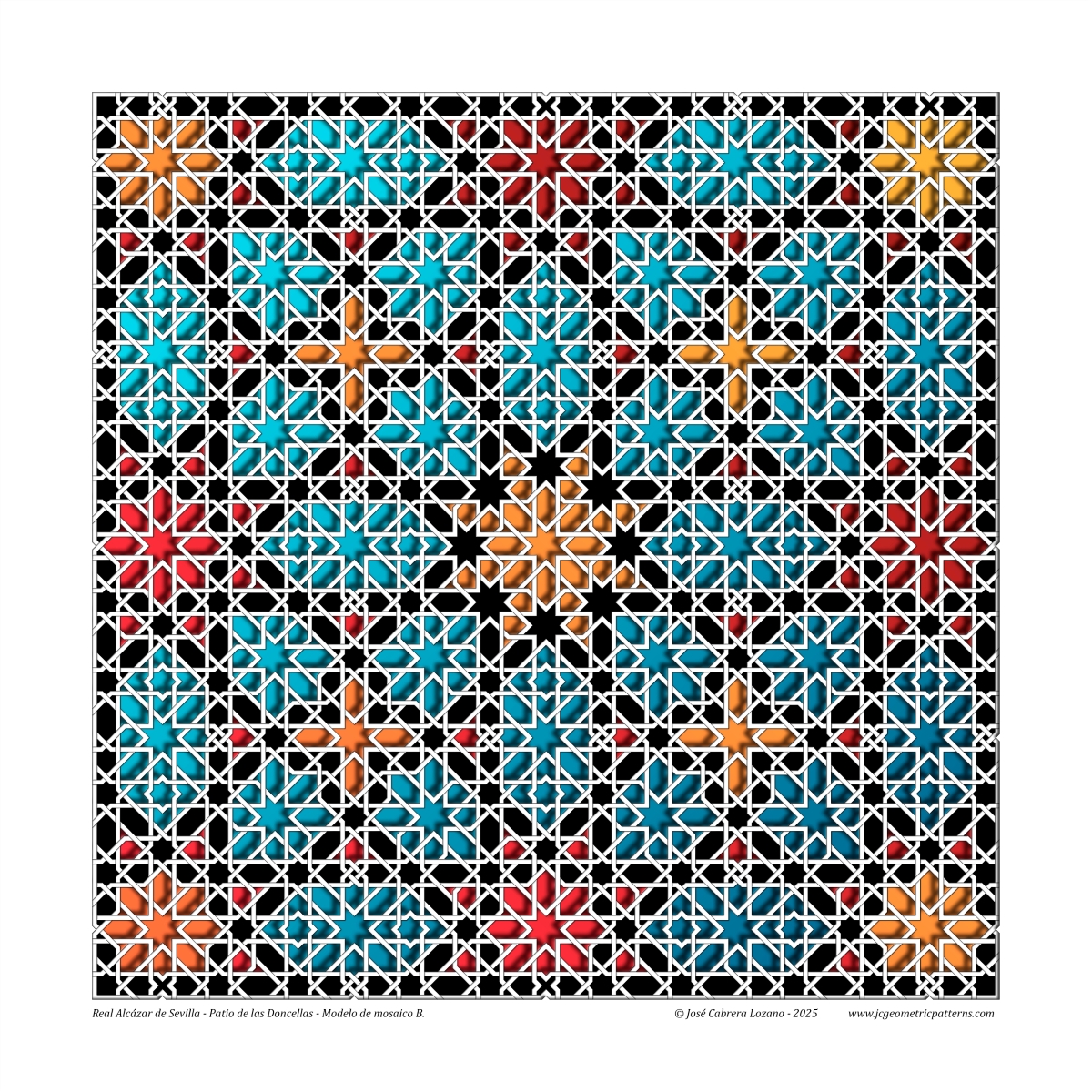
Contemplating this artwork transcends mere visual observation; it is an act of immersion into the architectural memory of Al-Andalus, encoded through the contemporary lens of JC Geometric Patterns. In 'Stars of Al-Andalus', the echoes of the legendary Maiden's Courtyard in the Royal Alcázar of Seville are presented not as a static relic, but as a pulsating entity. The infinite, immaculate white threads weave a network of stars that capture the duality of the universe: the earthly and the divine. The vibrant cyan acts as a visual sigh of the flowing water that gives life to Andalusian gardens, a liquid freshness that masterfully contrasts with the warmth of red and ochre, reminiscent of the southern sun striking the historical brick, plaster, and tile. Every geometric intersection is a syllable in a visual poem speaking of cosmic order. The carefully curated color palette, enhanced by digitally cast shadows, endows the composition with a hypnotic three-dimensionality. It is a meditation on time, where Islamic sacred geometry reveals itself as a universal and imperishable language. The artwork invites the viewer to lose themselves in its labyrinths of light and shadow, finding in its symmetrical repetition a space for inner silence and spiritual reflection.