Stars of Al-Ándalus (Aluminium)
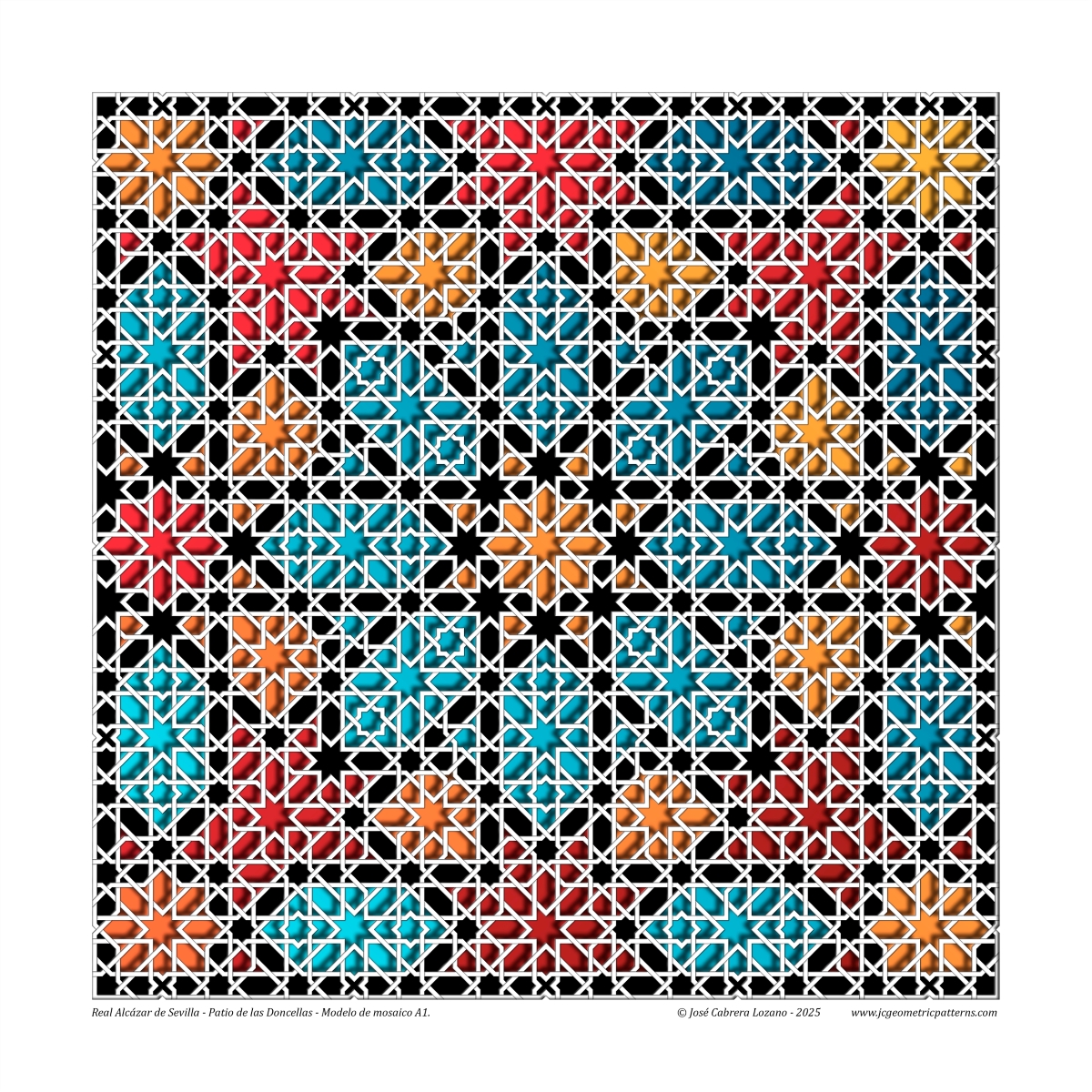
Contemplating this artwork transcends mere visual observation; it is an act of immersion into the architectural memory of Al-Andalus, encoded through the contemporary lens of JC Geometric Patterns. In 'Stars of Al-Andalus', the echoes of the legendary Maiden's Courtyard in the Royal Alcázar of Seville are presented not as a static relic, but as a pulsating entity. The infinite, immaculate white threads weave a network of stars that capture the duality of the universe: the earthly and the divine. The vibrant cyan acts as a visual sigh of the flowing water that gives life to Andalusian gardens, a liquid freshness that masterfully contrasts with the warmth of red and ochre, reminiscent of the southern sun striking the historical brick, plaster, and tile. Every geometric intersection is a syllable in a visual poem speaking of cosmic order. The carefully curated color palette, enhanced by digitally cast shadows, endows the composition with a hypnotic three-dimensionality. It is a meditation on time, where Islamic sacred geometry reveals itself as a universal and imperishable language. The artwork invites the viewer to lose themselves in its labyrinths of light and shadow, finding in its symmetrical repetition a space for inner silence and spiritual reflection. From a technical and compositional perspective, this piece represents a milestone in the execution of complex patterns through digital media. The structure is based on a network of primary eight-pointed stars, creating a perfect tessellation that leaves no empty spaces. The artist has applied a 'drop shadow' treatment beneath the main white latticework. This technical resource is not merely aesthetic; it separates the interlaced bands from the polychrome background, generating an effect of sculptural relief that emulates traditional plaster or wood carving. The choice of physical medium is crucial. Printed on 310 gsm Fine Art Hahnemühle William Turner paper, the artwork acquires an unsurpassable tactile dimension. This 100% cotton paper, white and free of optical brighteners, features a matte surface that is both pronounced and subtle. This organic characteristic brings a visual three-dimensionality that counteracts the precision of the digital medium. Furthermore, it is fundamental for the absorption of dark pigments: the blacks acquire a velvety, abyssal depth against which the colors vibrate with extraordinary saturation. Ambient Suggestions To enhance the three-dimensional nature of the design and the rich texture of the Hahnemühle paper, a 'floating frame' in matte black stained ash or dark walnut is highly recommended. It is advisable to omit the glass if the environment allows, to fully appreciate the texture. In terms of interior design, this piece serves as a high-impact focal point. It is exceptionally well-suited for corporate collections in executive offices, boardrooms, and luxury hotel lobbies. Its aesthetic also makes it ideal for luxury yachts or minimalist residences aiming to project sophistication and a profound cultural legacy.
Stars or Al-Ándalus (Original)
Contemplating this artwork transcends mere visual observation; it is an act of immersion into the architectural memory of Al-Andalus, encoded through the contemporary lens of JC Geometric Patterns. In 'Stars of Al-Andalus', the echoes of the legendary Maiden's Courtyard in the Royal Alcázar of Seville are presented not as a static relic, but as a pulsating entity. The infinite, immaculate white threads weave a network of stars that capture the duality of the universe: the earthly and the divine. The vibrant cyan acts as a visual sigh of the flowing water that gives life to Andalusian gardens, a liquid freshness that masterfully contrasts with the warmth of red and ochre, reminiscent of the southern sun striking the historical brick, plaster, and tile. Every geometric intersection is a syllable in a visual poem speaking of cosmic order. The carefully curated color palette, enhanced by digitally cast shadows, endows the composition with a hypnotic three-dimensionality. It is a meditation on time, where Islamic sacred geometry reveals itself as a universal and imperishable language. The artwork invites the viewer to lose themselves in its labyrinths of light and shadow, finding in its symmetrical repetition a space for inner silence and spiritual reflection. From a technical and compositional perspective, this piece represents a milestone in the execution of complex patterns through digital media. The structure is based on a network of primary eight-pointed stars, creating a perfect tessellation that leaves no empty spaces. The artist has applied a 'drop shadow' treatment beneath the main white latticework. This technical resource is not merely aesthetic; it separates the interlaced bands from the polychrome background, generating an effect of sculptural relief that emulates traditional plaster or wood carving. The choice of physical medium is crucial. Printed on 310 gsm Fine Art Hahnemühle William Turner paper, the artwork acquires an unsurpassable tactile dimension. This 100% cotton paper, white and free of optical brighteners, features a matte surface that is both pronounced and subtle. This organic characteristic brings a visual three-dimensionality that counteracts the precision of the digital medium. Furthermore, it is fundamental for the absorption of dark pigments: the blacks acquire a velvety, abyssal depth against which the colors vibrate with extraordinary saturation. Ambient Suggestions To enhance the three-dimensional nature of the design and the rich texture of the Hahnemühle paper, a 'floating frame' in matte black stained ash or dark walnut is highly recommended. It is advisable to omit the glass if the environment allows, to fully appreciate the texture. In terms of interior design, this piece serves as a high-impact focal point. It is exceptionally well-suited for corporate collections in executive offices, boardrooms, and luxury hotel lobbies. Its aesthetic also makes it ideal for luxury yachts or minimalist residences aiming to project sophistication and a profound cultural legacy.
Symphony of Stars
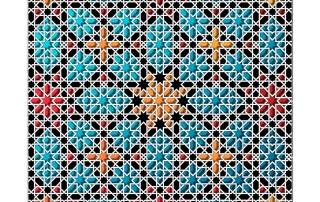
There is an invisible harmony that connects the centuries, a web of light that José Cabrera Lozano has unveiled in this masterly interpretation. In 'Symphony of Stars', the pattern from the Maiden’s Courtyard ceases to be an architectural fragment and becomes a window into the infinite. The white latticework, pure and mathematical, intertwines over a background where the cyan of the Andalusian sky and the solar tones of ochre and red vibrate with renewed energy. It is not just geometry; it is the echo of a civilization that sought beauty in the perfection of order. Each star is a note in a visual composition that invites calm, reminding us that art, even in its most abstract and digital form, can capture the soul of a place as sacred as the Royal Alcázar of Seville.
Symphony of Stars (Aluminium)
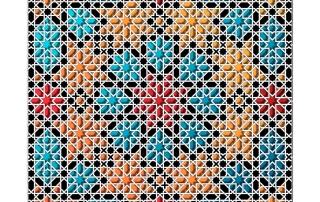
There is an invisible harmony that connects the centuries, a web of light that José Cabrera Lozano has unveiled in this masterly interpretation. In 'Symphony of Stars', the pattern from the Maiden’s Courtyard ceases to be an architectural fragment and becomes a window into the infinite. The white latticework, pure and mathematical, intertwines over a background where the cyan of the Andalusian sky and the solar tones of ochre and red vibrate with renewed energy. It is not just geometry; it is the echo of a civilization that sought beauty in the perfection of order. Each star is a note in a visual composition that invites calm, reminding us that art, even in its most abstract and digital form, can capture the soul of a place as sacred as the Royal Alcázar of Seville. From a technical standpoint, the work 'Symphony of Stars' stands out for the complexity of its network of eight-pointed stars. The artist uses a digital shadow technique ('drop shadow') that raises the network of white lines above the colored background, creating a three-dimensionality that emulates the depth of ancient plasterwork. The choice of medium is key: 310 gsm Fine Art Hahnemühle William Turner paper. This 100% cotton, museum-quality support (ISO 9706) has a unique grainy texture that breaks the pixel's coolness. The absence of optical brighteners ensures that colors maintain their fidelity for decades, while the depth of the blacks provides the perfect contrast for the cyan and earth tones to glow with almost organic intensity. Ambient Suggestions To enhance the work's relief effect, a 'floating frame' in natural wood or matte black lacquer is recommended. It is an ideal piece for high-ceilinged living rooms, contemporary design offices, or reception spaces in luxury hotels. Its complex yet balanced design makes it an immediate conversation piece, projecting an image of sophistication, culture, and respect for historical legacy.
Symphony of Stars (Original)
There is an invisible harmony that connects the centuries, a web of light that José Cabrera Lozano has unveiled in this masterly interpretation. In 'Symphony of Stars', the pattern from the Maiden’s Courtyard ceases to be an architectural fragment and becomes a window into the infinite. The white latticework, pure and mathematical, intertwines over a background where the cyan of the Andalusian sky and the solar tones of ochre and red vibrate with renewed energy. It is not just geometry; it is the echo of a civilization that sought beauty in the perfection of order. Each star is a note in a visual composition that invites calm, reminding us that art, even in its most abstract and digital form, can capture the soul of a place as sacred as the Royal Alcázar of Seville. From a technical standpoint, the work 'Symphony of Stars' stands out for the complexity of its network of eight-pointed stars. The artist uses a digital shadow technique ('drop shadow') that raises the network of white lines above the colored background, creating a three-dimensionality that emulates the depth of ancient plasterwork. The choice of medium is key: 310 gsm Fine Art Hahnemühle William Turner paper. This 100% cotton, museum-quality support (ISO 9706) has a unique grainy texture that breaks the pixel's coolness. The absence of optical brighteners ensures that colors maintain their fidelity for decades, while the depth of the blacks provides the perfect contrast for the cyan and earth tones to glow with almost organic intensity. Ambient Suggestions To enhance the work's relief effect, a 'floating frame' in natural wood or matte black lacquer is recommended. It is an ideal piece for high-ceilinged living rooms, contemporary design offices, or reception spaces in luxury hotels. Its complex yet balanced design makes it an immediate conversation piece, projecting an image of sophistication, culture, and respect for historical legacy.
The Crucible of Maidens
This work is a threshold that transports us to the heart of the Real Alcázar of Seville, specifically to the mathematical serenity of the Patio de las Doncellas. José Cabrera Lozano does not merely reproduce a pattern; he captures the breath of a civilization that understood geometry as the language of the divine. The Crucible of the Maidens is a dance of light and shadow where the blue of the Andalusian sky and the ochre of the earth intertwine in perfect harmony. The deep black of the backgrounds is not a void, but the necessary silence for the symphony of eight-pointed stars to manifest. Each line, each intersection, is a reminder of the interconnectivity of the universe. In this piece, time stands still; the Mudejar heritage detaches itself from the stone walls to take on a new digital life, vibrant and eternal. It is an invitation to visual meditation, a reminder that within the most complex order lies the purest beauty.
The Crucible of Maidens (Aluminium)
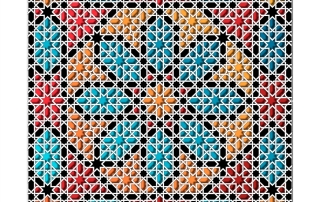
This work is a threshold that transports us to the heart of the Real Alcázar of Seville, specifically to the mathematical serenity of the Patio de las Doncellas. José Cabrera Lozano does not merely reproduce a pattern; he captures the breath of a civilization that understood geometry as the language of the divine. The Crucible of the Maidens is a dance of light and shadow where the blue of the Andalusian sky and the ochre of the earth intertwine in perfect harmony. The deep black of the backgrounds is not a void, but the necessary silence for the symphony of eight-pointed stars to manifest. Each line, each intersection, is a reminder of the interconnectivity of the universe. In this piece, time stands still; the Mudejar heritage detaches itself from the stone walls to take on a new digital life, vibrant and eternal. It is an invitation to visual meditation, a reminder that within the most complex order lies the purest beauty. From a technical point of view, the work stands out for its structural complexity based on fractal geometry and radial symmetry. The pattern is based on the 'lazo de ocho' (eight-fold knot), one of the most sophisticated forms of Islamic tracery, executed with a vector precision that would be impossible to achieve without contemporary tools. The color palette uses saturated colors to generate high contrast: cyan, carmine, and gold, which interact with a network of white lines (interlacing) that apply a visual relief effect, creating an illusory three-dimensionality. The print on Hahnemühle William Turner paper (310 gsm) is fundamental to the work. This museum-quality cotton paper has a felt-like texture that absorbs ink in a unique way, giving the blacks a velvety depth and the colors an organic vibration that emulates artisanal ceramics. The absence of optical brighteners ensures that the work maintains its integrity for centuries, complying with the ISO 9706 standard. Ambient Suggestions Given the chromatic richness and depth of the work, minimalist framing in dark wood or matte black with museum glass (anti-reflective and UV protection) is recommended. Ideal spaces:
- Luxury Yacht Salons: Complements fine wood finishes and marble.
- Boutique Hotel Lobbies: As a centerpiece evoking history and modernity.
- High-Level Corporate Offices: Provides an air of order, precision, and cultural sophistication.
The Crucible of Maidens (Original)
This work is a threshold that transports us to the heart of the Real Alcázar of Seville, specifically to the mathematical serenity of the Patio de las Doncellas. José Cabrera Lozano does not merely reproduce a pattern; he captures the breath of a civilization that understood geometry as the language of the divine. The Crucible of the Maidens is a dance of light and shadow where the blue of the Andalusian sky and the ochre of the earth intertwine in perfect harmony. The deep black of the backgrounds is not a void, but the necessary silence for the symphony of eight-pointed stars to manifest. Each line, each intersection, is a reminder of the interconnectivity of the universe. In this piece, time stands still; the Mudejar heritage detaches itself from the stone walls to take on a new digital life, vibrant and eternal. It is an invitation to visual meditation, a reminder that within the most complex order lies the purest beauty. From a technical point of view, the work stands out for its structural complexity based on fractal geometry and radial symmetry. The pattern is based on the 'lazo de ocho' (eight-fold knot), one of the most sophisticated forms of Islamic tracery, executed with a vector precision that would be impossible to achieve without contemporary tools. The color palette uses saturated colors to generate high contrast: cyan, carmine, and gold, which interact with a network of white lines (interlacing) that apply a visual relief effect, creating an illusory three-dimensionality. The print on Hahnemühle William Turner paper (310 gsm) is fundamental to the work. This museum-quality cotton paper has a felt-like texture that absorbs ink in a unique way, giving the blacks a velvety depth and the colors an organic vibration that emulates artisanal ceramics. The absence of optical brighteners ensures that the work maintains its integrity for centuries, complying with the ISO 9706 standard. Ambient Suggestions Given the chromatic richness and depth of the work, minimalist framing in dark wood or matte black with museum glass (anti-reflective and UV protection) is recommended. Ideal spaces:
- Luxury Yacht Salons: Complements fine wood finishes and marble.
- Boutique Hotel Lobbies: As a centerpiece evoking history and modernity.
- High-Level Corporate Offices: Provides an air of order, precision, and cultural sophistication.
The Garden of Stars
Contemplating this artwork transcends mere visual observation; it is an act of immersion into the architectural memory of Al-Andalus, encoded through the contemporary lens of JC Geometric Patterns. In 'Stars of Al-Andalus', the echoes of the legendary Maiden's Courtyard in the Royal Alcázar of Seville are presented not as a static relic, but as a pulsating entity. The infinite, immaculate white threads weave a network of stars that capture the duality of the universe: the earthly and the divine. The vibrant cyan acts as a visual sigh of the flowing water that gives life to Andalusian gardens, a liquid freshness that masterfully contrasts with the warmth of red and ochre, reminiscent of the southern sun striking the historical brick, plaster, and tile. Every geometric intersection is a syllable in a visual poem speaking of cosmic order. The carefully curated color palette, enhanced by digitally cast shadows, endows the composition with a hypnotic three-dimensionality. It is a meditation on time, where Islamic sacred geometry reveals itself as a universal and imperishable language. The artwork invites the viewer to lose themselves in its labyrinths of light and shadow, finding in its symmetrical repetition a space for inner silence and spiritual reflection.
The Garden of Stars (Aluminium)
This work is not merely a geometric representation; it is a whisper of history emanating from the walls of the Royal Alcázar of Seville. In 'The Garden of the Stars', José Cabrera Lozano captures the essence of the Maiden’s Courtyard, transforming stone and tile into a contemporary dance of light. The white lines intertwine like paths of light against a jet-black firmament, guiding the viewer through a labyrinth where order and beauty are infinite. The electric cyan recalls the freshness of the water channels, while vibrant reds and oranges evoke the setting sun that sets the palace walls ablaze. It is a piece that invites stillness, a reflection of the mathematical perfection that ancient masters considered a path to the divine, now revitalized by the precision of digital art. Technically, the work stands out for the flawless execution of the interlacing based on the original pattern. The composition uses a complex network of stars that generate an almost architectural visual depth. The strategic use of drop shadows under the white bands gives the piece a relief effect reminiscent of Andalusian plasterwork, creating a hypnotic three-dimensionality. The realization on 310 gsm Fine Art Hahnemühle William Turner paper is essential. Its organic and grainy texture, characteristic of 100% cotton paper, provides a tactile warmth that humanizes digital precision. The medium’s ability to absorb pigment allows the blacks to reach an abyssal depth, serving as the perfect contrast for the primary and secondary colors to shine with extraordinary and lasting saturation. Ambient Suggestions Given the chromatic richness and depth of the work, minimalist framing in dark wood or matte black with museum glass (anti-reflective and UV protection) is recommended. Ideal spaces:
- Luxury Yacht Salons: Complements fine wood finishes and marble.
- Boutique Hotel Lobbies: As a centerpiece evoking history and modernity.
- High-Level Corporate Offices: Provides an air of order, precision, and cultural sophistication.
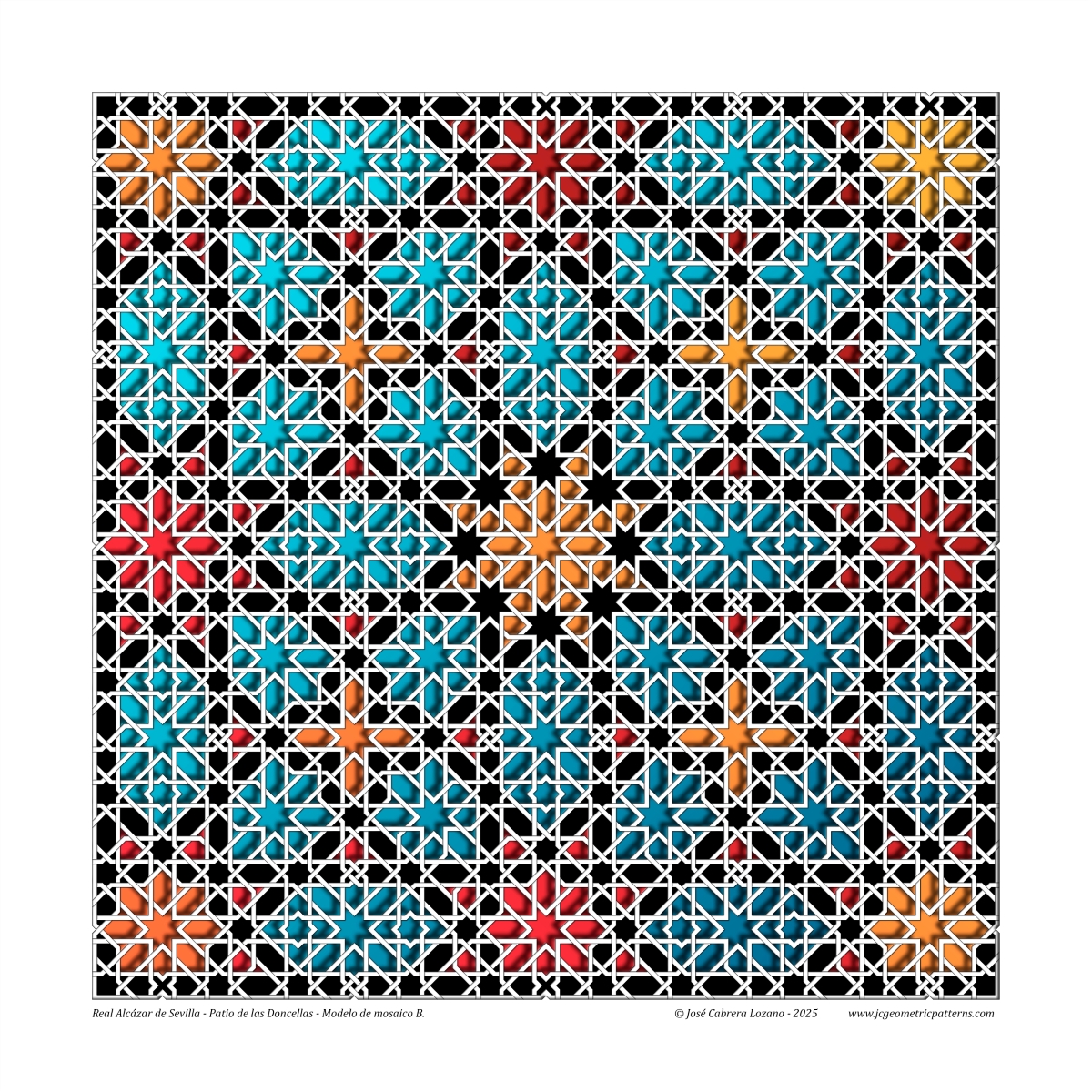
Contemplating this artwork transcends mere visual observation; it is an act of immersion into the architectural memory of Al-Andalus, encoded through the contemporary lens of JC Geometric Patterns. In 'Stars of Al-Andalus', the echoes of the legendary Maiden's Courtyard in the Royal Alcázar of Seville are presented not as a static relic, but as a pulsating entity. The infinite, immaculate white threads weave a network of stars that capture the duality of the universe: the earthly and the divine. The vibrant cyan acts as a visual sigh of the flowing water that gives life to Andalusian gardens, a liquid freshness that masterfully contrasts with the warmth of red and ochre, reminiscent of the southern sun striking the historical brick, plaster, and tile. Every geometric intersection is a syllable in a visual poem speaking of cosmic order. The carefully curated color palette, enhanced by digitally cast shadows, endows the composition with a hypnotic three-dimensionality. It is a meditation on time, where Islamic sacred geometry reveals itself as a universal and imperishable language. The artwork invites the viewer to lose themselves in its labyrinths of light and shadow, finding in its symmetrical repetition a space for inner silence and spiritual reflection. From a technical and compositional perspective, this piece represents a milestone in the execution of complex patterns through digital media. The structure is based on a network of primary eight-pointed stars, creating a perfect tessellation that leaves no empty spaces. The artist has applied a 'drop shadow' treatment beneath the main white latticework. This technical resource is not merely aesthetic; it separates the interlaced bands from the polychrome background, generating an effect of sculptural relief that emulates traditional plaster or wood carving. The choice of physical medium is crucial. Printed on 310 gsm Fine Art Hahnemühle William Turner paper, the artwork acquires an unsurpassable tactile dimension. This 100% cotton paper, white and free of optical brighteners, features a matte surface that is both pronounced and subtle. This organic characteristic brings a visual three-dimensionality that counteracts the precision of the digital medium. Furthermore, it is fundamental for the absorption of dark pigments: the blacks acquire a velvety, abyssal depth against which the colors vibrate with extraordinary saturation. Ambient Suggestions To enhance the three-dimensional nature of the design and the rich texture of the Hahnemühle paper, a 'floating frame' in matte black stained ash or dark walnut is highly recommended. It is advisable to omit the glass if the environment allows, to fully appreciate the texture. In terms of interior design, this piece serves as a high-impact focal point. It is exceptionally well-suited for corporate collections in executive offices, boardrooms, and luxury hotel lobbies. Its aesthetic also makes it ideal for luxury yachts or minimalist residences aiming to project sophistication and a profound cultural legacy.
Contemplating this artwork transcends mere visual observation; it is an act of immersion into the architectural memory of Al-Andalus, encoded through the contemporary lens of JC Geometric Patterns. In 'Stars of Al-Andalus', the echoes of the legendary Maiden's Courtyard in the Royal Alcázar of Seville are presented not as a static relic, but as a pulsating entity. The infinite, immaculate white threads weave a network of stars that capture the duality of the universe: the earthly and the divine. The vibrant cyan acts as a visual sigh of the flowing water that gives life to Andalusian gardens, a liquid freshness that masterfully contrasts with the warmth of red and ochre, reminiscent of the southern sun striking the historical brick, plaster, and tile. Every geometric intersection is a syllable in a visual poem speaking of cosmic order. The carefully curated color palette, enhanced by digitally cast shadows, endows the composition with a hypnotic three-dimensionality. It is a meditation on time, where Islamic sacred geometry reveals itself as a universal and imperishable language. The artwork invites the viewer to lose themselves in its labyrinths of light and shadow, finding in its symmetrical repetition a space for inner silence and spiritual reflection. From a technical and compositional perspective, this piece represents a milestone in the execution of complex patterns through digital media. The structure is based on a network of primary eight-pointed stars, creating a perfect tessellation that leaves no empty spaces. The artist has applied a 'drop shadow' treatment beneath the main white latticework. This technical resource is not merely aesthetic; it separates the interlaced bands from the polychrome background, generating an effect of sculptural relief that emulates traditional plaster or wood carving. The choice of physical medium is crucial. Printed on 310 gsm Fine Art Hahnemühle William Turner paper, the artwork acquires an unsurpassable tactile dimension. This 100% cotton paper, white and free of optical brighteners, features a matte surface that is both pronounced and subtle. This organic characteristic brings a visual three-dimensionality that counteracts the precision of the digital medium. Furthermore, it is fundamental for the absorption of dark pigments: the blacks acquire a velvety, abyssal depth against which the colors vibrate with extraordinary saturation. Ambient Suggestions To enhance the three-dimensional nature of the design and the rich texture of the Hahnemühle paper, a 'floating frame' in matte black stained ash or dark walnut is highly recommended. It is advisable to omit the glass if the environment allows, to fully appreciate the texture. In terms of interior design, this piece serves as a high-impact focal point. It is exceptionally well-suited for corporate collections in executive offices, boardrooms, and luxury hotel lobbies. Its aesthetic also makes it ideal for luxury yachts or minimalist residences aiming to project sophistication and a profound cultural legacy.
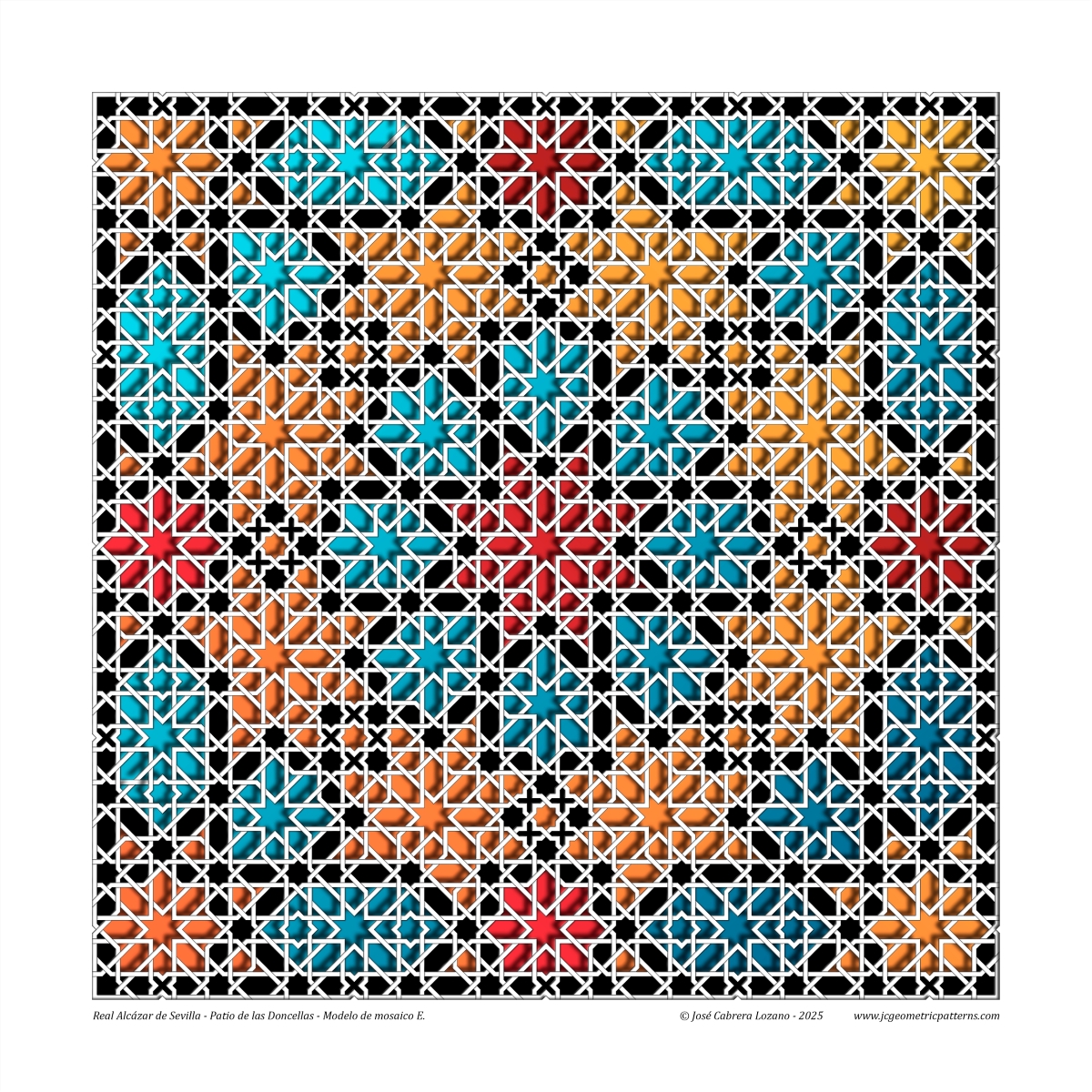
There is an invisible harmony that connects the centuries, a web of light that José Cabrera Lozano has unveiled in this masterly interpretation. In 'Symphony of Stars', the pattern from the Maiden’s Courtyard ceases to be an architectural fragment and becomes a window into the infinite. The white latticework, pure and mathematical, intertwines over a background where the cyan of the Andalusian sky and the solar tones of ochre and red vibrate with renewed energy. It is not just geometry; it is the echo of a civilization that sought beauty in the perfection of order. Each star is a note in a visual composition that invites calm, reminding us that art, even in its most abstract and digital form, can capture the soul of a place as sacred as the Royal Alcázar of Seville.
There is an invisible harmony that connects the centuries, a web of light that José Cabrera Lozano has unveiled in this masterly interpretation. In 'Symphony of Stars', the pattern from the Maiden’s Courtyard ceases to be an architectural fragment and becomes a window into the infinite. The white latticework, pure and mathematical, intertwines over a background where the cyan of the Andalusian sky and the solar tones of ochre and red vibrate with renewed energy. It is not just geometry; it is the echo of a civilization that sought beauty in the perfection of order. Each star is a note in a visual composition that invites calm, reminding us that art, even in its most abstract and digital form, can capture the soul of a place as sacred as the Royal Alcázar of Seville. From a technical standpoint, the work 'Symphony of Stars' stands out for the complexity of its network of eight-pointed stars. The artist uses a digital shadow technique ('drop shadow') that raises the network of white lines above the colored background, creating a three-dimensionality that emulates the depth of ancient plasterwork. The choice of medium is key: 310 gsm Fine Art Hahnemühle William Turner paper. This 100% cotton, museum-quality support (ISO 9706) has a unique grainy texture that breaks the pixel's coolness. The absence of optical brighteners ensures that colors maintain their fidelity for decades, while the depth of the blacks provides the perfect contrast for the cyan and earth tones to glow with almost organic intensity. Ambient Suggestions To enhance the work's relief effect, a 'floating frame' in natural wood or matte black lacquer is recommended. It is an ideal piece for high-ceilinged living rooms, contemporary design offices, or reception spaces in luxury hotels. Its complex yet balanced design makes it an immediate conversation piece, projecting an image of sophistication, culture, and respect for historical legacy.
There is an invisible harmony that connects the centuries, a web of light that José Cabrera Lozano has unveiled in this masterly interpretation. In 'Symphony of Stars', the pattern from the Maiden’s Courtyard ceases to be an architectural fragment and becomes a window into the infinite. The white latticework, pure and mathematical, intertwines over a background where the cyan of the Andalusian sky and the solar tones of ochre and red vibrate with renewed energy. It is not just geometry; it is the echo of a civilization that sought beauty in the perfection of order. Each star is a note in a visual composition that invites calm, reminding us that art, even in its most abstract and digital form, can capture the soul of a place as sacred as the Royal Alcázar of Seville. From a technical standpoint, the work 'Symphony of Stars' stands out for the complexity of its network of eight-pointed stars. The artist uses a digital shadow technique ('drop shadow') that raises the network of white lines above the colored background, creating a three-dimensionality that emulates the depth of ancient plasterwork. The choice of medium is key: 310 gsm Fine Art Hahnemühle William Turner paper. This 100% cotton, museum-quality support (ISO 9706) has a unique grainy texture that breaks the pixel's coolness. The absence of optical brighteners ensures that colors maintain their fidelity for decades, while the depth of the blacks provides the perfect contrast for the cyan and earth tones to glow with almost organic intensity. Ambient Suggestions To enhance the work's relief effect, a 'floating frame' in natural wood or matte black lacquer is recommended. It is an ideal piece for high-ceilinged living rooms, contemporary design offices, or reception spaces in luxury hotels. Its complex yet balanced design makes it an immediate conversation piece, projecting an image of sophistication, culture, and respect for historical legacy.
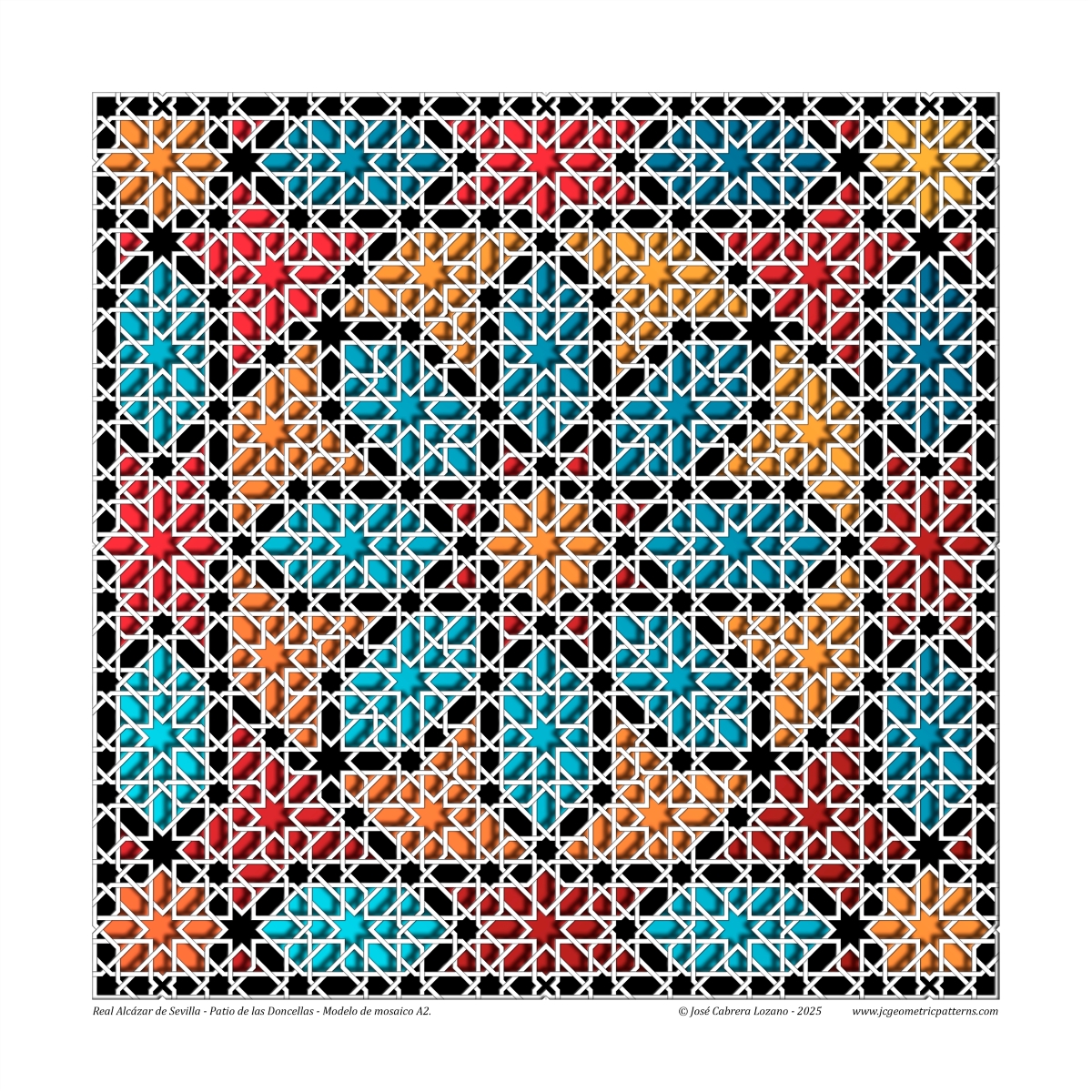
This work is a threshold that transports us to the heart of the Real Alcázar of Seville, specifically to the mathematical serenity of the Patio de las Doncellas. José Cabrera Lozano does not merely reproduce a pattern; he captures the breath of a civilization that understood geometry as the language of the divine. The Crucible of the Maidens is a dance of light and shadow where the blue of the Andalusian sky and the ochre of the earth intertwine in perfect harmony. The deep black of the backgrounds is not a void, but the necessary silence for the symphony of eight-pointed stars to manifest. Each line, each intersection, is a reminder of the interconnectivity of the universe. In this piece, time stands still; the Mudejar heritage detaches itself from the stone walls to take on a new digital life, vibrant and eternal. It is an invitation to visual meditation, a reminder that within the most complex order lies the purest beauty.
This work is a threshold that transports us to the heart of the Real Alcázar of Seville, specifically to the mathematical serenity of the Patio de las Doncellas. José Cabrera Lozano does not merely reproduce a pattern; he captures the breath of a civilization that understood geometry as the language of the divine. The Crucible of the Maidens is a dance of light and shadow where the blue of the Andalusian sky and the ochre of the earth intertwine in perfect harmony. The deep black of the backgrounds is not a void, but the necessary silence for the symphony of eight-pointed stars to manifest. Each line, each intersection, is a reminder of the interconnectivity of the universe. In this piece, time stands still; the Mudejar heritage detaches itself from the stone walls to take on a new digital life, vibrant and eternal. It is an invitation to visual meditation, a reminder that within the most complex order lies the purest beauty. From a technical point of view, the work stands out for its structural complexity based on fractal geometry and radial symmetry. The pattern is based on the 'lazo de ocho' (eight-fold knot), one of the most sophisticated forms of Islamic tracery, executed with a vector precision that would be impossible to achieve without contemporary tools. The color palette uses saturated colors to generate high contrast: cyan, carmine, and gold, which interact with a network of white lines (interlacing) that apply a visual relief effect, creating an illusory three-dimensionality. The print on Hahnemühle William Turner paper (310 gsm) is fundamental to the work. This museum-quality cotton paper has a felt-like texture that absorbs ink in a unique way, giving the blacks a velvety depth and the colors an organic vibration that emulates artisanal ceramics. The absence of optical brighteners ensures that the work maintains its integrity for centuries, complying with the ISO 9706 standard. Ambient Suggestions Given the chromatic richness and depth of the work, minimalist framing in dark wood or matte black with museum glass (anti-reflective and UV protection) is recommended. Ideal spaces:
- Luxury Yacht Salons: Complements fine wood finishes and marble.
- Boutique Hotel Lobbies: As a centerpiece evoking history and modernity.
- High-Level Corporate Offices: Provides an air of order, precision, and cultural sophistication.
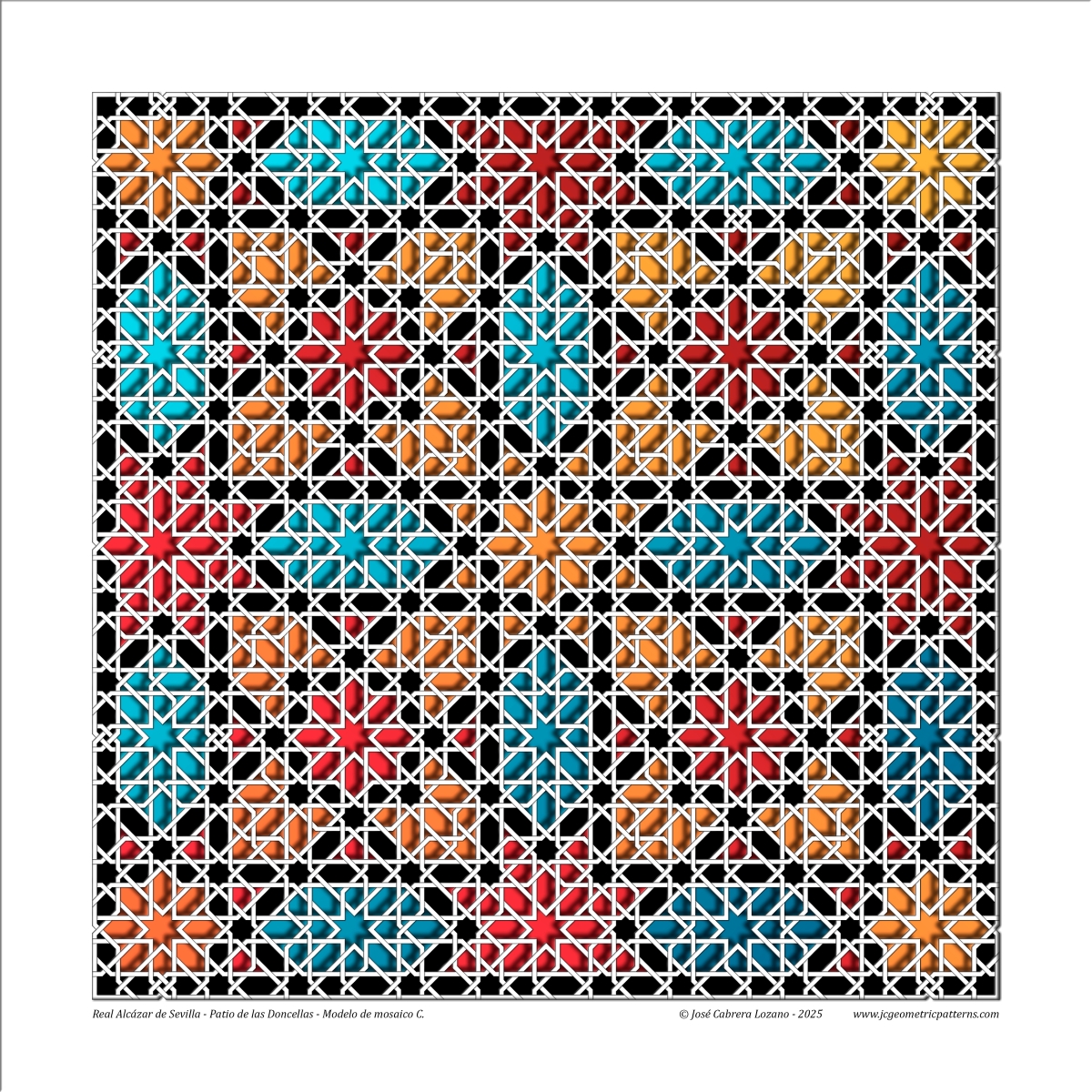
Contemplating this artwork transcends mere visual observation; it is an act of immersion into the architectural memory of Al-Andalus, encoded through the contemporary lens of JC Geometric Patterns. In 'Stars of Al-Andalus', the echoes of the legendary Maiden's Courtyard in the Royal Alcázar of Seville are presented not as a static relic, but as a pulsating entity. The infinite, immaculate white threads weave a network of stars that capture the duality of the universe: the earthly and the divine. The vibrant cyan acts as a visual sigh of the flowing water that gives life to Andalusian gardens, a liquid freshness that masterfully contrasts with the warmth of red and ochre, reminiscent of the southern sun striking the historical brick, plaster, and tile. Every geometric intersection is a syllable in a visual poem speaking of cosmic order. The carefully curated color palette, enhanced by digitally cast shadows, endows the composition with a hypnotic three-dimensionality. It is a meditation on time, where Islamic sacred geometry reveals itself as a universal and imperishable language. The artwork invites the viewer to lose themselves in its labyrinths of light and shadow, finding in its symmetrical repetition a space for inner silence and spiritual reflection.
This work is not merely a geometric representation; it is a whisper of history emanating from the walls of the Royal Alcázar of Seville. In 'The Garden of the Stars', José Cabrera Lozano captures the essence of the Maiden’s Courtyard, transforming stone and tile into a contemporary dance of light. The white lines intertwine like paths of light against a jet-black firmament, guiding the viewer through a labyrinth where order and beauty are infinite. The electric cyan recalls the freshness of the water channels, while vibrant reds and oranges evoke the setting sun that sets the palace walls ablaze. It is a piece that invites stillness, a reflection of the mathematical perfection that ancient masters considered a path to the divine, now revitalized by the precision of digital art. Technically, the work stands out for the flawless execution of the interlacing based on the original pattern. The composition uses a complex network of stars that generate an almost architectural visual depth. The strategic use of drop shadows under the white bands gives the piece a relief effect reminiscent of Andalusian plasterwork, creating a hypnotic three-dimensionality. The realization on 310 gsm Fine Art Hahnemühle William Turner paper is essential. Its organic and grainy texture, characteristic of 100% cotton paper, provides a tactile warmth that humanizes digital precision. The medium’s ability to absorb pigment allows the blacks to reach an abyssal depth, serving as the perfect contrast for the primary and secondary colors to shine with extraordinary and lasting saturation. Ambient Suggestions Given the chromatic richness and depth of the work, minimalist framing in dark wood or matte black with museum glass (anti-reflective and UV protection) is recommended. Ideal spaces:
- Luxury Yacht Salons: Complements fine wood finishes and marble.
- Boutique Hotel Lobbies: As a centerpiece evoking history and modernity.
- High-Level Corporate Offices: Provides an air of order, precision, and cultural sophistication.