

The Echo of Comares: The Labyrinth of Light (Original)
In 'The Labyrinth of Light', José Cabrera Lozano immerses us in a mathematical dance of divine proportions. This work does not merely emulate the decorative art of the Alhambra but decomposes and reconstructs it under a contemporary light. The viewer faces a crossroads of white ribbons that, like Ariadne's threads, guide us through a vibrant space of color and shadow. The centrality of the composition, marked by a cruciform structure emerging from the star pattern, suggests a meeting point between the human and the divine. The warm tones of orange and ochre evoke the sunset over the alcazaba walls, while flashes of turquoise and magenta bring a freshness that breaks geometric rigidity. It is a work that speaks of patience, order, and the beauty that arises when logic and creativity are seamlessly intertwined. Each intersection is a reminder of the interconnection of all things, a visual representation of the universal harmony that Cabrera Lozano has successfully distilled into an image of absolute purity. Technically, this piece is a marvel of vector illustration and digital light processing. The pattern is based on an eight-pointed star grid, but with a particular emphasis on the development of the central ribbon, whose three-dimensionality is achieved through mathematically precise drop shadows. This relief effect is what separates the work from a simple flat illustration, turning it into a multi-layered visual object. The choice of Hahnemühle William Turner (310 gsm) paper is critical to the work's success. Its heavily textured, matte surface absorbs light so that digital shadows appear natural, as if carved into real plasterwork. The density of pigments on 100% cotton allows the contrast between the white ribbons and dark backgrounds to be sharp and deep, guaranteeing a longevity exceeding a century. The work is presented as a piece of aesthetic engineering, where software yields to the mastery of traditional design. Ambient Suggestions Due to its strong central structure and warm palette, this artwork is ideal for:
- Executive boardrooms (projecting order and a structured vision).
- Modern Mediterranean-style private residences.
- Luxury spas and wellness centers (for its meditative effect).
The Echo of Comares: The Mirror of the Eternity (Original)
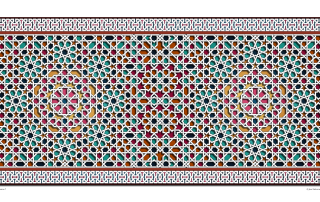
To contemplate 'The Mirror of Eternity' is to embark on a meditative journey into the heart of Nasrid cosmology, a space where visual beauty acts as a bridge to the ineffable. Inspired by the legendary panels of the Alhambra's Comares Hall, this artwork transcends mere ornamentation to stand as a portal of profound spiritual resonance. Through a horizontal layout that evokes the infinite, the composition reveals a duplicated cosmos, governed by two majestic twelve-pointed stars operating as radiant suns of vital energy. These central figures are not static; they beat rhythmically, expanding their influence through an intricate network of uninterrupted lacework. In Islamic philosophy, this continuity without beginning or end symbolizes the eternal journey of the soul and the indissoluble interconnection of all facets of creation under an unalterable divine order. The chromatic palette is a poetic tribute to the elemental forces of the Andalusian universe. Deep cobalt blues and turquoises immerse us in the contemplation of crystalline waters and the celestial vault, suggesting purification and protection. Meanwhile, crimson reds and golden ochre tones anchor the vision to fertile earth and regal splendor, blending the earthly with the heavenly. The duplicated arrangement of the elements creates a harmonic echo, a silent dialogue that invites the viewer to find their own inner balance. 'The Mirror of Eternity' is essentially a crystallized mantra in sacred geometry; a contained breath that pacifies the mind, elevates the spirit, and transforms any environment into a true sanctuary of order, symmetry, and timeless contemplation. From an analytical and compositional perspective, 'The Mirror of Eternity' constitutes a superlative feat of geometric design and translational symmetry. The visual architecture of the piece is based on a rigorous modular grid of octogons and eight-pointed stars, masterfully intertwined to cover an extensive landscape surface without sacrificing structural coherence. The use of cutting-edge digital tools allows for the millimeter-precise articulation of the white interlacing lines. These trajectories, which in traditional analog methods would be subject to the inevitable imperfections of the compass and ruler, achieve absolute mathematical perfection here. The intersection angles are resolved with surgical cleanliness, ensuring that the viewer's visual flow navigates the geometric labyrinth without encountering obstacles or dissonances, achieving unparalleled perceptual fluidity. The physical vehicle supporting this geometric manifestation is of critical importance for its correct sensory decoding. Printing on the prestigious Fine Art Hahnemühle William Turner 310 gsm paper elevates the artwork to the category of a two-dimensional sculpture. Its 100% cotton composition and, above all, its markedly pronounced matte texture, generate a subtle yet undeniable bas-relief effect. The white bands seem to physically emerge above the colored planes, interacting with ambient light to cast micro-shadows that emphasize the three-dimensionality of the whole. Lacking optical brighteners, this substrate absorbs the darkest pigments with a cavernous and velvety depth, ensuring no parasitic reflections occur and maintaining the integrity of the vibrant Nasrid palette with museum archival quality. Ambient Suggestions This work is a statement of aesthetic principles. We recommend its installation in:
- Presidential suites of luxury hotels (as a focal point above the headboard or sitting area).
- Main halls of contemporary villas with double-height ceilings.
- High-level diplomatic or consulting offices.

The Echo of Comares: The Prism of Unity (Original)
In 'The Prism of Unity,' José Cabrera Lozano presents the culmination of his study of the Hall of Comares. This work serves as a visual metaphor for creation: a core of turquoise clarity—symbol of purity and water—from which an unfathomable network of geometric connections emanates. The viewer is not standing before a static design, but an energy flow captured in time. The warm tones—intense magentas and copper oranges—that flank the center seem to represent the warmth of thought and the architectural passion of the Granadian artisans. The work invites slow, almost hypnotic observation, where the eye discovers there are no hierarchies, but a democracy of lines where every knot is essential for the balance of the whole. It is a piece that transcends the decorative to become a tool for contemplation. Formally, 'The Prism of Unity' features the highest interlacing density of the series. Cabrera Lozano employs a highly complex star-grid geometry where the immaculate white ribbon stands out against a background of bold chromatic contrasts. The use of deep digital shadows gives the piece an almost architectural character, simulating the relief of original plasterwork under zenithal light. The Hahnemühle William Turner (310 gsm) paper support is decisive for the aesthetic experience of this work. Its coarse grain and 100% cotton nature allow for ink absorption that eliminates unwanted reflections, providing the magentas and turquoises with organic saturation. Being acid and whitener-free, the work becomes a heritage investment, designed to last for centuries without losing its original vibration. The precision of the digital stroke, combined with the handcrafted texture of the paper, creates a tension between the technological and the human. Ambient Suggestions This work is a statement of aesthetic principles. We recommend its installation in:
- Presidential suites of luxury hotels (as a focal point above the headboard or sitting area).
- Main halls of contemporary villas with double-height ceilings.
- High-level diplomatic or consulting offices.

The Echo of Comares: The Sun of Thought (Original)
In 'The Sun of Thought,' José Cabrera Lozano reveals the radiant heart of the Hall of Comares. This work is distinguished by a golden core that acts as a metaphysical sun, from which the complexity of the ordered universe unfolds. It is a representation of the 'mishkat' or the niche of light, a spiritual concept where divine light is refracted into geometric shapes to become comprehensible to the human eye. The gaze is magnetically drawn toward the amber center, then navigates the intricate paths of turquoise and carmine surrounding it. Every white line that crosses and rises is a testament to mathematical perfection, an echo of the prayers carved in stone at the Alhambra. This piece invites serenity; it is a visual refuge where the viewer can find balance. It is not just a pattern; it is a narrative about the unity of being and the multiplicity of existence, captured with a digital sharpness that honors tradition while embracing advanced technology. Technically, ‘The Sun of Thought' is a study of chromatic contrast and geometric hierarchy. The center is organized into an eight-pointed star radiating yellow and orange tones, creating a light focus that organizes the entire composition. The interlacing of white ribbons uses an algorithmic shading system that produces a sense of tactile relief, emulating the depth of handcrafted carving. The excellence of Hahnemühle William Turner 310 gsm paper is fundamental here. The matte and pronounced texture of the paper absorbs light such that the golden colors seem to emit their own glow, while the dark backgrounds acquire an abyssal depth. Being 100% cotton and free of optical brighteners, it guarantees that Cabrera Lozano's designed palette remains unalterable for generations. This work, especially in its 100 cm format as a unique piece, stands at the peak of contemporary digital art, offering a sensory experience that blends vector precision with handcrafted warmth. Ambient Suggestions This artwork is ideal for spaces that seek to convey wisdom and order:
- Private libraries or luxury study rooms.
- Executive offices that value strategy and balance.
- Boutique hotels seeking a connection with the Mediterranean heritage.

The Garden of the Stars (Original)
This work is not merely a geometric representation; it is a whisper of history emanating from the walls of the Royal Alcázar of Seville. In 'The Garden of the Stars', José Cabrera Lozano captures the essence of the Maiden’s Courtyard, transforming stone and tile into a contemporary dance of light. The white lines intertwine like paths of light against a jet-black firmament, guiding the viewer through a labyrinth where order and beauty are infinite. The electric cyan recalls the freshness of the water channels, while vibrant reds and oranges evoke the setting sun that sets the palace walls ablaze. It is a piece that invites stillness, a reflection of the mathematical perfection that ancient masters considered a path to the divine, now revitalized by the precision of digital art. Technically, the work stands out for the flawless execution of the interlacing based on the original pattern. The composition uses a complex network of stars that generate an almost architectural visual depth. The strategic use of drop shadows under the white bands gives the piece a relief effect reminiscent of Andalusian plasterwork, creating a hypnotic three-dimensionality. The realization on 310 gsm Fine Art Hahnemühle William Turner paper is essential. Its organic and grainy texture, characteristic of 100% cotton paper, provides a tactile warmth that humanizes digital precision. The medium’s ability to absorb pigment allows the blacks to reach an abyssal depth, serving as the perfect contrast for the primary and secondary colors to shine with extraordinary and lasting saturation. Ambient Suggestions Given the chromatic richness and depth of the work, minimalist framing in dark wood or matte black with museum glass (anti-reflective and UV protection) is recommended. Ideal spaces:
- Luxury Yacht Salons: Complements fine wood finishes and marble.
- Boutique Hotel Lobbies: As a centerpiece evoking history and modernity.
- High-Level Corporate Offices: Provides an air of order, precision, and cultural sophistication.

The Geometry of Nasrid Splendor: The Golden Algorithm of the Barca (Original)
To enter 'The Geometry of Nasrid Splendor: The Golden Algorithm of the Barca' is to experience a chromatic and spiritual epiphany. This magnificent artwork by José Cabrera Lozano, under the acclaimed JC Geometric Patterns brand, reinterprets the historic dado of the Sala de la Barca in the Alhambra, distilling its essence and translating it into a contemporary digital language of sublime precision. In this specific color palette (Model 2), the composition ignites with a majestic vibration; the internal polygons are stained with a deep crimson and textured old gold—colors historically tied to royalty, divine dignity, and the zenith of Andalusian power. The interlacing ribbons, executed in a subtly warm ivory tone, weave an infinite net that captures and releases light simultaneously. Each eight-pointed star acts as a spiritual sun, a mystical node where the cosmic order and the human desire for transcendence converge. The artwork is not a mere archaeological depiction; it is a living organism breathing through its sacred symmetry, inducing a state of active meditation and intellectual wonder. Cabrera Lozano successfully ensures that the viewer does not simply look at history, but rather inhabits the timeless luxury of an eternal palace. Technically, the piece stands out for its structural complexity rooted in classical Islamic geometric modulation. The linear interlacing straps expand over an ivory-toned ribbon pattern framed by a fine dark outline, generating an accentuated visual relief through high-precision digital drop shadows. This three-dimensional effect contrasts vividly with the deep teal-blue background that unifies the composition. The starry polygons alternate rhythmically between intense crimson and a golden ochre featuring a subtle digital micro-gradient, mimicking the rich quality of glazed ceramic mosaics shifting under natural light. The materialization on Hahnemühle William Turner 310 gsm Fine Art paper is vital to enhancing the museum-grade status of the artwork. The heavy texture of this 100% cotton mould-made medium absorbs and scatters pigments optimally, providing an unmatched matte richness to the crimson fields and a velvet density to the dark shadows. Free of optical brighteners, the paper provides a natural warmth, ensuring excellent color permanence for centuries under the strictest art preservation standards. Ambient Suggestions This artwork radiates a warm, institutional opulence that demands environments of grand character and aristocratic refinement. It is uniquely suited for international law firm boardrooms, five-star hotel presidential suites, or formal dining salons on luxury superyachts. Its gold and crimson palette pairs exquisitely with dark wood paneling (such as rosewood or mahogany) and brushed bronze fixtures. Framing: A deep box frame crafted from dark wood with a subtle inner gold fillet is highly recommended. Utilizing a floating mount showcases the beautiful deckle edges of the Hahnemühle paper, sealed under anti-reflective museum glass.

The Heart of Order: Geometry in Suspension (Original)
In this piece, José Cabrera Lozano invites us to contemplate the precise moment when a mathematical idea materializes. 'The Heart of Order' is not just a representation of sacred geometry; it is an exploration of void and structure. By leaving the underlying construction grid exposed, the artist unveils the secrets of Nasrid design, allowing the viewer to participate in the genesis of form. Polychrome elements in royal garnet, cobalt blue, and pure white appear to levitate above the medium, creating a sense of suspension that defies gravity. The empty center of the composition acts as a focal point of serenity, a reminder that at the heart of all complexity lies a point of silence and absolute balance. Eight-pointed stars expand rhythmically toward the edges, guiding the gaze on a journey of technical and spiritual discovery. It is a work that celebrates the transparency of the creative process, turning technical drawing into a visual gem of timeless elegance. Owning this piece is owning the soul of design, a tribute to the perfection that rules both the cosmos and the art of Al-Andalus. From a technical standpoint, 'The Heart of Order' is an exercise in virtuosity regarding transparency and digital volume. The work is based on an 8-fold symmetry grid, where every intersection has been calculated with industrial rigor. What sets this piece apart is the integration of vectorial construction lines as an aesthetic part of the composition, providing a conceptual depth that emulates classical architectural treatises. The relief effect is achieved through carefully placed drop shadows and high-precision gradients, giving each polygon a physical three-dimensionality on the plane. The chosen support is 310 gsm Hahnemühle William Turner Fine Art paper. This museum-quality paper, made from 100% cotton, has a markedly textured matte surface that is essential for absorbing the density of the garnet and blue pigments. The paper's natural roughness interacts with the printed shadows, creating a real micro-dimensionality that complements the digital illusion. Durability is guaranteed under the ISO 9706 standard, ensuring that the sharpness of the technical lines and the chromatic richness remain unaltered for generations, consolidating Cabrera Lozano as a master of visual precision. Ambient Suggestions Given the transparency and technical nature of the artwork, a minimalist frame in brushed aluminum or natural maple wood is recommended. A deep mat will enhance the feeling that the geometry is floating in space. Ideal for design studios, architecture firms, or contemporary spaces seeking a clean, intellectual elegance.

The Heartbeat of Stone (Original)
There is a silent music in the repetition of form, a melody that José Cabrera Lozano has rescued from the walls of the Royal Alcázar to project it into the future. In 'The Heartbeat of Stone', the Maiden’s Courtyard is liberated from its historical weight to become an ethereal dance. The eight-pointed stars are not just figures; they are pulsations of a civilization that understood the cosmos as a perfect fabric. The deep cyan evokes the night sky over Seville, while the solar reds and yellows act as sparks of light that breathe life into the structure. Each white line is a path inviting us to rediscover universal harmony, merging the master craftsmanship of the past with the digital purity of the present. Technically, the work is a feat of algorithmic precision. Based on the complex interlacing, the composition uses a layering system that generates a three-dimensionality enhanced by digitally calculated drop shadows. This visual relief emulates the depth of the original plasterwork, allowing the latticework to appear as if floating over the polychrome background. The chosen medium is the 310 gsm Fine Art Hahnemühle William Turner paper. This 100% cotton paper not only guarantees museum-grade longevity (ISO 9706), but its textured surface absorbs light uniquely, granting the blacks a velvety depth that makes the cyan, red, and ochre colors vibrate with an almost organic intensity. The absence of optical brighteners ensures that the warmth of the work remains unchanged over decades. Ambient Suggestions Given the chromatic richness and depth of the work, minimalist framing in dark wood or matte black with museum glass (anti-reflective and UV protection) is recommended. Ideal spaces:
- Luxury Yacht Salons: Complements fine wood finishes and marble.
- Boutique Hotel Lobbies: As a centerpiece evoking history and modernity.
- High-Level Corporate Offices: Provides an air of order, precision, and cultural sophistication.

The Infinite Echo of the Mexuar: Lattices of Divine Transit (Original)
To contemplate 'The Infinite Echo of the Mexuar: Lattices of Divine Transit' is to step across a threshold where time is suspended and matter dissolves into pure mathematical vibration. Inspired by the majestic zócalo (dado) of the Sala de la Barca in Granada's Alhambra, this digital masterpiece by José Cabrera Lozano transcends mere historical reproduction to become a mystical bridge between the earthly plane and the infinitude of the cosmos. The interlacing pattern, born from the strict rigor of Islamic sacred geometry, traces an eternal dance of black and white ribbons that cross without beginning or end, embodying the Sufi concept of *Tawhid*—unity in multiplicity. The polygonal spaces are flooded with a superb color palette: deep teals evoke the Andalusian sky and the reflective waters of the courtyard, while the pink stars and warm golden-amber centerpieces act as skylights for the soul, drawing the gaze toward an inner illumination. Each intersection is a knot of consciousness; each repetition, a visual mantra inducing contemplation and serenity. The artist successfully captures the sacred atmosphere of the Nasrid palaces, where the air itself seems imbued with poetry and mysticism. This is not simple decorative design; it is a spiritual cartography that celebrates the perfect symmetry of the universe and the transit of the soul toward absolute beauty. From a technical standpoint, the artwork is built upon an intricate modular grid based on rotation and reflection symmetries, typical of monumental Nasrid art. The linear structure of the interlacing straps utilizes clean-edged black and white ribbons that generate a high-frequency contrast, enhancing the digital three-dimensionality through subtle drop shadows and gradients that add depth and volume to the two-dimensional plane. The interstitial spaces reveal a calculated chromatic organization: a dominant pattern of octagonal stars and geometric shapes in pale mint green and deep teal, harmoniously accented by a central axis of warm ochre-orange hues that subtly disrupts the repetition and guides the viewer's eye. The chosen medium, Hahnemühle William Turner 310 gsm Fine Art paper, is fundamental to the material experience of the art. Its mould-made, highly tactile yet refined texture absorbs pigments perfectly, achieving an extraordinary density in the blacks and optimal color fidelity. The absence of optical brighteners ensures a natural warmth and stability in the whites, while its 100% cotton composition endows the piece with exceptional archival aging resistance, ideal for institutional and private collectors. Ambient Suggestions This artwork possesses an undeniable architectural presence, making it perfect for spaces designed to reflect erudition, timeless luxury, and serenity. We highly recommend displaying it in:
- Main salons of Luxury Superyachts, where its teal and mint tones dialogue naturally with marine vistas.
- Lobbies of Ultra-Luxury Boutique Hotels or executive corporate boardrooms, offering a sophisticated intellectual focal point.

The Interlaced Cosmos of Mexuar: Lapis Lazuli Sky over Gold (Original)
This monumental work, 'Lapis Lazuli Sky over Gold: The Interlaced Cosmos of Mexuar', stands as a threshold for contemplation. José Cabrera Lozano not only reinterprets Nasrid lacería, but he endows it with a contemporary spiritual pulse. The white interlacing, like a river of living water, flows incessantly, reminding us that in sacred geometry, every line is a path and every intersection a destination. The composition presents two visions: one, a centralized radiant sun where unity (tawhid) is the focal point; the other, an infinite expansion where the complexity of the forms multiplies towards the unreachability of infinity. It is a dialogue between mathematical rigidity and mystical emotion, a choreography of forms that seem to breathe over an abyss of black velvet. The colors are palpable jewels: the blue of the sky, the turquoise of the water, the ochre of the earth, and the gold of the divine. The profound black is the primal void, the initial mystery that serves as a stage for this expanding cosmos to manifest. The work is an invitation to silence, a bridge connecting the Andalusian past with the digital present, reminding us that beauty is, above all, an act of faith. It is the Andalusian cosmos at its finest, a 'zenith of the Andalusian jewel'. From a technical perspective, the work is a masterful exploration of high-fidelity digital composition. The geometry is based on a complex system of Nasrid zillij, where the modules pivot between 8, and 16-point bases, organized on an underlying grid. The central variation focuses on a radiant 8-point star that governs the radial symmetry, while the expanding variation multiplies the quadrangular modules, showcasing the infinity of the pattern. The use of color is crucial. Cabrera Lozano employs texturing algorithms to emulate the mineral nature of stone and enameled ceramics, creating a subtle but perceptible three-dimensional relief. The white lacería, with a macro-relief, stands out against the absolute black. The choice of Fine Art Hahnemühle William Turner (310 gr/m2) paper is fundamental to this process. Its matte surface, with a pronounced mold-made texture, allows the black pigments to achieve absolute density, an 'infinite black' that serves as a primordial stage upon which the turquoise and ochre colors seem to float. This tactile and visual experience changes according to the ambient light, revealing hidden layers of depth. Ambient Suggestions Given its magnificent nature and cultural heritage, this piece is ideal for spaces of prestige and authority. It is the ideal choice for the main salon of a superyacht, where the geometric theme and deep blue connect with the marine environment. Similarly, in the lobby of a five-star hotel with historical roots, or in executive offices where technical sophistication must go hand-in-hand with a profound cultural narrative. Framing: A floating frame (shadow box) with a dark or matte charcoal wood molding is suggested to let the work breathe. It is crucial to use anti-reflective museum glass with UV protection to preserve the texture of the paper and the depth of the blacks.

In 'The Labyrinth of Light', José Cabrera Lozano immerses us in a mathematical dance of divine proportions. This work does not merely emulate the decorative art of the Alhambra but decomposes and reconstructs it under a contemporary light. The viewer faces a crossroads of white ribbons that, like Ariadne's threads, guide us through a vibrant space of color and shadow. The centrality of the composition, marked by a cruciform structure emerging from the star pattern, suggests a meeting point between the human and the divine. The warm tones of orange and ochre evoke the sunset over the alcazaba walls, while flashes of turquoise and magenta bring a freshness that breaks geometric rigidity. It is a work that speaks of patience, order, and the beauty that arises when logic and creativity are seamlessly intertwined. Each intersection is a reminder of the interconnection of all things, a visual representation of the universal harmony that Cabrera Lozano has successfully distilled into an image of absolute purity. Technically, this piece is a marvel of vector illustration and digital light processing. The pattern is based on an eight-pointed star grid, but with a particular emphasis on the development of the central ribbon, whose three-dimensionality is achieved through mathematically precise drop shadows. This relief effect is what separates the work from a simple flat illustration, turning it into a multi-layered visual object. The choice of Hahnemühle William Turner (310 gsm) paper is critical to the work's success. Its heavily textured, matte surface absorbs light so that digital shadows appear natural, as if carved into real plasterwork. The density of pigments on 100% cotton allows the contrast between the white ribbons and dark backgrounds to be sharp and deep, guaranteeing a longevity exceeding a century. The work is presented as a piece of aesthetic engineering, where software yields to the mastery of traditional design. Ambient Suggestions Due to its strong central structure and warm palette, this artwork is ideal for:
- Executive boardrooms (projecting order and a structured vision).
- Modern Mediterranean-style private residences.
- Luxury spas and wellness centers (for its meditative effect).

To contemplate 'The Mirror of Eternity' is to embark on a meditative journey into the heart of Nasrid cosmology, a space where visual beauty acts as a bridge to the ineffable. Inspired by the legendary panels of the Alhambra's Comares Hall, this artwork transcends mere ornamentation to stand as a portal of profound spiritual resonance. Through a horizontal layout that evokes the infinite, the composition reveals a duplicated cosmos, governed by two majestic twelve-pointed stars operating as radiant suns of vital energy. These central figures are not static; they beat rhythmically, expanding their influence through an intricate network of uninterrupted lacework. In Islamic philosophy, this continuity without beginning or end symbolizes the eternal journey of the soul and the indissoluble interconnection of all facets of creation under an unalterable divine order. The chromatic palette is a poetic tribute to the elemental forces of the Andalusian universe. Deep cobalt blues and turquoises immerse us in the contemplation of crystalline waters and the celestial vault, suggesting purification and protection. Meanwhile, crimson reds and golden ochre tones anchor the vision to fertile earth and regal splendor, blending the earthly with the heavenly. The duplicated arrangement of the elements creates a harmonic echo, a silent dialogue that invites the viewer to find their own inner balance. 'The Mirror of Eternity' is essentially a crystallized mantra in sacred geometry; a contained breath that pacifies the mind, elevates the spirit, and transforms any environment into a true sanctuary of order, symmetry, and timeless contemplation. From an analytical and compositional perspective, 'The Mirror of Eternity' constitutes a superlative feat of geometric design and translational symmetry. The visual architecture of the piece is based on a rigorous modular grid of octogons and eight-pointed stars, masterfully intertwined to cover an extensive landscape surface without sacrificing structural coherence. The use of cutting-edge digital tools allows for the millimeter-precise articulation of the white interlacing lines. These trajectories, which in traditional analog methods would be subject to the inevitable imperfections of the compass and ruler, achieve absolute mathematical perfection here. The intersection angles are resolved with surgical cleanliness, ensuring that the viewer's visual flow navigates the geometric labyrinth without encountering obstacles or dissonances, achieving unparalleled perceptual fluidity. The physical vehicle supporting this geometric manifestation is of critical importance for its correct sensory decoding. Printing on the prestigious Fine Art Hahnemühle William Turner 310 gsm paper elevates the artwork to the category of a two-dimensional sculpture. Its 100% cotton composition and, above all, its markedly pronounced matte texture, generate a subtle yet undeniable bas-relief effect. The white bands seem to physically emerge above the colored planes, interacting with ambient light to cast micro-shadows that emphasize the three-dimensionality of the whole. Lacking optical brighteners, this substrate absorbs the darkest pigments with a cavernous and velvety depth, ensuring no parasitic reflections occur and maintaining the integrity of the vibrant Nasrid palette with museum archival quality. Ambient Suggestions This work is a statement of aesthetic principles. We recommend its installation in:
- Presidential suites of luxury hotels (as a focal point above the headboard or sitting area).
- Main halls of contemporary villas with double-height ceilings.
- High-level diplomatic or consulting offices.

In 'The Prism of Unity,' José Cabrera Lozano presents the culmination of his study of the Hall of Comares. This work serves as a visual metaphor for creation: a core of turquoise clarity—symbol of purity and water—from which an unfathomable network of geometric connections emanates. The viewer is not standing before a static design, but an energy flow captured in time. The warm tones—intense magentas and copper oranges—that flank the center seem to represent the warmth of thought and the architectural passion of the Granadian artisans. The work invites slow, almost hypnotic observation, where the eye discovers there are no hierarchies, but a democracy of lines where every knot is essential for the balance of the whole. It is a piece that transcends the decorative to become a tool for contemplation. Formally, 'The Prism of Unity' features the highest interlacing density of the series. Cabrera Lozano employs a highly complex star-grid geometry where the immaculate white ribbon stands out against a background of bold chromatic contrasts. The use of deep digital shadows gives the piece an almost architectural character, simulating the relief of original plasterwork under zenithal light. The Hahnemühle William Turner (310 gsm) paper support is decisive for the aesthetic experience of this work. Its coarse grain and 100% cotton nature allow for ink absorption that eliminates unwanted reflections, providing the magentas and turquoises with organic saturation. Being acid and whitener-free, the work becomes a heritage investment, designed to last for centuries without losing its original vibration. The precision of the digital stroke, combined with the handcrafted texture of the paper, creates a tension between the technological and the human. Ambient Suggestions This work is a statement of aesthetic principles. We recommend its installation in:
- Presidential suites of luxury hotels (as a focal point above the headboard or sitting area).
- Main halls of contemporary villas with double-height ceilings.
- High-level diplomatic or consulting offices.

In 'The Sun of Thought,' José Cabrera Lozano reveals the radiant heart of the Hall of Comares. This work is distinguished by a golden core that acts as a metaphysical sun, from which the complexity of the ordered universe unfolds. It is a representation of the 'mishkat' or the niche of light, a spiritual concept where divine light is refracted into geometric shapes to become comprehensible to the human eye. The gaze is magnetically drawn toward the amber center, then navigates the intricate paths of turquoise and carmine surrounding it. Every white line that crosses and rises is a testament to mathematical perfection, an echo of the prayers carved in stone at the Alhambra. This piece invites serenity; it is a visual refuge where the viewer can find balance. It is not just a pattern; it is a narrative about the unity of being and the multiplicity of existence, captured with a digital sharpness that honors tradition while embracing advanced technology. Technically, ‘The Sun of Thought' is a study of chromatic contrast and geometric hierarchy. The center is organized into an eight-pointed star radiating yellow and orange tones, creating a light focus that organizes the entire composition. The interlacing of white ribbons uses an algorithmic shading system that produces a sense of tactile relief, emulating the depth of handcrafted carving. The excellence of Hahnemühle William Turner 310 gsm paper is fundamental here. The matte and pronounced texture of the paper absorbs light such that the golden colors seem to emit their own glow, while the dark backgrounds acquire an abyssal depth. Being 100% cotton and free of optical brighteners, it guarantees that Cabrera Lozano's designed palette remains unalterable for generations. This work, especially in its 100 cm format as a unique piece, stands at the peak of contemporary digital art, offering a sensory experience that blends vector precision with handcrafted warmth. Ambient Suggestions This artwork is ideal for spaces that seek to convey wisdom and order:
- Private libraries or luxury study rooms.
- Executive offices that value strategy and balance.
- Boutique hotels seeking a connection with the Mediterranean heritage.

This work is not merely a geometric representation; it is a whisper of history emanating from the walls of the Royal Alcázar of Seville. In 'The Garden of the Stars', José Cabrera Lozano captures the essence of the Maiden’s Courtyard, transforming stone and tile into a contemporary dance of light. The white lines intertwine like paths of light against a jet-black firmament, guiding the viewer through a labyrinth where order and beauty are infinite. The electric cyan recalls the freshness of the water channels, while vibrant reds and oranges evoke the setting sun that sets the palace walls ablaze. It is a piece that invites stillness, a reflection of the mathematical perfection that ancient masters considered a path to the divine, now revitalized by the precision of digital art. Technically, the work stands out for the flawless execution of the interlacing based on the original pattern. The composition uses a complex network of stars that generate an almost architectural visual depth. The strategic use of drop shadows under the white bands gives the piece a relief effect reminiscent of Andalusian plasterwork, creating a hypnotic three-dimensionality. The realization on 310 gsm Fine Art Hahnemühle William Turner paper is essential. Its organic and grainy texture, characteristic of 100% cotton paper, provides a tactile warmth that humanizes digital precision. The medium’s ability to absorb pigment allows the blacks to reach an abyssal depth, serving as the perfect contrast for the primary and secondary colors to shine with extraordinary and lasting saturation. Ambient Suggestions Given the chromatic richness and depth of the work, minimalist framing in dark wood or matte black with museum glass (anti-reflective and UV protection) is recommended. Ideal spaces:
- Luxury Yacht Salons: Complements fine wood finishes and marble.
- Boutique Hotel Lobbies: As a centerpiece evoking history and modernity.
- High-Level Corporate Offices: Provides an air of order, precision, and cultural sophistication.

To enter 'The Geometry of Nasrid Splendor: The Golden Algorithm of the Barca' is to experience a chromatic and spiritual epiphany. This magnificent artwork by José Cabrera Lozano, under the acclaimed JC Geometric Patterns brand, reinterprets the historic dado of the Sala de la Barca in the Alhambra, distilling its essence and translating it into a contemporary digital language of sublime precision. In this specific color palette (Model 2), the composition ignites with a majestic vibration; the internal polygons are stained with a deep crimson and textured old gold—colors historically tied to royalty, divine dignity, and the zenith of Andalusian power. The interlacing ribbons, executed in a subtly warm ivory tone, weave an infinite net that captures and releases light simultaneously. Each eight-pointed star acts as a spiritual sun, a mystical node where the cosmic order and the human desire for transcendence converge. The artwork is not a mere archaeological depiction; it is a living organism breathing through its sacred symmetry, inducing a state of active meditation and intellectual wonder. Cabrera Lozano successfully ensures that the viewer does not simply look at history, but rather inhabits the timeless luxury of an eternal palace. Technically, the piece stands out for its structural complexity rooted in classical Islamic geometric modulation. The linear interlacing straps expand over an ivory-toned ribbon pattern framed by a fine dark outline, generating an accentuated visual relief through high-precision digital drop shadows. This three-dimensional effect contrasts vividly with the deep teal-blue background that unifies the composition. The starry polygons alternate rhythmically between intense crimson and a golden ochre featuring a subtle digital micro-gradient, mimicking the rich quality of glazed ceramic mosaics shifting under natural light. The materialization on Hahnemühle William Turner 310 gsm Fine Art paper is vital to enhancing the museum-grade status of the artwork. The heavy texture of this 100% cotton mould-made medium absorbs and scatters pigments optimally, providing an unmatched matte richness to the crimson fields and a velvet density to the dark shadows. Free of optical brighteners, the paper provides a natural warmth, ensuring excellent color permanence for centuries under the strictest art preservation standards. Ambient Suggestions This artwork radiates a warm, institutional opulence that demands environments of grand character and aristocratic refinement. It is uniquely suited for international law firm boardrooms, five-star hotel presidential suites, or formal dining salons on luxury superyachts. Its gold and crimson palette pairs exquisitely with dark wood paneling (such as rosewood or mahogany) and brushed bronze fixtures. Framing: A deep box frame crafted from dark wood with a subtle inner gold fillet is highly recommended. Utilizing a floating mount showcases the beautiful deckle edges of the Hahnemühle paper, sealed under anti-reflective museum glass.

In this piece, José Cabrera Lozano invites us to contemplate the precise moment when a mathematical idea materializes. 'The Heart of Order' is not just a representation of sacred geometry; it is an exploration of void and structure. By leaving the underlying construction grid exposed, the artist unveils the secrets of Nasrid design, allowing the viewer to participate in the genesis of form. Polychrome elements in royal garnet, cobalt blue, and pure white appear to levitate above the medium, creating a sense of suspension that defies gravity. The empty center of the composition acts as a focal point of serenity, a reminder that at the heart of all complexity lies a point of silence and absolute balance. Eight-pointed stars expand rhythmically toward the edges, guiding the gaze on a journey of technical and spiritual discovery. It is a work that celebrates the transparency of the creative process, turning technical drawing into a visual gem of timeless elegance. Owning this piece is owning the soul of design, a tribute to the perfection that rules both the cosmos and the art of Al-Andalus. From a technical standpoint, 'The Heart of Order' is an exercise in virtuosity regarding transparency and digital volume. The work is based on an 8-fold symmetry grid, where every intersection has been calculated with industrial rigor. What sets this piece apart is the integration of vectorial construction lines as an aesthetic part of the composition, providing a conceptual depth that emulates classical architectural treatises. The relief effect is achieved through carefully placed drop shadows and high-precision gradients, giving each polygon a physical three-dimensionality on the plane. The chosen support is 310 gsm Hahnemühle William Turner Fine Art paper. This museum-quality paper, made from 100% cotton, has a markedly textured matte surface that is essential for absorbing the density of the garnet and blue pigments. The paper's natural roughness interacts with the printed shadows, creating a real micro-dimensionality that complements the digital illusion. Durability is guaranteed under the ISO 9706 standard, ensuring that the sharpness of the technical lines and the chromatic richness remain unaltered for generations, consolidating Cabrera Lozano as a master of visual precision. Ambient Suggestions Given the transparency and technical nature of the artwork, a minimalist frame in brushed aluminum or natural maple wood is recommended. A deep mat will enhance the feeling that the geometry is floating in space. Ideal for design studios, architecture firms, or contemporary spaces seeking a clean, intellectual elegance.

There is a silent music in the repetition of form, a melody that José Cabrera Lozano has rescued from the walls of the Royal Alcázar to project it into the future. In 'The Heartbeat of Stone', the Maiden’s Courtyard is liberated from its historical weight to become an ethereal dance. The eight-pointed stars are not just figures; they are pulsations of a civilization that understood the cosmos as a perfect fabric. The deep cyan evokes the night sky over Seville, while the solar reds and yellows act as sparks of light that breathe life into the structure. Each white line is a path inviting us to rediscover universal harmony, merging the master craftsmanship of the past with the digital purity of the present. Technically, the work is a feat of algorithmic precision. Based on the complex interlacing, the composition uses a layering system that generates a three-dimensionality enhanced by digitally calculated drop shadows. This visual relief emulates the depth of the original plasterwork, allowing the latticework to appear as if floating over the polychrome background. The chosen medium is the 310 gsm Fine Art Hahnemühle William Turner paper. This 100% cotton paper not only guarantees museum-grade longevity (ISO 9706), but its textured surface absorbs light uniquely, granting the blacks a velvety depth that makes the cyan, red, and ochre colors vibrate with an almost organic intensity. The absence of optical brighteners ensures that the warmth of the work remains unchanged over decades. Ambient Suggestions Given the chromatic richness and depth of the work, minimalist framing in dark wood or matte black with museum glass (anti-reflective and UV protection) is recommended. Ideal spaces:
- Luxury Yacht Salons: Complements fine wood finishes and marble.
- Boutique Hotel Lobbies: As a centerpiece evoking history and modernity.
- High-Level Corporate Offices: Provides an air of order, precision, and cultural sophistication.

To contemplate 'The Infinite Echo of the Mexuar: Lattices of Divine Transit' is to step across a threshold where time is suspended and matter dissolves into pure mathematical vibration. Inspired by the majestic zócalo (dado) of the Sala de la Barca in Granada's Alhambra, this digital masterpiece by José Cabrera Lozano transcends mere historical reproduction to become a mystical bridge between the earthly plane and the infinitude of the cosmos. The interlacing pattern, born from the strict rigor of Islamic sacred geometry, traces an eternal dance of black and white ribbons that cross without beginning or end, embodying the Sufi concept of *Tawhid*—unity in multiplicity. The polygonal spaces are flooded with a superb color palette: deep teals evoke the Andalusian sky and the reflective waters of the courtyard, while the pink stars and warm golden-amber centerpieces act as skylights for the soul, drawing the gaze toward an inner illumination. Each intersection is a knot of consciousness; each repetition, a visual mantra inducing contemplation and serenity. The artist successfully captures the sacred atmosphere of the Nasrid palaces, where the air itself seems imbued with poetry and mysticism. This is not simple decorative design; it is a spiritual cartography that celebrates the perfect symmetry of the universe and the transit of the soul toward absolute beauty. From a technical standpoint, the artwork is built upon an intricate modular grid based on rotation and reflection symmetries, typical of monumental Nasrid art. The linear structure of the interlacing straps utilizes clean-edged black and white ribbons that generate a high-frequency contrast, enhancing the digital three-dimensionality through subtle drop shadows and gradients that add depth and volume to the two-dimensional plane. The interstitial spaces reveal a calculated chromatic organization: a dominant pattern of octagonal stars and geometric shapes in pale mint green and deep teal, harmoniously accented by a central axis of warm ochre-orange hues that subtly disrupts the repetition and guides the viewer's eye. The chosen medium, Hahnemühle William Turner 310 gsm Fine Art paper, is fundamental to the material experience of the art. Its mould-made, highly tactile yet refined texture absorbs pigments perfectly, achieving an extraordinary density in the blacks and optimal color fidelity. The absence of optical brighteners ensures a natural warmth and stability in the whites, while its 100% cotton composition endows the piece with exceptional archival aging resistance, ideal for institutional and private collectors. Ambient Suggestions This artwork possesses an undeniable architectural presence, making it perfect for spaces designed to reflect erudition, timeless luxury, and serenity. We highly recommend displaying it in:
- Main salons of Luxury Superyachts, where its teal and mint tones dialogue naturally with marine vistas.
- Lobbies of Ultra-Luxury Boutique Hotels or executive corporate boardrooms, offering a sophisticated intellectual focal point.

This monumental work, 'Lapis Lazuli Sky over Gold: The Interlaced Cosmos of Mexuar', stands as a threshold for contemplation. José Cabrera Lozano not only reinterprets Nasrid lacería, but he endows it with a contemporary spiritual pulse. The white interlacing, like a river of living water, flows incessantly, reminding us that in sacred geometry, every line is a path and every intersection a destination. The composition presents two visions: one, a centralized radiant sun where unity (tawhid) is the focal point; the other, an infinite expansion where the complexity of the forms multiplies towards the unreachability of infinity. It is a dialogue between mathematical rigidity and mystical emotion, a choreography of forms that seem to breathe over an abyss of black velvet. The colors are palpable jewels: the blue of the sky, the turquoise of the water, the ochre of the earth, and the gold of the divine. The profound black is the primal void, the initial mystery that serves as a stage for this expanding cosmos to manifest. The work is an invitation to silence, a bridge connecting the Andalusian past with the digital present, reminding us that beauty is, above all, an act of faith. It is the Andalusian cosmos at its finest, a 'zenith of the Andalusian jewel'. From a technical perspective, the work is a masterful exploration of high-fidelity digital composition. The geometry is based on a complex system of Nasrid zillij, where the modules pivot between 8, and 16-point bases, organized on an underlying grid. The central variation focuses on a radiant 8-point star that governs the radial symmetry, while the expanding variation multiplies the quadrangular modules, showcasing the infinity of the pattern. The use of color is crucial. Cabrera Lozano employs texturing algorithms to emulate the mineral nature of stone and enameled ceramics, creating a subtle but perceptible three-dimensional relief. The white lacería, with a macro-relief, stands out against the absolute black. The choice of Fine Art Hahnemühle William Turner (310 gr/m2) paper is fundamental to this process. Its matte surface, with a pronounced mold-made texture, allows the black pigments to achieve absolute density, an 'infinite black' that serves as a primordial stage upon which the turquoise and ochre colors seem to float. This tactile and visual experience changes according to the ambient light, revealing hidden layers of depth. Ambient Suggestions Given its magnificent nature and cultural heritage, this piece is ideal for spaces of prestige and authority. It is the ideal choice for the main salon of a superyacht, where the geometric theme and deep blue connect with the marine environment. Similarly, in the lobby of a five-star hotel with historical roots, or in executive offices where technical sophistication must go hand-in-hand with a profound cultural narrative. Framing: A floating frame (shadow box) with a dark or matte charcoal wood molding is suggested to let the work breathe. It is crucial to use anti-reflective museum glass with UV protection to preserve the texture of the paper and the depth of the blacks.
