

The Infinite Echo of the Mexuar: Lattices of Divine Transit (Methacrylate)
To contemplate 'The Infinite Echo of the Mexuar: Lattices of Divine Transit' is to step across a threshold where time is suspended and matter dissolves into pure mathematical vibration. Inspired by the majestic zócalo (dado) of the Sala de la Barca in Granada's Alhambra, this digital masterpiece by José Cabrera Lozano transcends mere historical reproduction to become a mystical bridge between the earthly plane and the infinitude of the cosmos. The interlacing pattern, born from the strict rigor of Islamic sacred geometry, traces an eternal dance of black and white ribbons that cross without beginning or end, embodying the Sufi concept of *Tawhid*—unity in multiplicity. The polygonal spaces are flooded with a superb color palette: deep teals evoke the Andalusian sky and the reflective waters of the courtyard, while the pink stars and warm golden-amber centerpieces act as skylights for the soul, drawing the gaze toward an inner illumination. Each intersection is a knot of consciousness; each repetition, a visual mantra inducing contemplation and serenity. The artist successfully captures the sacred atmosphere of the Nasrid palaces, where the air itself seems imbued with poetry and mysticism. This is not simple decorative design; it is a spiritual cartography that celebrates the perfect symmetry of the universe and the transit of the soul toward absolute beauty. From a technical standpoint, the artwork is built upon an intricate modular grid based on rotation and reflection symmetries, typical of monumental Nasrid art. The linear structure of the interlacing straps utilizes clean-edged black and white ribbons that generate a high-frequency contrast, enhancing the digital three-dimensionality through subtle drop shadows and gradients that add depth and volume to the two-dimensional plane. The interstitial spaces reveal a calculated chromatic organization: a dominant pattern of octagonal stars and geometric shapes in pale mint green and deep teal, harmoniously accented by a central axis of warm ochre-orange hues that subtly disrupts the repetition and guides the viewer's eye. The chosen medium, Hahnemühle William Turner 310 gsm Fine Art paper, is fundamental to the material experience of the art. Its mould-made, highly tactile yet refined texture absorbs pigments perfectly, achieving an extraordinary density in the blacks and optimal color fidelity. The absence of optical brighteners ensures a natural warmth and stability in the whites, while its 100% cotton composition endows the piece with exceptional archival aging resistance, ideal for institutional and private collectors. Ambient Suggestions This artwork possesses an undeniable architectural presence, making it perfect for spaces designed to reflect erudition, timeless luxury, and serenity. We highly recommend displaying it in:
- Main salons of Luxury Superyachts, where its teal and mint tones dialogue naturally with marine vistas.
- Lobbies of Ultra-Luxury Boutique Hotels or executive corporate boardrooms, offering a sophisticated intellectual focal point.

The Interlaced Cosmos of Mexuar: Lapis Lazuli over Gold (Methacrylate)
This monumental work, 'Lapis Lazuli Sky over Gold: The Interlaced Cosmos of Mexuar', stands as a threshold for contemplation. José Cabrera Lozano not only reinterprets Nasrid lacería, but he endows it with a contemporary spiritual pulse. The white interlacing, like a river of living water, flows incessantly, reminding us that in sacred geometry, every line is a path and every intersection a destination. The composition presents two visions: one, a centralized radiant sun where unity (tawhid) is the focal point; the other, an infinite expansion where the complexity of the forms multiplies towards the unreachability of infinity. It is a dialogue between mathematical rigidity and mystical emotion, a choreography of forms that seem to breathe over an abyss of black velvet. The colors are palpable jewels: the blue of the sky, the turquoise of the water, the ochre of the earth, and the gold of the divine. The profound black is the primal void, the initial mystery that serves as a stage for this expanding cosmos to manifest. The work is an invitation to silence, a bridge connecting the Andalusian past with the digital present, reminding us that beauty is, above all, an act of faith. It is the Andalusian cosmos at its finest, a 'zenith of the Andalusian jewel'. From a technical perspective, the work is a masterful exploration of high-fidelity digital composition. The geometry is based on a complex system of Nasrid zillij, where the modules pivot between 8, and 16-point bases, organized on an underlying grid. The central variation focuses on a radiant 8-point star that governs the radial symmetry, while the expanding variation multiplies the quadrangular modules, showcasing the infinity of the pattern. The use of color is crucial. Cabrera Lozano employs texturing algorithms to emulate the mineral nature of stone and enameled ceramics, creating a subtle but perceptible three-dimensional relief. The white lacería, with a macro-relief, stands out against the absolute black. The choice of Fine Art Hahnemühle William Turner (310 gr/m2) paper is fundamental to this process. Its matte surface, with a pronounced mold-made texture, allows the black pigments to achieve absolute density, an 'infinite black' that serves as a primordial stage upon which the turquoise and ochre colors seem to float. This tactile and visual experience changes according to the ambient light, revealing hidden layers of depth. Ambient Suggestions Given its magnificent nature and cultural heritage, this piece is ideal for spaces of prestige and authority. It is the ideal choice for the main salon of a superyacht, where the geometric theme and deep blue connect with the marine environment. Similarly, in the lobby of a five-star hotel with historical roots, or in executive offices where technical sophistication must go hand-in-hand with a profound cultural narrative. Framing: A floating frame (shadow box) with a dark or matte charcoal wood molding is suggested to let the work breathe. It is crucial to use anti-reflective museum glass with UV protection to preserve the texture of the paper and the depth of the blacks.

The Interlaced Cosmos of Mexuar: The Star of Mexuar (Methacrylate)
This monumental work, 'The Star of Mexuar, represents a milestone in the career of José Cabrera Lozano, where the millennial tradition of the Alhambra merges with the cutting edge of digital art. Inspired by the 'lacería' (interlacing) tilework of the Mexuar—the oldest and most historically charged hall of the Nasrid Palace—this piece stands as a profound study of symmetry and light. The composition orbits around a sixteen-pointed star, a polygon of exceptional geometric complexity that symbolizes the center of the universe in Islamic cosmology. This star, bathed in a vibrant cobalt blue, acts as a spiritual sun from which lines of force emanate infinitely, creating a visual rhythm that oscillates between mathematical order and visual poetry. From a technical standpoint, Cabrera Lozano transcends two-dimensionality through the use of texturing algorithms that mimic the porosity of carved plaster and the mineral density of lapis lazuli. Each white 'ribbon' or interlaced knot has been modeled with subtle variations in shadow and light, generating a depth that tricks the eye, making the work appear as a bas-relief sculpture. The choice of Hahnemühle William Turner Fine Art paper (310 gsm) is fundamental to this process. Its matte surface, with a pronounced yet refined mold-made texture, allows the black pigments to achieve absolute density—an 'infinite black' that serves as a primal void upon which the turquoises and ochres seem to float. The absence of optical brighteners in the paper ensures that the warmth of the work remains unchanged, offering a tactile and visual experience that shifts according to the ambient light. It is a piece that is not just observed; it is inhabited through the gaze, discovering in every intersection a new detail of Granada's heritage reinterpreted for the 21st century. Ambient Suggestions Given the scale and visual power of this piece, it demands an environment that dialogues with its sophistication. We recommend installation in spaces with high ceilings and controlled lighting. A 'shadow box' framing with an ebonized wood or matte charcoal molding would allow the William Turner paper to breathe, highlighting its handcrafted edges. This work is ideal for the main salon of a superyacht, where the geometric theme and deep blue connect with the marine surroundings. Similarly, in a luxury hotel lobby or a high-level executive boardroom, the work conveys a message of order, history, and technological vision.

The Interlaced Cosmos of Mexuar: The Wishper of Mexuar (Methacrylate)
This work is an ode to the contemplative stillness of Nasrid palaces. José Cabrera Lozano successfully captures the vibration of the Mexuar, the space where justice and administration met under the gaze of absolute mathematical order. The interlaced patterns (lacería) are not mere ornaments here; they are a web that catches light and shadow, a metaphor for the cosmos where every eight-pointed star is a center of spiritual gravity. The viewer's gaze gets lost in a labyrinth of white lines that flow with the precision of a celestial river, interconnecting fragments of deep blue, turquoise, and golden ochres. It is a 'horror vacui' that does not overwhelm but invites silence. The dark background acts as the primordial void, allowing the geometry to emerge with almost tactile force, reminding us that eternity resides in rhythmic repetition. Technically, 'The Whisper of the Alhambra' represents the pinnacle of digital geometric reconstruction. The pattern is based on a complex network of star polygons radiating from a 8-point center, one of the most challenging structures in Islamic geometry. The application of digital textures in the rendering gives the piece a visual depth that simulates the relief of stucco and glazed ceramics. The chosen support, Hahnemühle William Turner 310 gsm paper, is essential to the aesthetic experience. Its matte surface and genuine mould-made texture accentuate the density of the blacks and the saturation of the pigments, providing a three-dimensionality that shifts according to the ambient light. The absence of optical brighteners ensures that the work maintains its chromatic integrity for decades, complying with the ISO 9706 museum permanence standard. Ambient Suggestions This piece demands a space that allows for introspection. It is ideal for luxury hotel suites, main salons on contemporary yachts, or corporate offices where an image of sophistication, order, and cultural heritage is desired. We recommend a minimalist frame with museum-quality (anti-reflective) glass and a floating mount that allows the irregular texture of the William Turner paper's edges to be appreciated.
The Lattice of Paradise: Echoes of Ancestral Geometry (Methacrylate)
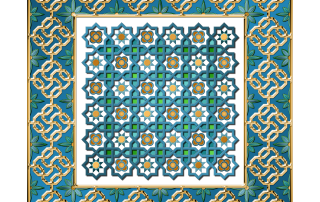
This work by José Cabrera Lozano manifests as a visual meditation on order and infinity. At the heart of the piece, an intricate network of turquoise bands intertwines in a perpetual dance, evoking the celestial gardens of Islamic tradition where water and geometry flow in harmony. The viewer is invited to lose themselves in the 'Khatam', the eight-pointed star that serves as a spiritual anchor, representing the expansion of knowledge and the connection between the four cardinal points and their intermediates. The color palette, dominated by deep turquoise and accents of ochre and gold, suggests a transition between the twilight sky and the light of enlightenment. It is not merely a static image; it is a geometric organism that breathes through its digital shadows. Each line has been drawn with the precision of an architect and the sensitivity of a poet, seeking not only aesthetic beauty but the resonance of the universal laws that govern nature. Contemplating 'The Lattice of Paradise', we face the paradox of sacred geometry: the ability of the finite—a paper surface—to contain the representation of the infinite. It is a reminder that, in the chaos of the modern world, there is an underlying structure of peace and balance that can be decoded through art. This piece acts as a temporal bridge, rescuing design techniques from the Alhambra and projecting them into the future through the mastery of cutting-edge digital tools, consolidating Cabrera Lozano as a contemporary guardian of visual harmony.

The Maidens’ Labyrinth: Sevillian Polychromy (Methacrylate)
In the heart of the Real Alcázar of Seville, the Courtyard of the Maidens (Patio de las Doncellas) breathes an elegance that has captivated generations. This work by José Cabrera Lozano rescues the vibrant geometry of its tiled plinth, transforming glazed clay into a visual experience of infinite depth. The piece manifests as a labyrinth of interlaced shapes where light seems to filter through a digital lattice, revealing a universe of colors that are the very signature of Mudejar Seville: intense turquoises, deep magentas, and golden ochres. Contemplating 'The Maidens' Labyrinth', the viewer does not merely observe a pattern; they immerse themselves in the history of a palace where water and geometry merge to create an earthly paradise. The deep blue network of arches acts as a frame of order over the polychrome burst of the background, inviting meditation on the balance between structure and creative freedom. Each digital 'tile' is an echo of the craftsmen who, centuries ago, hand-cut each piece to honor beauty. This work is a bridge bringing that devotion to the present, allowing the majesty of the Alcázar to inhabit contemporary spaces with unprecedented freshness and clarity. From a technical perspective, this work represents a milestone in digital volume simulation applied to historical heritage. Cabrera Lozano uses his precision as an Industrial Engineer to deconstruct the original tile network and reconstruct it through high-precision vector shadow layers. The result is an extraordinary trompe-l'œil effect: the upper lattice of arches casts calculated shadows over the polychrome background, giving the piece a three-dimensionality that seems to rise from the physical support. The choice of 310 gsm Hahnemühle William Turner Fine Art paper is critical. Its matte and markedly textured surface interacts with the Giclée print to emulate the porosity and relief of real ceramics. Pigment saturation has been adjusted to maintain the vibrancy of magentas and turquoises, ensuring absolute contrast with the deep blacks of the shadows. Durability under the ISO 9706 standard guarantees that this technical representation of Mudejar art remains unaltered for generations, offering museum-grade archival quality that captures every detail of the original vector design. Ambient Suggestions Due to its rich color palette, a floating frame in dark wood or matte black is recommended to highlight the edges of the Hahnemühle paper. Ideal for stately lobbies, boutique hotels with a historical essence, or designer spaces seeking a visually striking piece that celebrates Spanish heritage.
The Threshold of Dawn: Chromatic Arabesque of the Wine Gate (Methacrylate)
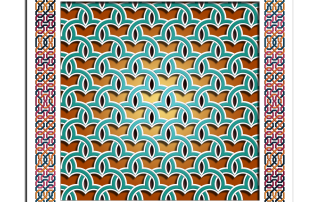
To contemplate 'The Threshold of Dawn: Chromatic Arabesques of the Wine Gate' is to witness the perfect intersection between the solidity of Nasrid military architecture and the lyrical volatility of its mural decoration. Inspired by the remnants of polychrome wall paintings that once adorned the interior arches of the emblematic Wine Gate (Puerta del Vino) in Granada's Alhambra, this digital masterpiece by José Cabrera Lozano rescues a symphony of sinuous shapes and infinite interlacing from the depths of time, elevating them into a contemporary dimension of unparalleled vividness. The central field of the composition simulates a rhythmic wave of interlaced polylobed arches, where deep terracotta tones and gradient ochres evoke the warmth of Andalusian clay and the sunset light bathing the fortress walls. Above this earthly foundation, vibrant emerald and turquoise ribbons meander like mystical vines, embodying the continuous flow of life and water. The magnificent outer border surrounding the piece acts as a guardian of order—a polychromatic, micro-geometric labyrinth where threads of pink, blue, orange, and white intertwine in absolute mathematical rigor. This artwork suspends the viewer in a state of pure aesthetic contemplation, transforming a historic mural fragment into a gateway to the eternal. In terms of design and execution, the artwork achieves a bold balance between the organic fluidity of the central arabesque and the modular rigor of its geometric frame. The central panel consists of a network of ogival arches and curvilinear interlaces outlined in pure white and emerald green, enhanced through digital drop shadows that create a tactile sensation of a layered low-relief. The background fields utilize rich gradients of ochre, sienna, and amber, introducing a focused central luminosity that mimics natural light behavior. The border, conversely, is a marvel of continuous polychromatic linear interlacing based on complex translation and reflection symmetries. The choice of Hahnemühle William Turner 310 gsm Fine Art paper significantly magnifies the visual impact of this piece. The pronounced, mould-made texture of this pure cotton paper interacts beautifully with the terracotta gradients, adding a physical patina that emulates the porous nature of the original Alhambra wall plaster. Furthermore, the complete absence of optical brighteners yields a natural ivory base tone that seamlessly harmonizes the high-frequency chromatic shifts within the border structure. Ambient Suggestions Due to its warmth and curvilinear dynamism, this piece is extraordinary for creating a focal point of sumptuous elegance in high-end residential foyers, premium boutique hotel reception areas, or luxury spa zones aboard superyachts, evoking the soothing heritage of ancient Arab baths. It pairs flawlessly with cream marble, travertine surfaces, or natural stone architectural accents. Framing Suggestions: We strongly recommend a deep-set showcase frame in natural oak or pickled teak. A floating mount will elevate the artwork, accentuating the rich tactile texture of the Hahnemühle paper, protected under museum-grade anti-reflective glass.

To contemplate 'The Infinite Echo of the Mexuar: Lattices of Divine Transit' is to step across a threshold where time is suspended and matter dissolves into pure mathematical vibration. Inspired by the majestic zócalo (dado) of the Sala de la Barca in Granada's Alhambra, this digital masterpiece by José Cabrera Lozano transcends mere historical reproduction to become a mystical bridge between the earthly plane and the infinitude of the cosmos. The interlacing pattern, born from the strict rigor of Islamic sacred geometry, traces an eternal dance of black and white ribbons that cross without beginning or end, embodying the Sufi concept of *Tawhid*—unity in multiplicity. The polygonal spaces are flooded with a superb color palette: deep teals evoke the Andalusian sky and the reflective waters of the courtyard, while the pink stars and warm golden-amber centerpieces act as skylights for the soul, drawing the gaze toward an inner illumination. Each intersection is a knot of consciousness; each repetition, a visual mantra inducing contemplation and serenity. The artist successfully captures the sacred atmosphere of the Nasrid palaces, where the air itself seems imbued with poetry and mysticism. This is not simple decorative design; it is a spiritual cartography that celebrates the perfect symmetry of the universe and the transit of the soul toward absolute beauty. From a technical standpoint, the artwork is built upon an intricate modular grid based on rotation and reflection symmetries, typical of monumental Nasrid art. The linear structure of the interlacing straps utilizes clean-edged black and white ribbons that generate a high-frequency contrast, enhancing the digital three-dimensionality through subtle drop shadows and gradients that add depth and volume to the two-dimensional plane. The interstitial spaces reveal a calculated chromatic organization: a dominant pattern of octagonal stars and geometric shapes in pale mint green and deep teal, harmoniously accented by a central axis of warm ochre-orange hues that subtly disrupts the repetition and guides the viewer's eye. The chosen medium, Hahnemühle William Turner 310 gsm Fine Art paper, is fundamental to the material experience of the art. Its mould-made, highly tactile yet refined texture absorbs pigments perfectly, achieving an extraordinary density in the blacks and optimal color fidelity. The absence of optical brighteners ensures a natural warmth and stability in the whites, while its 100% cotton composition endows the piece with exceptional archival aging resistance, ideal for institutional and private collectors. Ambient Suggestions This artwork possesses an undeniable architectural presence, making it perfect for spaces designed to reflect erudition, timeless luxury, and serenity. We highly recommend displaying it in:
- Main salons of Luxury Superyachts, where its teal and mint tones dialogue naturally with marine vistas.
- Lobbies of Ultra-Luxury Boutique Hotels or executive corporate boardrooms, offering a sophisticated intellectual focal point.

This monumental work, 'Lapis Lazuli Sky over Gold: The Interlaced Cosmos of Mexuar', stands as a threshold for contemplation. José Cabrera Lozano not only reinterprets Nasrid lacería, but he endows it with a contemporary spiritual pulse. The white interlacing, like a river of living water, flows incessantly, reminding us that in sacred geometry, every line is a path and every intersection a destination. The composition presents two visions: one, a centralized radiant sun where unity (tawhid) is the focal point; the other, an infinite expansion where the complexity of the forms multiplies towards the unreachability of infinity. It is a dialogue between mathematical rigidity and mystical emotion, a choreography of forms that seem to breathe over an abyss of black velvet. The colors are palpable jewels: the blue of the sky, the turquoise of the water, the ochre of the earth, and the gold of the divine. The profound black is the primal void, the initial mystery that serves as a stage for this expanding cosmos to manifest. The work is an invitation to silence, a bridge connecting the Andalusian past with the digital present, reminding us that beauty is, above all, an act of faith. It is the Andalusian cosmos at its finest, a 'zenith of the Andalusian jewel'. From a technical perspective, the work is a masterful exploration of high-fidelity digital composition. The geometry is based on a complex system of Nasrid zillij, where the modules pivot between 8, and 16-point bases, organized on an underlying grid. The central variation focuses on a radiant 8-point star that governs the radial symmetry, while the expanding variation multiplies the quadrangular modules, showcasing the infinity of the pattern. The use of color is crucial. Cabrera Lozano employs texturing algorithms to emulate the mineral nature of stone and enameled ceramics, creating a subtle but perceptible three-dimensional relief. The white lacería, with a macro-relief, stands out against the absolute black. The choice of Fine Art Hahnemühle William Turner (310 gr/m2) paper is fundamental to this process. Its matte surface, with a pronounced mold-made texture, allows the black pigments to achieve absolute density, an 'infinite black' that serves as a primordial stage upon which the turquoise and ochre colors seem to float. This tactile and visual experience changes according to the ambient light, revealing hidden layers of depth. Ambient Suggestions Given its magnificent nature and cultural heritage, this piece is ideal for spaces of prestige and authority. It is the ideal choice for the main salon of a superyacht, where the geometric theme and deep blue connect with the marine environment. Similarly, in the lobby of a five-star hotel with historical roots, or in executive offices where technical sophistication must go hand-in-hand with a profound cultural narrative. Framing: A floating frame (shadow box) with a dark or matte charcoal wood molding is suggested to let the work breathe. It is crucial to use anti-reflective museum glass with UV protection to preserve the texture of the paper and the depth of the blacks.

This monumental work, 'The Star of Mexuar, represents a milestone in the career of José Cabrera Lozano, where the millennial tradition of the Alhambra merges with the cutting edge of digital art. Inspired by the 'lacería' (interlacing) tilework of the Mexuar—the oldest and most historically charged hall of the Nasrid Palace—this piece stands as a profound study of symmetry and light. The composition orbits around a sixteen-pointed star, a polygon of exceptional geometric complexity that symbolizes the center of the universe in Islamic cosmology. This star, bathed in a vibrant cobalt blue, acts as a spiritual sun from which lines of force emanate infinitely, creating a visual rhythm that oscillates between mathematical order and visual poetry. From a technical standpoint, Cabrera Lozano transcends two-dimensionality through the use of texturing algorithms that mimic the porosity of carved plaster and the mineral density of lapis lazuli. Each white 'ribbon' or interlaced knot has been modeled with subtle variations in shadow and light, generating a depth that tricks the eye, making the work appear as a bas-relief sculpture. The choice of Hahnemühle William Turner Fine Art paper (310 gsm) is fundamental to this process. Its matte surface, with a pronounced yet refined mold-made texture, allows the black pigments to achieve absolute density—an 'infinite black' that serves as a primal void upon which the turquoises and ochres seem to float. The absence of optical brighteners in the paper ensures that the warmth of the work remains unchanged, offering a tactile and visual experience that shifts according to the ambient light. It is a piece that is not just observed; it is inhabited through the gaze, discovering in every intersection a new detail of Granada's heritage reinterpreted for the 21st century. Ambient Suggestions Given the scale and visual power of this piece, it demands an environment that dialogues with its sophistication. We recommend installation in spaces with high ceilings and controlled lighting. A 'shadow box' framing with an ebonized wood or matte charcoal molding would allow the William Turner paper to breathe, highlighting its handcrafted edges. This work is ideal for the main salon of a superyacht, where the geometric theme and deep blue connect with the marine surroundings. Similarly, in a luxury hotel lobby or a high-level executive boardroom, the work conveys a message of order, history, and technological vision.

This work is an ode to the contemplative stillness of Nasrid palaces. José Cabrera Lozano successfully captures the vibration of the Mexuar, the space where justice and administration met under the gaze of absolute mathematical order. The interlaced patterns (lacería) are not mere ornaments here; they are a web that catches light and shadow, a metaphor for the cosmos where every eight-pointed star is a center of spiritual gravity. The viewer's gaze gets lost in a labyrinth of white lines that flow with the precision of a celestial river, interconnecting fragments of deep blue, turquoise, and golden ochres. It is a 'horror vacui' that does not overwhelm but invites silence. The dark background acts as the primordial void, allowing the geometry to emerge with almost tactile force, reminding us that eternity resides in rhythmic repetition. Technically, 'The Whisper of the Alhambra' represents the pinnacle of digital geometric reconstruction. The pattern is based on a complex network of star polygons radiating from a 8-point center, one of the most challenging structures in Islamic geometry. The application of digital textures in the rendering gives the piece a visual depth that simulates the relief of stucco and glazed ceramics. The chosen support, Hahnemühle William Turner 310 gsm paper, is essential to the aesthetic experience. Its matte surface and genuine mould-made texture accentuate the density of the blacks and the saturation of the pigments, providing a three-dimensionality that shifts according to the ambient light. The absence of optical brighteners ensures that the work maintains its chromatic integrity for decades, complying with the ISO 9706 museum permanence standard. Ambient Suggestions This piece demands a space that allows for introspection. It is ideal for luxury hotel suites, main salons on contemporary yachts, or corporate offices where an image of sophistication, order, and cultural heritage is desired. We recommend a minimalist frame with museum-quality (anti-reflective) glass and a floating mount that allows the irregular texture of the William Turner paper's edges to be appreciated.

This work by José Cabrera Lozano manifests as a visual meditation on order and infinity. At the heart of the piece, an intricate network of turquoise bands intertwines in a perpetual dance, evoking the celestial gardens of Islamic tradition where water and geometry flow in harmony. The viewer is invited to lose themselves in the 'Khatam', the eight-pointed star that serves as a spiritual anchor, representing the expansion of knowledge and the connection between the four cardinal points and their intermediates. The color palette, dominated by deep turquoise and accents of ochre and gold, suggests a transition between the twilight sky and the light of enlightenment. It is not merely a static image; it is a geometric organism that breathes through its digital shadows. Each line has been drawn with the precision of an architect and the sensitivity of a poet, seeking not only aesthetic beauty but the resonance of the universal laws that govern nature. Contemplating 'The Lattice of Paradise', we face the paradox of sacred geometry: the ability of the finite—a paper surface—to contain the representation of the infinite. It is a reminder that, in the chaos of the modern world, there is an underlying structure of peace and balance that can be decoded through art. This piece acts as a temporal bridge, rescuing design techniques from the Alhambra and projecting them into the future through the mastery of cutting-edge digital tools, consolidating Cabrera Lozano as a contemporary guardian of visual harmony.

In the heart of the Real Alcázar of Seville, the Courtyard of the Maidens (Patio de las Doncellas) breathes an elegance that has captivated generations. This work by José Cabrera Lozano rescues the vibrant geometry of its tiled plinth, transforming glazed clay into a visual experience of infinite depth. The piece manifests as a labyrinth of interlaced shapes where light seems to filter through a digital lattice, revealing a universe of colors that are the very signature of Mudejar Seville: intense turquoises, deep magentas, and golden ochres. Contemplating 'The Maidens' Labyrinth', the viewer does not merely observe a pattern; they immerse themselves in the history of a palace where water and geometry merge to create an earthly paradise. The deep blue network of arches acts as a frame of order over the polychrome burst of the background, inviting meditation on the balance between structure and creative freedom. Each digital 'tile' is an echo of the craftsmen who, centuries ago, hand-cut each piece to honor beauty. This work is a bridge bringing that devotion to the present, allowing the majesty of the Alcázar to inhabit contemporary spaces with unprecedented freshness and clarity. From a technical perspective, this work represents a milestone in digital volume simulation applied to historical heritage. Cabrera Lozano uses his precision as an Industrial Engineer to deconstruct the original tile network and reconstruct it through high-precision vector shadow layers. The result is an extraordinary trompe-l'œil effect: the upper lattice of arches casts calculated shadows over the polychrome background, giving the piece a three-dimensionality that seems to rise from the physical support. The choice of 310 gsm Hahnemühle William Turner Fine Art paper is critical. Its matte and markedly textured surface interacts with the Giclée print to emulate the porosity and relief of real ceramics. Pigment saturation has been adjusted to maintain the vibrancy of magentas and turquoises, ensuring absolute contrast with the deep blacks of the shadows. Durability under the ISO 9706 standard guarantees that this technical representation of Mudejar art remains unaltered for generations, offering museum-grade archival quality that captures every detail of the original vector design. Ambient Suggestions Due to its rich color palette, a floating frame in dark wood or matte black is recommended to highlight the edges of the Hahnemühle paper. Ideal for stately lobbies, boutique hotels with a historical essence, or designer spaces seeking a visually striking piece that celebrates Spanish heritage.

To contemplate 'The Threshold of Dawn: Chromatic Arabesques of the Wine Gate' is to witness the perfect intersection between the solidity of Nasrid military architecture and the lyrical volatility of its mural decoration. Inspired by the remnants of polychrome wall paintings that once adorned the interior arches of the emblematic Wine Gate (Puerta del Vino) in Granada's Alhambra, this digital masterpiece by José Cabrera Lozano rescues a symphony of sinuous shapes and infinite interlacing from the depths of time, elevating them into a contemporary dimension of unparalleled vividness. The central field of the composition simulates a rhythmic wave of interlaced polylobed arches, where deep terracotta tones and gradient ochres evoke the warmth of Andalusian clay and the sunset light bathing the fortress walls. Above this earthly foundation, vibrant emerald and turquoise ribbons meander like mystical vines, embodying the continuous flow of life and water. The magnificent outer border surrounding the piece acts as a guardian of order—a polychromatic, micro-geometric labyrinth where threads of pink, blue, orange, and white intertwine in absolute mathematical rigor. This artwork suspends the viewer in a state of pure aesthetic contemplation, transforming a historic mural fragment into a gateway to the eternal. In terms of design and execution, the artwork achieves a bold balance between the organic fluidity of the central arabesque and the modular rigor of its geometric frame. The central panel consists of a network of ogival arches and curvilinear interlaces outlined in pure white and emerald green, enhanced through digital drop shadows that create a tactile sensation of a layered low-relief. The background fields utilize rich gradients of ochre, sienna, and amber, introducing a focused central luminosity that mimics natural light behavior. The border, conversely, is a marvel of continuous polychromatic linear interlacing based on complex translation and reflection symmetries. The choice of Hahnemühle William Turner 310 gsm Fine Art paper significantly magnifies the visual impact of this piece. The pronounced, mould-made texture of this pure cotton paper interacts beautifully with the terracotta gradients, adding a physical patina that emulates the porous nature of the original Alhambra wall plaster. Furthermore, the complete absence of optical brighteners yields a natural ivory base tone that seamlessly harmonizes the high-frequency chromatic shifts within the border structure. Ambient Suggestions Due to its warmth and curvilinear dynamism, this piece is extraordinary for creating a focal point of sumptuous elegance in high-end residential foyers, premium boutique hotel reception areas, or luxury spa zones aboard superyachts, evoking the soothing heritage of ancient Arab baths. It pairs flawlessly with cream marble, travertine surfaces, or natural stone architectural accents. Framing Suggestions: We strongly recommend a deep-set showcase frame in natural oak or pickled teak. A floating mount will elevate the artwork, accentuating the rich tactile texture of the Hahnemühle paper, protected under museum-grade anti-reflective glass.
