
The Threshold of Dawn: Chromatic Arabesque of the Wine Gate (Original)
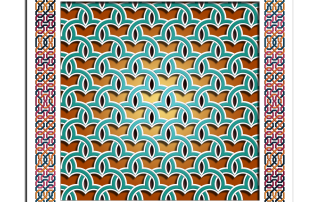
To contemplate 'The Threshold of Dawn: Chromatic Arabesques of the Wine Gate' is to witness the perfect intersection between the solidity of Nasrid military architecture and the lyrical volatility of its mural decoration. Inspired by the remnants of polychrome wall paintings that once adorned the interior arches of the emblematic Wine Gate (Puerta del Vino) in Granada's Alhambra, this digital masterpiece by José Cabrera Lozano rescues a symphony of sinuous shapes and infinite interlacing from the depths of time, elevating them into a contemporary dimension of unparalleled vividness. The central field of the composition simulates a rhythmic wave of interlaced polylobed arches, where deep terracotta tones and gradient ochres evoke the warmth of Andalusian clay and the sunset light bathing the fortress walls. Above this earthly foundation, vibrant emerald and turquoise ribbons meander like mystical vines, embodying the continuous flow of life and water. The magnificent outer border surrounding the piece acts as a guardian of order—a polychromatic, micro-geometric labyrinth where threads of pink, blue, orange, and white intertwine in absolute mathematical rigor. This artwork suspends the viewer in a state of pure aesthetic contemplation, transforming a historic mural fragment into a gateway to the eternal. In terms of design and execution, the artwork achieves a bold balance between the organic fluidity of the central arabesque and the modular rigor of its geometric frame. The central panel consists of a network of ogival arches and curvilinear interlaces outlined in pure white and emerald green, enhanced through digital drop shadows that create a tactile sensation of a layered low-relief. The background fields utilize rich gradients of ochre, sienna, and amber, introducing a focused central luminosity that mimics natural light behavior. The border, conversely, is a marvel of continuous polychromatic linear interlacing based on complex translation and reflection symmetries. The choice of Hahnemühle William Turner 310 gsm Fine Art paper significantly magnifies the visual impact of this piece. The pronounced, mould-made texture of this pure cotton paper interacts beautifully with the terracotta gradients, adding a physical patina that emulates the porous nature of the original Alhambra wall plaster. Furthermore, the complete absence of optical brighteners yields a natural ivory base tone that seamlessly harmonizes the high-frequency chromatic shifts within the border structure. Ambient Suggestions Due to its warmth and curvilinear dynamism, this piece is extraordinary for creating a focal point of sumptuous elegance in high-end residential foyers, premium boutique hotel reception areas, or luxury spa zones aboard superyachts, evoking the soothing heritage of ancient Arab baths. It pairs flawlessly with cream marble, travertine surfaces, or natural stone architectural accents. Framing Suggestions: We strongly recommend a deep-set showcase frame in natural oak or pickled teak. A floating mount will elevate the artwork, accentuating the rich tactile texture of the Hahnemühle paper, protected under museum-grade anti-reflective glass.

The Whisper of the Alhambra
This work is an ode to the contemplative stillness of Nasrid palaces. José Cabrera Lozano successfully captures the vibration of the Mexuar, the space where justice and administration met under the gaze of absolute mathematical order. The interlaced patterns (lacería) are not mere ornaments here; they are a web that catches light and shadow, a metaphor for the cosmos where every eight-pointed star is a center of spiritual gravity. The viewer's gaze gets lost in a labyrinth of white lines that flow with the precision of a celestial river, interconnecting fragments of deep blue, turquoise, and golden ochres. It is a 'horror vacui' that does not overwhelm but invites silence. The dark background acts as the primordial void, allowing the geometry to emerge with almost tactile force, reminding us that eternity resides in rhythmic repetition.

To contemplate 'The Threshold of Dawn: Chromatic Arabesques of the Wine Gate' is to witness the perfect intersection between the solidity of Nasrid military architecture and the lyrical volatility of its mural decoration. Inspired by the remnants of polychrome wall paintings that once adorned the interior arches of the emblematic Wine Gate (Puerta del Vino) in Granada's Alhambra, this digital masterpiece by José Cabrera Lozano rescues a symphony of sinuous shapes and infinite interlacing from the depths of time, elevating them into a contemporary dimension of unparalleled vividness. The central field of the composition simulates a rhythmic wave of interlaced polylobed arches, where deep terracotta tones and gradient ochres evoke the warmth of Andalusian clay and the sunset light bathing the fortress walls. Above this earthly foundation, vibrant emerald and turquoise ribbons meander like mystical vines, embodying the continuous flow of life and water. The magnificent outer border surrounding the piece acts as a guardian of order—a polychromatic, micro-geometric labyrinth where threads of pink, blue, orange, and white intertwine in absolute mathematical rigor. This artwork suspends the viewer in a state of pure aesthetic contemplation, transforming a historic mural fragment into a gateway to the eternal. In terms of design and execution, the artwork achieves a bold balance between the organic fluidity of the central arabesque and the modular rigor of its geometric frame. The central panel consists of a network of ogival arches and curvilinear interlaces outlined in pure white and emerald green, enhanced through digital drop shadows that create a tactile sensation of a layered low-relief. The background fields utilize rich gradients of ochre, sienna, and amber, introducing a focused central luminosity that mimics natural light behavior. The border, conversely, is a marvel of continuous polychromatic linear interlacing based on complex translation and reflection symmetries. The choice of Hahnemühle William Turner 310 gsm Fine Art paper significantly magnifies the visual impact of this piece. The pronounced, mould-made texture of this pure cotton paper interacts beautifully with the terracotta gradients, adding a physical patina that emulates the porous nature of the original Alhambra wall plaster. Furthermore, the complete absence of optical brighteners yields a natural ivory base tone that seamlessly harmonizes the high-frequency chromatic shifts within the border structure. Ambient Suggestions Due to its warmth and curvilinear dynamism, this piece is extraordinary for creating a focal point of sumptuous elegance in high-end residential foyers, premium boutique hotel reception areas, or luxury spa zones aboard superyachts, evoking the soothing heritage of ancient Arab baths. It pairs flawlessly with cream marble, travertine surfaces, or natural stone architectural accents. Framing Suggestions: We strongly recommend a deep-set showcase frame in natural oak or pickled teak. A floating mount will elevate the artwork, accentuating the rich tactile texture of the Hahnemühle paper, protected under museum-grade anti-reflective glass.

This work is an ode to the contemplative stillness of Nasrid palaces. José Cabrera Lozano successfully captures the vibration of the Mexuar, the space where justice and administration met under the gaze of absolute mathematical order. The interlaced patterns (lacería) are not mere ornaments here; they are a web that catches light and shadow, a metaphor for the cosmos where every eight-pointed star is a center of spiritual gravity. The viewer's gaze gets lost in a labyrinth of white lines that flow with the precision of a celestial river, interconnecting fragments of deep blue, turquoise, and golden ochres. It is a 'horror vacui' that does not overwhelm but invites silence. The dark background acts as the primordial void, allowing the geometry to emerge with almost tactile force, reminding us that eternity resides in rhythmic repetition.
