

Stars of Al-Ándalus (Aluminium)
Contemplating this artwork transcends mere visual observation; it is an act of immersion into the architectural memory of Al-Andalus, encoded through the contemporary lens of JC Geometric Patterns. In 'Stars of Al-Andalus', the echoes of the legendary Maiden's Courtyard in the Royal Alcázar of Seville are presented not as a static relic, but as a pulsating entity. The infinite, immaculate white threads weave a network of stars that capture the duality of the universe: the earthly and the divine. The vibrant cyan acts as a visual sigh of the flowing water that gives life to Andalusian gardens, a liquid freshness that masterfully contrasts with the warmth of red and ochre, reminiscent of the southern sun striking the historical brick, plaster, and tile. Every geometric intersection is a syllable in a visual poem speaking of cosmic order. The carefully curated color palette, enhanced by digitally cast shadows, endows the composition with a hypnotic three-dimensionality. It is a meditation on time, where Islamic sacred geometry reveals itself as a universal and imperishable language. The artwork invites the viewer to lose themselves in its labyrinths of light and shadow, finding in its symmetrical repetition a space for inner silence and spiritual reflection. From a technical and compositional perspective, this piece represents a milestone in the execution of complex patterns through digital media. The structure is based on a network of primary eight-pointed stars, creating a perfect tessellation that leaves no empty spaces. The artist has applied a 'drop shadow' treatment beneath the main white latticework. This technical resource is not merely aesthetic; it separates the interlaced bands from the polychrome background, generating an effect of sculptural relief that emulates traditional plaster or wood carving. The choice of physical medium is crucial. Printed on 310 gsm Fine Art Hahnemühle William Turner paper, the artwork acquires an unsurpassable tactile dimension. This 100% cotton paper, white and free of optical brighteners, features a matte surface that is both pronounced and subtle. This organic characteristic brings a visual three-dimensionality that counteracts the precision of the digital medium. Furthermore, it is fundamental for the absorption of dark pigments: the blacks acquire a velvety, abyssal depth against which the colors vibrate with extraordinary saturation. Ambient Suggestions To enhance the three-dimensional nature of the design and the rich texture of the Hahnemühle paper, a 'floating frame' in matte black stained ash or dark walnut is highly recommended. It is advisable to omit the glass if the environment allows, to fully appreciate the texture. In terms of interior design, this piece serves as a high-impact focal point. It is exceptionally well-suited for corporate collections in executive offices, boardrooms, and luxury hotel lobbies. Its aesthetic also makes it ideal for luxury yachts or minimalist residences aiming to project sophistication and a profound cultural legacy.
Stars or Al-Ándalus (Original)
Contemplating this artwork transcends mere visual observation; it is an act of immersion into the architectural memory of Al-Andalus, encoded through the contemporary lens of JC Geometric Patterns. In 'Stars of Al-Andalus', the echoes of the legendary Maiden's Courtyard in the Royal Alcázar of Seville are presented not as a static relic, but as a pulsating entity. The infinite, immaculate white threads weave a network of stars that capture the duality of the universe: the earthly and the divine. The vibrant cyan acts as a visual sigh of the flowing water that gives life to Andalusian gardens, a liquid freshness that masterfully contrasts with the warmth of red and ochre, reminiscent of the southern sun striking the historical brick, plaster, and tile. Every geometric intersection is a syllable in a visual poem speaking of cosmic order. The carefully curated color palette, enhanced by digitally cast shadows, endows the composition with a hypnotic three-dimensionality. It is a meditation on time, where Islamic sacred geometry reveals itself as a universal and imperishable language. The artwork invites the viewer to lose themselves in its labyrinths of light and shadow, finding in its symmetrical repetition a space for inner silence and spiritual reflection. From a technical and compositional perspective, this piece represents a milestone in the execution of complex patterns through digital media. The structure is based on a network of primary eight-pointed stars, creating a perfect tessellation that leaves no empty spaces. The artist has applied a 'drop shadow' treatment beneath the main white latticework. This technical resource is not merely aesthetic; it separates the interlaced bands from the polychrome background, generating an effect of sculptural relief that emulates traditional plaster or wood carving. The choice of physical medium is crucial. Printed on 310 gsm Fine Art Hahnemühle William Turner paper, the artwork acquires an unsurpassable tactile dimension. This 100% cotton paper, white and free of optical brighteners, features a matte surface that is both pronounced and subtle. This organic characteristic brings a visual three-dimensionality that counteracts the precision of the digital medium. Furthermore, it is fundamental for the absorption of dark pigments: the blacks acquire a velvety, abyssal depth against which the colors vibrate with extraordinary saturation. Ambient Suggestions To enhance the three-dimensional nature of the design and the rich texture of the Hahnemühle paper, a 'floating frame' in matte black stained ash or dark walnut is highly recommended. It is advisable to omit the glass if the environment allows, to fully appreciate the texture. In terms of interior design, this piece serves as a high-impact focal point. It is exceptionally well-suited for corporate collections in executive offices, boardrooms, and luxury hotel lobbies. Its aesthetic also makes it ideal for luxury yachts or minimalist residences aiming to project sophistication and a profound cultural legacy.

Symphony of Oriental Vortex
In 'Symphony of the Oriental Vortex', José Cabrera Lozano immerses us in a visual experience where color and form engage in a dialectical dialogue. The center of the composition is a burst of vital energy; a deep, passionate red that seems to pulse from within the work. On this incandescent background, a web of white ribbons intertwines with perfect mathematical logic, creating a vortex that draws the gaze toward a geometric infinite. This core represents the dynamism of the spirit and the complexity of ideas in constant flux. Countering this central intensity, the frame manifests in turquoise and aquamarine tones, evoking the coolness of lapis lazuli or the freshness of tiles in oriental fountains. This border is not merely decorative; it is a containment structure, a reminder that even the most overflowing passion finds its place within a universal order. The cross and star motifs in the frame suggest an architecture of peace that protects the creative fire of the center. The work is a symphony in the purest sense: a harmonization of disparate elements that, under the artist's hand, achieve a transcendental unity. It is a piece that not only decorates a space but transforms it, inviting reflection on the balance between order and chaos, between reason and emotion. Cabrera Lozano reaffirms here his ability to reinterpret ancestral patterns through a contemporary lens, delivering a work that resonates with the strength of tradition and the cleanliness of modernity.

Symphony of Stars
There is an invisible harmony that connects the centuries, a web of light that José Cabrera Lozano has unveiled in this masterly interpretation. In 'Symphony of Stars', the pattern from the Maiden’s Courtyard ceases to be an architectural fragment and becomes a window into the infinite. The white latticework, pure and mathematical, intertwines over a background where the cyan of the Andalusian sky and the solar tones of ochre and red vibrate with renewed energy. It is not just geometry; it is the echo of a civilization that sought beauty in the perfection of order. Each star is a note in a visual composition that invites calm, reminding us that art, even in its most abstract and digital form, can capture the soul of a place as sacred as the Royal Alcázar of Seville.
Symphony of Stars (Aluminium)
There is an invisible harmony that connects the centuries, a web of light that José Cabrera Lozano has unveiled in this masterly interpretation. In 'Symphony of Stars', the pattern from the Maiden’s Courtyard ceases to be an architectural fragment and becomes a window into the infinite. The white latticework, pure and mathematical, intertwines over a background where the cyan of the Andalusian sky and the solar tones of ochre and red vibrate with renewed energy. It is not just geometry; it is the echo of a civilization that sought beauty in the perfection of order. Each star is a note in a visual composition that invites calm, reminding us that art, even in its most abstract and digital form, can capture the soul of a place as sacred as the Royal Alcázar of Seville. From a technical standpoint, the work 'Symphony of Stars' stands out for the complexity of its network of eight-pointed stars. The artist uses a digital shadow technique ('drop shadow') that raises the network of white lines above the colored background, creating a three-dimensionality that emulates the depth of ancient plasterwork. The choice of medium is key: 310 gsm Fine Art Hahnemühle William Turner paper. This 100% cotton, museum-quality support (ISO 9706) has a unique grainy texture that breaks the pixel's coolness. The absence of optical brighteners ensures that colors maintain their fidelity for decades, while the depth of the blacks provides the perfect contrast for the cyan and earth tones to glow with almost organic intensity. Ambient Suggestions To enhance the work's relief effect, a 'floating frame' in natural wood or matte black lacquer is recommended. It is an ideal piece for high-ceilinged living rooms, contemporary design offices, or reception spaces in luxury hotels. Its complex yet balanced design makes it an immediate conversation piece, projecting an image of sophistication, culture, and respect for historical legacy.
Symphony of Stars (Original)
There is an invisible harmony that connects the centuries, a web of light that José Cabrera Lozano has unveiled in this masterly interpretation. In 'Symphony of Stars', the pattern from the Maiden’s Courtyard ceases to be an architectural fragment and becomes a window into the infinite. The white latticework, pure and mathematical, intertwines over a background where the cyan of the Andalusian sky and the solar tones of ochre and red vibrate with renewed energy. It is not just geometry; it is the echo of a civilization that sought beauty in the perfection of order. Each star is a note in a visual composition that invites calm, reminding us that art, even in its most abstract and digital form, can capture the soul of a place as sacred as the Royal Alcázar of Seville. From a technical standpoint, the work 'Symphony of Stars' stands out for the complexity of its network of eight-pointed stars. The artist uses a digital shadow technique ('drop shadow') that raises the network of white lines above the colored background, creating a three-dimensionality that emulates the depth of ancient plasterwork. The choice of medium is key: 310 gsm Fine Art Hahnemühle William Turner paper. This 100% cotton, museum-quality support (ISO 9706) has a unique grainy texture that breaks the pixel's coolness. The absence of optical brighteners ensures that colors maintain their fidelity for decades, while the depth of the blacks provides the perfect contrast for the cyan and earth tones to glow with almost organic intensity. Ambient Suggestions To enhance the work's relief effect, a 'floating frame' in natural wood or matte black lacquer is recommended. It is an ideal piece for high-ceilinged living rooms, contemporary design offices, or reception spaces in luxury hotels. Its complex yet balanced design makes it an immediate conversation piece, projecting an image of sophistication, culture, and respect for historical legacy.
Symphony of the Oriental Vortex (Methacrylate)
In 'Symphony of the Oriental Vortex', José Cabrera Lozano immerses us in a visual experience where color and form engage in a dialectical dialogue. The center of the composition is a burst of vital energy; a deep, passionate red that seems to pulse from within the work. On this incandescent background, a web of white ribbons intertwines with perfect mathematical logic, creating a vortex that draws the gaze toward a geometric infinite. This core represents the dynamism of the spirit and the complexity of ideas in constant flux. Countering this central intensity, the frame manifests in turquoise and aquamarine tones, evoking the coolness of lapis lazuli or the freshness of tiles in oriental fountains. This border is not merely decorative; it is a containment structure, a reminder that even the most overflowing passion finds its place within a universal order. The cross and star motifs in the frame suggest an architecture of peace that protects the creative fire of the center. The work is a symphony in the purest sense: a harmonization of disparate elements that, under the artist's hand, achieve a transcendental unity. It is a piece that not only decorates a space but transforms it, inviting reflection on the balance between order and chaos, between reason and emotion. Cabrera Lozano reaffirms here his ability to reinterpret ancestral patterns through a contemporary lens, delivering a work that resonates with the strength of tradition and the cleanliness of modernity. Technically, 'Symphony of the Oriental Vortex' is an advanced study of digital volume and chromaticism. The central interlacing technique uses cast shadows to generate a multi-layer effect, where white bands seem to float above the red circular gradients. This digital 'trompe-l'œil' creates a perception of real depth, inviting the viewer to try and touch the surface. The outer frame features a tessellation design with faceted shading that simulates the three-dimensionality of relief tiles, providing a visual tactile richness to the composition. Color fidelity is critical in this piece. The support on 310 gsm Hahnemühle William Turner paper allows for exceptional reproduction of the chromatic range, from the brightest cyans to the most saturated reds, without losing detail in shadow transitions. The paper's texture, similar to that of a traditional watercolor, adds an organic dimension that softens the coolness of the vectorial line, turning the digital print into a complete sensory experience. Axial and radial symmetry are maintained with zero error tolerance, ensuring that the visual balance is perfect from any viewing angle. The result is a high-resolution piece that stands up to close observation, revealing technical details at every intersection and gradient that confirm the author's mastery of contemporary design tools. Ambient Suggestions Dada la paleta neutra y la sofisticación de la obra, se recomienda un enmarcado tipo 'box frame' en madera de nogal o aluminio negro satinado para acentuar el efecto 3D. Es ideal para salas de juntas ejecutivas, donde proyecta autoridad y orden, o en salones principales de yates de lujo que busquen un diálogo con la arquitectura minimalista contemporánea.
Symphony of the Oriental Vortex (Original)
In 'Symphony of the Oriental Vortex', José Cabrera Lozano immerses us in a visual experience where color and form engage in a dialectical dialogue. The center of the composition is a burst of vital energy; a deep, passionate red that seems to pulse from within the work. On this incandescent background, a web of white ribbons intertwines with perfect mathematical logic, creating a vortex that draws the gaze toward a geometric infinite. This core represents the dynamism of the spirit and the complexity of ideas in constant flux. Countering this central intensity, the frame manifests in turquoise and aquamarine tones, evoking the coolness of lapis lazuli or the freshness of tiles in oriental fountains. This border is not merely decorative; it is a containment structure, a reminder that even the most overflowing passion finds its place within a universal order. The cross and star motifs in the frame suggest an architecture of peace that protects the creative fire of the center. The work is a symphony in the purest sense: a harmonization of disparate elements that, under the artist's hand, achieve a transcendental unity. It is a piece that not only decorates a space but transforms it, inviting reflection on the balance between order and chaos, between reason and emotion. Cabrera Lozano reaffirms here his ability to reinterpret ancestral patterns through a contemporary lens, delivering a work that resonates with the strength of tradition and the cleanliness of modernity. Technically, 'Symphony of the Oriental Vortex' is an advanced study of digital volume and chromaticism. The central interlacing technique uses cast shadows to generate a multi-layer effect, where white bands seem to float above the red circular gradients. This digital 'trompe-l'œil' creates a perception of real depth, inviting the viewer to try and touch the surface. The outer frame features a tessellation design with faceted shading that simulates the three-dimensionality of relief tiles, providing a visual tactile richness to the composition. Color fidelity is critical in this piece. The support on 310 gsm Hahnemühle William Turner paper allows for exceptional reproduction of the chromatic range, from the brightest cyans to the most saturated reds, without losing detail in shadow transitions. The paper's texture, similar to that of a traditional watercolor, adds an organic dimension that softens the coolness of the vectorial line, turning the digital print into a complete sensory experience. Axial and radial symmetry are maintained with zero error tolerance, ensuring that the visual balance is perfect from any viewing angle. The result is a high-resolution piece that stands up to close observation, revealing technical details at every intersection and gradient that confirm the author's mastery of contemporary design tools. Ambient Suggestions Dada la paleta neutra y la sofisticación de la obra, se recomienda un enmarcado tipo 'box frame' en madera de nogal o aluminio negro satinado para acentuar el efecto 3D. Es ideal para salas de juntas ejecutivas, donde proyecta autoridad y orden, o en salones principales de yates de lujo que busquen un diálogo con la arquitectura minimalista contemporánea.
Tapestry of Stars: The Constellation of Sacred Thought
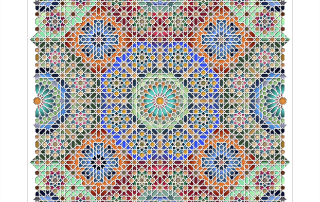
Tapestry of Stars is an open window into infinity. In this work, José Cabrera Lozano does not merely capture light; he organizes it into an architecture of divine proportions. Each twelve-pointed star acts as a central sun, around which a network of interlacing gravitates, symbolizing the indivisible connection of all things. It is a tribute to the master craftsmen of the East, yet executed with the clarity and precision of modernity. The chromatic vibration—from Mediterranean turquoise to the orange of desert sunsets—creates a visual rhythm that invites meditation. It is not a static image; it is a living geometric organism that seems to breathe thanks to the shadows levitating over the white background. Owning this piece means harboring a fragment of universal order, a mathematical prayer that celebrates the harmony of apparent chaos.
Tapestry of Stars: The Constellation of Sacred Thought (Aluminium)
Splendor of Humayun is an ode to the architecture of the soul, a digital transposition of the Mughal grandeur that has defined the Delhi skyline for centuries. At the heart of this piece beats a crimson star, a core of pure energy acting as the origin of all creation. From this vital center, geometry unfolds in layers of turquoise, emerald, and violet, evoking the transition from day to twilight in the gardens of Paradise. José Cabrera Lozano uses the white lattice not merely as a structure, but as a luminous membrane containing the vibration of color. Each line is a path; each intersection, a moment of mathematical clarity. It is a work that invites silent introspection, where the viewer can lose themselves in infinite repetition only to find themselves, ultimately, in the unity of the red center. It is not just a geometric pattern; it is a meditation on the harmony between the earthly and the divine, captured in a moment of chromatic perfection that resonates with the elegance of ancient palaces. Technically, Splendor of Humayun represents the pinnacle of radial symmetry applied to digital art. The structure is based on an eight-pointed star pattern expanding through golden ratios, creating a 'girih' interlacing network that floats above the background. The masterful use of drop shadows projected onto the color fields generates a real three-dimensionality that defies the two-dimensional plane. The color palette, transitioning from central bluish-greens to peripheral deep blues and purples, has been calibrated to maximize contrast with the white lattice. The chosen support, Hahnemühle William Turner 310 gsm paper, is essential to the work: its matte and granular texture absorbs light such that blacks and shadows acquire physical density, allowing the white network to appear physically suspended above the surface. The absence of optical brighteners ensures that the reproduction of emerald and cobalt tones maintains an organic purity under any lighting condition. Ambient Suggestions A 'Box Frame' in natural oak or satin white is recommended to emphasize the lattice relief. Ideal spaces: Luxury yacht salons, where the blues and turquoises connect with the sea; contemporary boutique hotel lobbies; or executive offices seeking a large-format piece that projects order, sophistication, and a global vision of art.

Contemplating this artwork transcends mere visual observation; it is an act of immersion into the architectural memory of Al-Andalus, encoded through the contemporary lens of JC Geometric Patterns. In 'Stars of Al-Andalus', the echoes of the legendary Maiden's Courtyard in the Royal Alcázar of Seville are presented not as a static relic, but as a pulsating entity. The infinite, immaculate white threads weave a network of stars that capture the duality of the universe: the earthly and the divine. The vibrant cyan acts as a visual sigh of the flowing water that gives life to Andalusian gardens, a liquid freshness that masterfully contrasts with the warmth of red and ochre, reminiscent of the southern sun striking the historical brick, plaster, and tile. Every geometric intersection is a syllable in a visual poem speaking of cosmic order. The carefully curated color palette, enhanced by digitally cast shadows, endows the composition with a hypnotic three-dimensionality. It is a meditation on time, where Islamic sacred geometry reveals itself as a universal and imperishable language. The artwork invites the viewer to lose themselves in its labyrinths of light and shadow, finding in its symmetrical repetition a space for inner silence and spiritual reflection. From a technical and compositional perspective, this piece represents a milestone in the execution of complex patterns through digital media. The structure is based on a network of primary eight-pointed stars, creating a perfect tessellation that leaves no empty spaces. The artist has applied a 'drop shadow' treatment beneath the main white latticework. This technical resource is not merely aesthetic; it separates the interlaced bands from the polychrome background, generating an effect of sculptural relief that emulates traditional plaster or wood carving. The choice of physical medium is crucial. Printed on 310 gsm Fine Art Hahnemühle William Turner paper, the artwork acquires an unsurpassable tactile dimension. This 100% cotton paper, white and free of optical brighteners, features a matte surface that is both pronounced and subtle. This organic characteristic brings a visual three-dimensionality that counteracts the precision of the digital medium. Furthermore, it is fundamental for the absorption of dark pigments: the blacks acquire a velvety, abyssal depth against which the colors vibrate with extraordinary saturation. Ambient Suggestions To enhance the three-dimensional nature of the design and the rich texture of the Hahnemühle paper, a 'floating frame' in matte black stained ash or dark walnut is highly recommended. It is advisable to omit the glass if the environment allows, to fully appreciate the texture. In terms of interior design, this piece serves as a high-impact focal point. It is exceptionally well-suited for corporate collections in executive offices, boardrooms, and luxury hotel lobbies. Its aesthetic also makes it ideal for luxury yachts or minimalist residences aiming to project sophistication and a profound cultural legacy.
Contemplating this artwork transcends mere visual observation; it is an act of immersion into the architectural memory of Al-Andalus, encoded through the contemporary lens of JC Geometric Patterns. In 'Stars of Al-Andalus', the echoes of the legendary Maiden's Courtyard in the Royal Alcázar of Seville are presented not as a static relic, but as a pulsating entity. The infinite, immaculate white threads weave a network of stars that capture the duality of the universe: the earthly and the divine. The vibrant cyan acts as a visual sigh of the flowing water that gives life to Andalusian gardens, a liquid freshness that masterfully contrasts with the warmth of red and ochre, reminiscent of the southern sun striking the historical brick, plaster, and tile. Every geometric intersection is a syllable in a visual poem speaking of cosmic order. The carefully curated color palette, enhanced by digitally cast shadows, endows the composition with a hypnotic three-dimensionality. It is a meditation on time, where Islamic sacred geometry reveals itself as a universal and imperishable language. The artwork invites the viewer to lose themselves in its labyrinths of light and shadow, finding in its symmetrical repetition a space for inner silence and spiritual reflection. From a technical and compositional perspective, this piece represents a milestone in the execution of complex patterns through digital media. The structure is based on a network of primary eight-pointed stars, creating a perfect tessellation that leaves no empty spaces. The artist has applied a 'drop shadow' treatment beneath the main white latticework. This technical resource is not merely aesthetic; it separates the interlaced bands from the polychrome background, generating an effect of sculptural relief that emulates traditional plaster or wood carving. The choice of physical medium is crucial. Printed on 310 gsm Fine Art Hahnemühle William Turner paper, the artwork acquires an unsurpassable tactile dimension. This 100% cotton paper, white and free of optical brighteners, features a matte surface that is both pronounced and subtle. This organic characteristic brings a visual three-dimensionality that counteracts the precision of the digital medium. Furthermore, it is fundamental for the absorption of dark pigments: the blacks acquire a velvety, abyssal depth against which the colors vibrate with extraordinary saturation. Ambient Suggestions To enhance the three-dimensional nature of the design and the rich texture of the Hahnemühle paper, a 'floating frame' in matte black stained ash or dark walnut is highly recommended. It is advisable to omit the glass if the environment allows, to fully appreciate the texture. In terms of interior design, this piece serves as a high-impact focal point. It is exceptionally well-suited for corporate collections in executive offices, boardrooms, and luxury hotel lobbies. Its aesthetic also makes it ideal for luxury yachts or minimalist residences aiming to project sophistication and a profound cultural legacy.

In 'Symphony of the Oriental Vortex', José Cabrera Lozano immerses us in a visual experience where color and form engage in a dialectical dialogue. The center of the composition is a burst of vital energy; a deep, passionate red that seems to pulse from within the work. On this incandescent background, a web of white ribbons intertwines with perfect mathematical logic, creating a vortex that draws the gaze toward a geometric infinite. This core represents the dynamism of the spirit and the complexity of ideas in constant flux. Countering this central intensity, the frame manifests in turquoise and aquamarine tones, evoking the coolness of lapis lazuli or the freshness of tiles in oriental fountains. This border is not merely decorative; it is a containment structure, a reminder that even the most overflowing passion finds its place within a universal order. The cross and star motifs in the frame suggest an architecture of peace that protects the creative fire of the center. The work is a symphony in the purest sense: a harmonization of disparate elements that, under the artist's hand, achieve a transcendental unity. It is a piece that not only decorates a space but transforms it, inviting reflection on the balance between order and chaos, between reason and emotion. Cabrera Lozano reaffirms here his ability to reinterpret ancestral patterns through a contemporary lens, delivering a work that resonates with the strength of tradition and the cleanliness of modernity.

There is an invisible harmony that connects the centuries, a web of light that José Cabrera Lozano has unveiled in this masterly interpretation. In 'Symphony of Stars', the pattern from the Maiden’s Courtyard ceases to be an architectural fragment and becomes a window into the infinite. The white latticework, pure and mathematical, intertwines over a background where the cyan of the Andalusian sky and the solar tones of ochre and red vibrate with renewed energy. It is not just geometry; it is the echo of a civilization that sought beauty in the perfection of order. Each star is a note in a visual composition that invites calm, reminding us that art, even in its most abstract and digital form, can capture the soul of a place as sacred as the Royal Alcázar of Seville.
There is an invisible harmony that connects the centuries, a web of light that José Cabrera Lozano has unveiled in this masterly interpretation. In 'Symphony of Stars', the pattern from the Maiden’s Courtyard ceases to be an architectural fragment and becomes a window into the infinite. The white latticework, pure and mathematical, intertwines over a background where the cyan of the Andalusian sky and the solar tones of ochre and red vibrate with renewed energy. It is not just geometry; it is the echo of a civilization that sought beauty in the perfection of order. Each star is a note in a visual composition that invites calm, reminding us that art, even in its most abstract and digital form, can capture the soul of a place as sacred as the Royal Alcázar of Seville. From a technical standpoint, the work 'Symphony of Stars' stands out for the complexity of its network of eight-pointed stars. The artist uses a digital shadow technique ('drop shadow') that raises the network of white lines above the colored background, creating a three-dimensionality that emulates the depth of ancient plasterwork. The choice of medium is key: 310 gsm Fine Art Hahnemühle William Turner paper. This 100% cotton, museum-quality support (ISO 9706) has a unique grainy texture that breaks the pixel's coolness. The absence of optical brighteners ensures that colors maintain their fidelity for decades, while the depth of the blacks provides the perfect contrast for the cyan and earth tones to glow with almost organic intensity. Ambient Suggestions To enhance the work's relief effect, a 'floating frame' in natural wood or matte black lacquer is recommended. It is an ideal piece for high-ceilinged living rooms, contemporary design offices, or reception spaces in luxury hotels. Its complex yet balanced design makes it an immediate conversation piece, projecting an image of sophistication, culture, and respect for historical legacy.
There is an invisible harmony that connects the centuries, a web of light that José Cabrera Lozano has unveiled in this masterly interpretation. In 'Symphony of Stars', the pattern from the Maiden’s Courtyard ceases to be an architectural fragment and becomes a window into the infinite. The white latticework, pure and mathematical, intertwines over a background where the cyan of the Andalusian sky and the solar tones of ochre and red vibrate with renewed energy. It is not just geometry; it is the echo of a civilization that sought beauty in the perfection of order. Each star is a note in a visual composition that invites calm, reminding us that art, even in its most abstract and digital form, can capture the soul of a place as sacred as the Royal Alcázar of Seville. From a technical standpoint, the work 'Symphony of Stars' stands out for the complexity of its network of eight-pointed stars. The artist uses a digital shadow technique ('drop shadow') that raises the network of white lines above the colored background, creating a three-dimensionality that emulates the depth of ancient plasterwork. The choice of medium is key: 310 gsm Fine Art Hahnemühle William Turner paper. This 100% cotton, museum-quality support (ISO 9706) has a unique grainy texture that breaks the pixel's coolness. The absence of optical brighteners ensures that colors maintain their fidelity for decades, while the depth of the blacks provides the perfect contrast for the cyan and earth tones to glow with almost organic intensity. Ambient Suggestions To enhance the work's relief effect, a 'floating frame' in natural wood or matte black lacquer is recommended. It is an ideal piece for high-ceilinged living rooms, contemporary design offices, or reception spaces in luxury hotels. Its complex yet balanced design makes it an immediate conversation piece, projecting an image of sophistication, culture, and respect for historical legacy.
In 'Symphony of the Oriental Vortex', José Cabrera Lozano immerses us in a visual experience where color and form engage in a dialectical dialogue. The center of the composition is a burst of vital energy; a deep, passionate red that seems to pulse from within the work. On this incandescent background, a web of white ribbons intertwines with perfect mathematical logic, creating a vortex that draws the gaze toward a geometric infinite. This core represents the dynamism of the spirit and the complexity of ideas in constant flux. Countering this central intensity, the frame manifests in turquoise and aquamarine tones, evoking the coolness of lapis lazuli or the freshness of tiles in oriental fountains. This border is not merely decorative; it is a containment structure, a reminder that even the most overflowing passion finds its place within a universal order. The cross and star motifs in the frame suggest an architecture of peace that protects the creative fire of the center. The work is a symphony in the purest sense: a harmonization of disparate elements that, under the artist's hand, achieve a transcendental unity. It is a piece that not only decorates a space but transforms it, inviting reflection on the balance between order and chaos, between reason and emotion. Cabrera Lozano reaffirms here his ability to reinterpret ancestral patterns through a contemporary lens, delivering a work that resonates with the strength of tradition and the cleanliness of modernity. Technically, 'Symphony of the Oriental Vortex' is an advanced study of digital volume and chromaticism. The central interlacing technique uses cast shadows to generate a multi-layer effect, where white bands seem to float above the red circular gradients. This digital 'trompe-l'œil' creates a perception of real depth, inviting the viewer to try and touch the surface. The outer frame features a tessellation design with faceted shading that simulates the three-dimensionality of relief tiles, providing a visual tactile richness to the composition. Color fidelity is critical in this piece. The support on 310 gsm Hahnemühle William Turner paper allows for exceptional reproduction of the chromatic range, from the brightest cyans to the most saturated reds, without losing detail in shadow transitions. The paper's texture, similar to that of a traditional watercolor, adds an organic dimension that softens the coolness of the vectorial line, turning the digital print into a complete sensory experience. Axial and radial symmetry are maintained with zero error tolerance, ensuring that the visual balance is perfect from any viewing angle. The result is a high-resolution piece that stands up to close observation, revealing technical details at every intersection and gradient that confirm the author's mastery of contemporary design tools. Ambient Suggestions Dada la paleta neutra y la sofisticación de la obra, se recomienda un enmarcado tipo 'box frame' en madera de nogal o aluminio negro satinado para acentuar el efecto 3D. Es ideal para salas de juntas ejecutivas, donde proyecta autoridad y orden, o en salones principales de yates de lujo que busquen un diálogo con la arquitectura minimalista contemporánea.
In 'Symphony of the Oriental Vortex', José Cabrera Lozano immerses us in a visual experience where color and form engage in a dialectical dialogue. The center of the composition is a burst of vital energy; a deep, passionate red that seems to pulse from within the work. On this incandescent background, a web of white ribbons intertwines with perfect mathematical logic, creating a vortex that draws the gaze toward a geometric infinite. This core represents the dynamism of the spirit and the complexity of ideas in constant flux. Countering this central intensity, the frame manifests in turquoise and aquamarine tones, evoking the coolness of lapis lazuli or the freshness of tiles in oriental fountains. This border is not merely decorative; it is a containment structure, a reminder that even the most overflowing passion finds its place within a universal order. The cross and star motifs in the frame suggest an architecture of peace that protects the creative fire of the center. The work is a symphony in the purest sense: a harmonization of disparate elements that, under the artist's hand, achieve a transcendental unity. It is a piece that not only decorates a space but transforms it, inviting reflection on the balance between order and chaos, between reason and emotion. Cabrera Lozano reaffirms here his ability to reinterpret ancestral patterns through a contemporary lens, delivering a work that resonates with the strength of tradition and the cleanliness of modernity. Technically, 'Symphony of the Oriental Vortex' is an advanced study of digital volume and chromaticism. The central interlacing technique uses cast shadows to generate a multi-layer effect, where white bands seem to float above the red circular gradients. This digital 'trompe-l'œil' creates a perception of real depth, inviting the viewer to try and touch the surface. The outer frame features a tessellation design with faceted shading that simulates the three-dimensionality of relief tiles, providing a visual tactile richness to the composition. Color fidelity is critical in this piece. The support on 310 gsm Hahnemühle William Turner paper allows for exceptional reproduction of the chromatic range, from the brightest cyans to the most saturated reds, without losing detail in shadow transitions. The paper's texture, similar to that of a traditional watercolor, adds an organic dimension that softens the coolness of the vectorial line, turning the digital print into a complete sensory experience. Axial and radial symmetry are maintained with zero error tolerance, ensuring that the visual balance is perfect from any viewing angle. The result is a high-resolution piece that stands up to close observation, revealing technical details at every intersection and gradient that confirm the author's mastery of contemporary design tools. Ambient Suggestions Dada la paleta neutra y la sofisticación de la obra, se recomienda un enmarcado tipo 'box frame' en madera de nogal o aluminio negro satinado para acentuar el efecto 3D. Es ideal para salas de juntas ejecutivas, donde proyecta autoridad y orden, o en salones principales de yates de lujo que busquen un diálogo con la arquitectura minimalista contemporánea.

Tapestry of Stars is an open window into infinity. In this work, José Cabrera Lozano does not merely capture light; he organizes it into an architecture of divine proportions. Each twelve-pointed star acts as a central sun, around which a network of interlacing gravitates, symbolizing the indivisible connection of all things. It is a tribute to the master craftsmen of the East, yet executed with the clarity and precision of modernity. The chromatic vibration—from Mediterranean turquoise to the orange of desert sunsets—creates a visual rhythm that invites meditation. It is not a static image; it is a living geometric organism that seems to breathe thanks to the shadows levitating over the white background. Owning this piece means harboring a fragment of universal order, a mathematical prayer that celebrates the harmony of apparent chaos.
Splendor of Humayun is an ode to the architecture of the soul, a digital transposition of the Mughal grandeur that has defined the Delhi skyline for centuries. At the heart of this piece beats a crimson star, a core of pure energy acting as the origin of all creation. From this vital center, geometry unfolds in layers of turquoise, emerald, and violet, evoking the transition from day to twilight in the gardens of Paradise. José Cabrera Lozano uses the white lattice not merely as a structure, but as a luminous membrane containing the vibration of color. Each line is a path; each intersection, a moment of mathematical clarity. It is a work that invites silent introspection, where the viewer can lose themselves in infinite repetition only to find themselves, ultimately, in the unity of the red center. It is not just a geometric pattern; it is a meditation on the harmony between the earthly and the divine, captured in a moment of chromatic perfection that resonates with the elegance of ancient palaces. Technically, Splendor of Humayun represents the pinnacle of radial symmetry applied to digital art. The structure is based on an eight-pointed star pattern expanding through golden ratios, creating a 'girih' interlacing network that floats above the background. The masterful use of drop shadows projected onto the color fields generates a real three-dimensionality that defies the two-dimensional plane. The color palette, transitioning from central bluish-greens to peripheral deep blues and purples, has been calibrated to maximize contrast with the white lattice. The chosen support, Hahnemühle William Turner 310 gsm paper, is essential to the work: its matte and granular texture absorbs light such that blacks and shadows acquire physical density, allowing the white network to appear physically suspended above the surface. The absence of optical brighteners ensures that the reproduction of emerald and cobalt tones maintains an organic purity under any lighting condition. Ambient Suggestions A 'Box Frame' in natural oak or satin white is recommended to emphasize the lattice relief. Ideal spaces: Luxury yacht salons, where the blues and turquoises connect with the sea; contemporary boutique hotel lobbies; or executive offices seeking a large-format piece that projects order, sophistication, and a global vision of art.
