
The Mirror of the Eternity
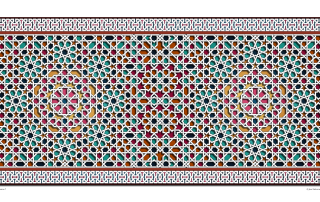
To contemplate 'The Mirror of Eternity' is to embark on a meditative journey into the heart of Nasrid cosmology, a space where visual beauty acts as a bridge to the ineffable. Inspired by the legendary panels of the Alhambra's Comares Hall, this artwork transcends mere ornamentation to stand as a portal of profound spiritual resonance. Through a horizontal layout that evokes the infinite, the composition reveals a duplicated cosmos, governed by two majestic twelve-pointed stars operating as radiant suns of vital energy. These central figures are not static; they beat rhythmically, expanding their influence through an intricate network of uninterrupted lacework. In Islamic philosophy, this continuity without beginning or end symbolizes the eternal journey of the soul and the indissoluble interconnection of all facets of creation under an unalterable divine order. The chromatic palette is a poetic tribute to the elemental forces of the Andalusian universe. Deep cobalt blues and turquoises immerse us in the contemplation of crystalline waters and the celestial vault, suggesting purification and protection. Meanwhile, crimson reds and golden ochre tones anchor the vision to fertile earth and regal splendor, blending the earthly with the heavenly. The duplicated arrangement of the elements creates a harmonic echo, a silent dialogue that invites the viewer to find their own inner balance. 'The Mirror of Eternity' is essentially a crystallized mantra in sacred geometry; a contained breath that pacifies the mind, elevates the spirit, and transforms any environment into a true sanctuary of order, symmetry, and timeless contemplation.

The Reflection of the Eternal
In 'Patio de las Doncellas: The Reflection of the Eternal,' José Cabrera Lozano invites us to a visual introspection in the heart of Sevillian Mudejar art. This work is not merely a reproduction, but a luminous deconstruction of infinity. The network of interlacing stars—descendants of sacred mathematics—floats above an abyss of color that pays homage to the Andalusian heritage. The turquoise evokes the water flowing through the courtyard's canals, the orange captures the midday sun over the bricks, and the crimson pulses with the passion of a thousand-year history. The white lattice, suspended in an ethereal three-dimensionality, symbolizes the light of reason ordering the chaos of the sensible world. It is a dance of forms with no beginning or end, designed to inhabit silence and elevate the spirit towards the contemplation of universal order.
The Reflection of the Eternal (Original)
In 'Patio de las Doncellas: The Reflection of the Eternal,' José Cabrera Lozano invites us to a visual introspection in the heart of Sevillian Mudejar art. This work is not merely a reproduction, but a luminous deconstruction of infinity. The network of interlacing stars—descendants of sacred mathematics—floats above an abyss of color that pays homage to the Andalusian heritage. The turquoise evokes the water flowing through the courtyard's canals, the orange captures the midday sun over the bricks, and the crimson pulses with the passion of a thousand-year history. The white lattice, suspended in an ethereal three-dimensionality, symbolizes the light of reason ordering the chaos of the sensible world. It is a dance of forms with no beginning or end, designed to inhabit silence and elevate the spirit towards the contemplation of universal order. Technically, the work stands out for its vectorial rigor and depth of execution. The pattern is based on a mosaic A1 model from the Royal Alcázar, where the precision of the 'girih' interlacing is enhanced by a masterful calculation of drop shadows that separate the white lattice from the polychrome background. The choice of Hahnemühle William Turner 310 gsm paper is fundamental to the tactile experience: its matte and markedly granular surface absorbs light in a way that the blacks and shadows acquire an almost sculptural density. As a 100% cotton, acid-free paper (museum quality ISO 9706), it guarantees a longevity exceeding a century, maintaining the vibration of the turquoise and ochre pigments without chromatic alteration. The work is a perfect synthesis between the porosity of historical plasterwork and the absolute sharpness of the digital avant-garde. Ambient Suggestions A minimalist box frame in natural oak or satin white is recommended to highlight the purity of the lattice. Ideal spaces: Luxury yacht salons, where the turquoise dialogues with the sea; contemporary boutique hotel lobbies; or executive offices seeking to project order, sophistication, and intellectual rigor.

The Star of Mexuar
This monumental work, 'The Star of Mexuar, represents a milestone in the career of José Cabrera Lozano, where the millennial tradition of the Alhambra merges with the cutting edge of digital art. Inspired by the 'lacería' (interlacing) tilework of the Mexuar—the oldest and most historically charged hall of the Nasrid Palace—this piece stands as a profound study of symmetry and light. The composition orbits around a sixteen-pointed star, a polygon of exceptional geometric complexity that symbolizes the center of the universe in Islamic cosmology. This star, bathed in a vibrant cobalt blue, acts as a spiritual sun from which lines of force emanate infinitely, creating a visual rhythm that oscillates between mathematical order and visual poetry.

The Sun of Thought
In 'The Sun of Thought,' José Cabrera Lozano reveals the radiant heart of the Hall of Comares. This work is distinguished by a golden core that acts as a metaphysical sun, from which the complexity of the ordered universe unfolds. It is a representation of the 'mishkat' or the niche of light, a spiritual concept where divine light is refracted into geometric shapes to become comprehensible to the human eye. The gaze is magnetically drawn toward the amber center, then navigates the intricate paths of turquoise and carmine surrounding it. Every white line that crosses and rises is a testament to mathematical perfection, an echo of the prayers carved in stone at the Alhambra. This piece invites serenity; it is a visual refuge where the viewer can find balance. It is not just a pattern; it is a narrative about the unity of being and the multiplicity of existence, captured with a digital sharpness that honors tradition while embracing advanced technology.
The Threshold of Dawn: Chromatic Arabesque of the Wine Gate
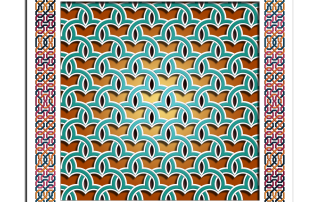
To contemplate 'The Threshold of Dawn: Chromatic Arabesques of the Wine Gate' is to witness the perfect intersection between the solidity of Nasrid military architecture and the lyrical volatility of its mural decoration. Inspired by the remnants of polychrome wall paintings that once adorned the interior arches of the emblematic Wine Gate (Puerta del Vino) in Granada's Alhambra, this digital masterpiece by José Cabrera Lozano rescues a symphony of sinuous shapes and infinite interlacing from the depths of time, elevating them into a contemporary dimension of unparalleled vividness. The central field of the composition simulates a rhythmic wave of interlaced polylobed arches, where deep terracotta tones and gradient ochres evoke the warmth of Andalusian clay and the sunset light bathing the fortress walls. Above this earthly foundation, vibrant emerald and turquoise ribbons meander like mystical vines, embodying the continuous flow of life and water. The magnificent outer border surrounding the piece acts as a guardian of order—a polychromatic, micro-geometric labyrinth where threads of pink, blue, orange, and white intertwine in absolute mathematical rigor. This artwork suspends the viewer in a state of pure aesthetic contemplation, transforming a historic mural fragment into a gateway to the eternal.
The Threshold of Dawn: Chromatic Arabesque of the Wine Gate (Original)
To contemplate 'The Threshold of Dawn: Chromatic Arabesques of the Wine Gate' is to witness the perfect intersection between the solidity of Nasrid military architecture and the lyrical volatility of its mural decoration. Inspired by the remnants of polychrome wall paintings that once adorned the interior arches of the emblematic Wine Gate (Puerta del Vino) in Granada's Alhambra, this digital masterpiece by José Cabrera Lozano rescues a symphony of sinuous shapes and infinite interlacing from the depths of time, elevating them into a contemporary dimension of unparalleled vividness. The central field of the composition simulates a rhythmic wave of interlaced polylobed arches, where deep terracotta tones and gradient ochres evoke the warmth of Andalusian clay and the sunset light bathing the fortress walls. Above this earthly foundation, vibrant emerald and turquoise ribbons meander like mystical vines, embodying the continuous flow of life and water. The magnificent outer border surrounding the piece acts as a guardian of order—a polychromatic, micro-geometric labyrinth where threads of pink, blue, orange, and white intertwine in absolute mathematical rigor. This artwork suspends the viewer in a state of pure aesthetic contemplation, transforming a historic mural fragment into a gateway to the eternal. In terms of design and execution, the artwork achieves a bold balance between the organic fluidity of the central arabesque and the modular rigor of its geometric frame. The central panel consists of a network of ogival arches and curvilinear interlaces outlined in pure white and emerald green, enhanced through digital drop shadows that create a tactile sensation of a layered low-relief. The background fields utilize rich gradients of ochre, sienna, and amber, introducing a focused central luminosity that mimics natural light behavior. The border, conversely, is a marvel of continuous polychromatic linear interlacing based on complex translation and reflection symmetries. The choice of Hahnemühle William Turner 310 gsm Fine Art paper significantly magnifies the visual impact of this piece. The pronounced, mould-made texture of this pure cotton paper interacts beautifully with the terracotta gradients, adding a physical patina that emulates the porous nature of the original Alhambra wall plaster. Furthermore, the complete absence of optical brighteners yields a natural ivory base tone that seamlessly harmonizes the high-frequency chromatic shifts within the border structure. Ambient Suggestions Due to its warmth and curvilinear dynamism, this piece is extraordinary for creating a focal point of sumptuous elegance in high-end residential foyers, premium boutique hotel reception areas, or luxury spa zones aboard superyachts, evoking the soothing heritage of ancient Arab baths. It pairs flawlessly with cream marble, travertine surfaces, or natural stone architectural accents. Framing Suggestions: We strongly recommend a deep-set showcase frame in natural oak or pickled teak. A floating mount will elevate the artwork, accentuating the rich tactile texture of the Hahnemühle paper, protected under museum-grade anti-reflective glass.

The Weave of Paradise
In 'The Weave of Paradise,' José Cabrera Lozano invites us to cross a threshold where time stands still. Inspired by the Patio de las Doncellas of the Royal Alcázar of Seville, this work is not a mere reproduction of Andalusian legacy, but a spiritual re-reading of its essence. Here, geometry acts as an echo of the divine; each white line is a thread of light searching for the infinite above a void of deep shadows. The author rescues the mysticism of the Mudejar, where horror vacui is not fear of the void, but a celebration of fullness. Observing the piece, the viewer is immersed in a hypnotic dance of star polygons that seem to pulse. The digital shadows, applied with a precision that only cutting-edge technique allows, endow the interlacing with an organic, almost tactile three-dimensionality. It is as if Mediterranean light had filtered through an invisible lattice, projecting the order of the cosmos onto matter. This work represents absolute balance: the meeting between mathematical rigor and aesthetic emotion, offering a visual sanctuary for introspection and peace within modern chaos.
The Weave of Paradise (Original)
In 'The Weave of Paradise,' José Cabrera Lozano invites us to cross a threshold where time stands still. Inspired by the Patio de las Doncellas of the Royal Alcázar of Seville, this work is not a mere reproduction of Andalusian legacy, but a spiritual re-reading of its essence. Here, geometry acts as an echo of the divine; each white line is a thread of light searching for the infinite above a void of deep shadows. The author rescues the mysticism of the Mudejar, where horror vacui is not fear of the void, but a celebration of fullness. Observing the piece, the viewer is immersed in a hypnotic dance of star polygons that seem to pulse. The digital shadows, applied with a precision that only cutting-edge technique allows, endow the interlacing with an organic, almost tactile three-dimensionality. It is as if Mediterranean light had filtered through an invisible lattice, projecting the order of the cosmos onto matter. This work represents absolute balance: the meeting between mathematical rigor and aesthetic emotion, offering a visual sanctuary for introspection and peace within modern chaos. The technical architecture of this work is based on perfect radial symmetry, where geometric tessellation reaches its highest expression. Cabrera Lozano utilizes advanced design algorithms to recreate the complexity of Sevillian interlacing, applying the 'rule of uncertainty' to ensure that, despite fractal repetition, the human eye always finds new depths. The chromatic palette is a study of cultural heritage: turquoises evoking the courtyard's water, reds reminiscent of the earth, and ochres capturing the setting sun. The chosen medium, 310 gsm Hahnemühle William Turner Fine Art paper, is fundamental to the experience. Its matte surface and markedly handcrafted texture allow the blacks to reach an abyssal depth, while the natural whiteness of the cotton (100%, without chemical brighteners) gives the colors a museum-like vibration. Each digital stroke rests within the paper's fibers, transforming a virtual creation into a physical object of weight and presence. The work is presented in dimensions ranging from the 100 cm unique piece to limited editions of 50 and 75 cm, ensuring its value as an artistic investment asset. Ambient Suggestions Given its structural sophistication, this work is ideal for main salons in luxury yachts, boutique hotel suites, or executive offices. A 'shadow box' framing in matte black oak is recommended to highlight the paper's relief.

The Whisper of the Alhambra
This work is an ode to the contemplative stillness of Nasrid palaces. José Cabrera Lozano successfully captures the vibration of the Mexuar, the space where justice and administration met under the gaze of absolute mathematical order. The interlaced patterns (lacería) are not mere ornaments here; they are a web that catches light and shadow, a metaphor for the cosmos where every eight-pointed star is a center of spiritual gravity. The viewer's gaze gets lost in a labyrinth of white lines that flow with the precision of a celestial river, interconnecting fragments of deep blue, turquoise, and golden ochres. It is a 'horror vacui' that does not overwhelm but invites silence. The dark background acts as the primordial void, allowing the geometry to emerge with almost tactile force, reminding us that eternity resides in rhythmic repetition.

To contemplate 'The Mirror of Eternity' is to embark on a meditative journey into the heart of Nasrid cosmology, a space where visual beauty acts as a bridge to the ineffable. Inspired by the legendary panels of the Alhambra's Comares Hall, this artwork transcends mere ornamentation to stand as a portal of profound spiritual resonance. Through a horizontal layout that evokes the infinite, the composition reveals a duplicated cosmos, governed by two majestic twelve-pointed stars operating as radiant suns of vital energy. These central figures are not static; they beat rhythmically, expanding their influence through an intricate network of uninterrupted lacework. In Islamic philosophy, this continuity without beginning or end symbolizes the eternal journey of the soul and the indissoluble interconnection of all facets of creation under an unalterable divine order. The chromatic palette is a poetic tribute to the elemental forces of the Andalusian universe. Deep cobalt blues and turquoises immerse us in the contemplation of crystalline waters and the celestial vault, suggesting purification and protection. Meanwhile, crimson reds and golden ochre tones anchor the vision to fertile earth and regal splendor, blending the earthly with the heavenly. The duplicated arrangement of the elements creates a harmonic echo, a silent dialogue that invites the viewer to find their own inner balance. 'The Mirror of Eternity' is essentially a crystallized mantra in sacred geometry; a contained breath that pacifies the mind, elevates the spirit, and transforms any environment into a true sanctuary of order, symmetry, and timeless contemplation.

In 'Patio de las Doncellas: The Reflection of the Eternal,' José Cabrera Lozano invites us to a visual introspection in the heart of Sevillian Mudejar art. This work is not merely a reproduction, but a luminous deconstruction of infinity. The network of interlacing stars—descendants of sacred mathematics—floats above an abyss of color that pays homage to the Andalusian heritage. The turquoise evokes the water flowing through the courtyard's canals, the orange captures the midday sun over the bricks, and the crimson pulses with the passion of a thousand-year history. The white lattice, suspended in an ethereal three-dimensionality, symbolizes the light of reason ordering the chaos of the sensible world. It is a dance of forms with no beginning or end, designed to inhabit silence and elevate the spirit towards the contemplation of universal order.
In 'Patio de las Doncellas: The Reflection of the Eternal,' José Cabrera Lozano invites us to a visual introspection in the heart of Sevillian Mudejar art. This work is not merely a reproduction, but a luminous deconstruction of infinity. The network of interlacing stars—descendants of sacred mathematics—floats above an abyss of color that pays homage to the Andalusian heritage. The turquoise evokes the water flowing through the courtyard's canals, the orange captures the midday sun over the bricks, and the crimson pulses with the passion of a thousand-year history. The white lattice, suspended in an ethereal three-dimensionality, symbolizes the light of reason ordering the chaos of the sensible world. It is a dance of forms with no beginning or end, designed to inhabit silence and elevate the spirit towards the contemplation of universal order. Technically, the work stands out for its vectorial rigor and depth of execution. The pattern is based on a mosaic A1 model from the Royal Alcázar, where the precision of the 'girih' interlacing is enhanced by a masterful calculation of drop shadows that separate the white lattice from the polychrome background. The choice of Hahnemühle William Turner 310 gsm paper is fundamental to the tactile experience: its matte and markedly granular surface absorbs light in a way that the blacks and shadows acquire an almost sculptural density. As a 100% cotton, acid-free paper (museum quality ISO 9706), it guarantees a longevity exceeding a century, maintaining the vibration of the turquoise and ochre pigments without chromatic alteration. The work is a perfect synthesis between the porosity of historical plasterwork and the absolute sharpness of the digital avant-garde. Ambient Suggestions A minimalist box frame in natural oak or satin white is recommended to highlight the purity of the lattice. Ideal spaces: Luxury yacht salons, where the turquoise dialogues with the sea; contemporary boutique hotel lobbies; or executive offices seeking to project order, sophistication, and intellectual rigor.

This monumental work, 'The Star of Mexuar, represents a milestone in the career of José Cabrera Lozano, where the millennial tradition of the Alhambra merges with the cutting edge of digital art. Inspired by the 'lacería' (interlacing) tilework of the Mexuar—the oldest and most historically charged hall of the Nasrid Palace—this piece stands as a profound study of symmetry and light. The composition orbits around a sixteen-pointed star, a polygon of exceptional geometric complexity that symbolizes the center of the universe in Islamic cosmology. This star, bathed in a vibrant cobalt blue, acts as a spiritual sun from which lines of force emanate infinitely, creating a visual rhythm that oscillates between mathematical order and visual poetry.

In 'The Sun of Thought,' José Cabrera Lozano reveals the radiant heart of the Hall of Comares. This work is distinguished by a golden core that acts as a metaphysical sun, from which the complexity of the ordered universe unfolds. It is a representation of the 'mishkat' or the niche of light, a spiritual concept where divine light is refracted into geometric shapes to become comprehensible to the human eye. The gaze is magnetically drawn toward the amber center, then navigates the intricate paths of turquoise and carmine surrounding it. Every white line that crosses and rises is a testament to mathematical perfection, an echo of the prayers carved in stone at the Alhambra. This piece invites serenity; it is a visual refuge where the viewer can find balance. It is not just a pattern; it is a narrative about the unity of being and the multiplicity of existence, captured with a digital sharpness that honors tradition while embracing advanced technology.

To contemplate 'The Threshold of Dawn: Chromatic Arabesques of the Wine Gate' is to witness the perfect intersection between the solidity of Nasrid military architecture and the lyrical volatility of its mural decoration. Inspired by the remnants of polychrome wall paintings that once adorned the interior arches of the emblematic Wine Gate (Puerta del Vino) in Granada's Alhambra, this digital masterpiece by José Cabrera Lozano rescues a symphony of sinuous shapes and infinite interlacing from the depths of time, elevating them into a contemporary dimension of unparalleled vividness. The central field of the composition simulates a rhythmic wave of interlaced polylobed arches, where deep terracotta tones and gradient ochres evoke the warmth of Andalusian clay and the sunset light bathing the fortress walls. Above this earthly foundation, vibrant emerald and turquoise ribbons meander like mystical vines, embodying the continuous flow of life and water. The magnificent outer border surrounding the piece acts as a guardian of order—a polychromatic, micro-geometric labyrinth where threads of pink, blue, orange, and white intertwine in absolute mathematical rigor. This artwork suspends the viewer in a state of pure aesthetic contemplation, transforming a historic mural fragment into a gateway to the eternal.
To contemplate 'The Threshold of Dawn: Chromatic Arabesques of the Wine Gate' is to witness the perfect intersection between the solidity of Nasrid military architecture and the lyrical volatility of its mural decoration. Inspired by the remnants of polychrome wall paintings that once adorned the interior arches of the emblematic Wine Gate (Puerta del Vino) in Granada's Alhambra, this digital masterpiece by José Cabrera Lozano rescues a symphony of sinuous shapes and infinite interlacing from the depths of time, elevating them into a contemporary dimension of unparalleled vividness. The central field of the composition simulates a rhythmic wave of interlaced polylobed arches, where deep terracotta tones and gradient ochres evoke the warmth of Andalusian clay and the sunset light bathing the fortress walls. Above this earthly foundation, vibrant emerald and turquoise ribbons meander like mystical vines, embodying the continuous flow of life and water. The magnificent outer border surrounding the piece acts as a guardian of order—a polychromatic, micro-geometric labyrinth where threads of pink, blue, orange, and white intertwine in absolute mathematical rigor. This artwork suspends the viewer in a state of pure aesthetic contemplation, transforming a historic mural fragment into a gateway to the eternal. In terms of design and execution, the artwork achieves a bold balance between the organic fluidity of the central arabesque and the modular rigor of its geometric frame. The central panel consists of a network of ogival arches and curvilinear interlaces outlined in pure white and emerald green, enhanced through digital drop shadows that create a tactile sensation of a layered low-relief. The background fields utilize rich gradients of ochre, sienna, and amber, introducing a focused central luminosity that mimics natural light behavior. The border, conversely, is a marvel of continuous polychromatic linear interlacing based on complex translation and reflection symmetries. The choice of Hahnemühle William Turner 310 gsm Fine Art paper significantly magnifies the visual impact of this piece. The pronounced, mould-made texture of this pure cotton paper interacts beautifully with the terracotta gradients, adding a physical patina that emulates the porous nature of the original Alhambra wall plaster. Furthermore, the complete absence of optical brighteners yields a natural ivory base tone that seamlessly harmonizes the high-frequency chromatic shifts within the border structure. Ambient Suggestions Due to its warmth and curvilinear dynamism, this piece is extraordinary for creating a focal point of sumptuous elegance in high-end residential foyers, premium boutique hotel reception areas, or luxury spa zones aboard superyachts, evoking the soothing heritage of ancient Arab baths. It pairs flawlessly with cream marble, travertine surfaces, or natural stone architectural accents. Framing Suggestions: We strongly recommend a deep-set showcase frame in natural oak or pickled teak. A floating mount will elevate the artwork, accentuating the rich tactile texture of the Hahnemühle paper, protected under museum-grade anti-reflective glass.

In 'The Weave of Paradise,' José Cabrera Lozano invites us to cross a threshold where time stands still. Inspired by the Patio de las Doncellas of the Royal Alcázar of Seville, this work is not a mere reproduction of Andalusian legacy, but a spiritual re-reading of its essence. Here, geometry acts as an echo of the divine; each white line is a thread of light searching for the infinite above a void of deep shadows. The author rescues the mysticism of the Mudejar, where horror vacui is not fear of the void, but a celebration of fullness. Observing the piece, the viewer is immersed in a hypnotic dance of star polygons that seem to pulse. The digital shadows, applied with a precision that only cutting-edge technique allows, endow the interlacing with an organic, almost tactile three-dimensionality. It is as if Mediterranean light had filtered through an invisible lattice, projecting the order of the cosmos onto matter. This work represents absolute balance: the meeting between mathematical rigor and aesthetic emotion, offering a visual sanctuary for introspection and peace within modern chaos.
In 'The Weave of Paradise,' José Cabrera Lozano invites us to cross a threshold where time stands still. Inspired by the Patio de las Doncellas of the Royal Alcázar of Seville, this work is not a mere reproduction of Andalusian legacy, but a spiritual re-reading of its essence. Here, geometry acts as an echo of the divine; each white line is a thread of light searching for the infinite above a void of deep shadows. The author rescues the mysticism of the Mudejar, where horror vacui is not fear of the void, but a celebration of fullness. Observing the piece, the viewer is immersed in a hypnotic dance of star polygons that seem to pulse. The digital shadows, applied with a precision that only cutting-edge technique allows, endow the interlacing with an organic, almost tactile three-dimensionality. It is as if Mediterranean light had filtered through an invisible lattice, projecting the order of the cosmos onto matter. This work represents absolute balance: the meeting between mathematical rigor and aesthetic emotion, offering a visual sanctuary for introspection and peace within modern chaos. The technical architecture of this work is based on perfect radial symmetry, where geometric tessellation reaches its highest expression. Cabrera Lozano utilizes advanced design algorithms to recreate the complexity of Sevillian interlacing, applying the 'rule of uncertainty' to ensure that, despite fractal repetition, the human eye always finds new depths. The chromatic palette is a study of cultural heritage: turquoises evoking the courtyard's water, reds reminiscent of the earth, and ochres capturing the setting sun. The chosen medium, 310 gsm Hahnemühle William Turner Fine Art paper, is fundamental to the experience. Its matte surface and markedly handcrafted texture allow the blacks to reach an abyssal depth, while the natural whiteness of the cotton (100%, without chemical brighteners) gives the colors a museum-like vibration. Each digital stroke rests within the paper's fibers, transforming a virtual creation into a physical object of weight and presence. The work is presented in dimensions ranging from the 100 cm unique piece to limited editions of 50 and 75 cm, ensuring its value as an artistic investment asset. Ambient Suggestions Given its structural sophistication, this work is ideal for main salons in luxury yachts, boutique hotel suites, or executive offices. A 'shadow box' framing in matte black oak is recommended to highlight the paper's relief.

This work is an ode to the contemplative stillness of Nasrid palaces. José Cabrera Lozano successfully captures the vibration of the Mexuar, the space where justice and administration met under the gaze of absolute mathematical order. The interlaced patterns (lacería) are not mere ornaments here; they are a web that catches light and shadow, a metaphor for the cosmos where every eight-pointed star is a center of spiritual gravity. The viewer's gaze gets lost in a labyrinth of white lines that flow with the precision of a celestial river, interconnecting fragments of deep blue, turquoise, and golden ochres. It is a 'horror vacui' that does not overwhelm but invites silence. The dark background acts as the primordial void, allowing the geometry to emerge with almost tactile force, reminding us that eternity resides in rhythmic repetition.