

The Hearbeat of Stone
There is a silent music in the repetition of form, a melody that José Cabrera Lozano has rescued from the walls of the Royal Alcázar to project it into the future. In 'The Heartbeat of Stone', the Maiden’s Courtyard is liberated from its historical weight to become an ethereal dance. The eight-pointed stars are not just figures; they are pulsations of a civilization that understood the cosmos as a perfect fabric. The deep cyan evokes the night sky over Seville, while the solar reds and yellows act as sparks of light that breathe life into the structure. Each white line is a path inviting us to rediscover universal harmony, merging the master craftsmanship of the past with the digital purity of the present.
The Heartbeat of Stone (Aluminium)
There is a silent music in the repetition of form, a melody that José Cabrera Lozano has rescued from the walls of the Royal Alcázar to project it into the future. In 'The Heartbeat of Stone', the Maiden’s Courtyard is liberated from its historical weight to become an ethereal dance. The eight-pointed stars are not just figures; they are pulsations of a civilization that understood the cosmos as a perfect fabric. The deep cyan evokes the night sky over Seville, while the solar reds and yellows act as sparks of light that breathe life into the structure. Each white line is a path inviting us to rediscover universal harmony, merging the master craftsmanship of the past with the digital purity of the present. Technically, the work is a feat of algorithmic precision. Based on the complex interlacing, the composition uses a layering system that generates a three-dimensionality enhanced by digitally calculated drop shadows. This visual relief emulates the depth of the original plasterwork, allowing the latticework to appear as if floating over the polychrome background. The chosen medium is the 310 gsm Fine Art Hahnemühle William Turner paper. This 100% cotton paper not only guarantees museum-grade longevity (ISO 9706), but its textured surface absorbs light uniquely, granting the blacks a velvety depth that makes the cyan, red, and ochre colors vibrate with an almost organic intensity. The absence of optical brighteners ensures that the warmth of the work remains unchanged over decades. Ambient Suggestions Given the chromatic richness and depth of the work, minimalist framing in dark wood or matte black with museum glass (anti-reflective and UV protection) is recommended. Ideal spaces:
- Luxury Yacht Salons: Complements fine wood finishes and marble.
- Boutique Hotel Lobbies: As a centerpiece evoking history and modernity.
- High-Level Corporate Offices: Provides an air of order, precision, and cultural sophistication.
The Heartbeat of Stone (Original)
There is a silent music in the repetition of form, a melody that José Cabrera Lozano has rescued from the walls of the Royal Alcázar to project it into the future. In 'The Heartbeat of Stone', the Maiden’s Courtyard is liberated from its historical weight to become an ethereal dance. The eight-pointed stars are not just figures; they are pulsations of a civilization that understood the cosmos as a perfect fabric. The deep cyan evokes the night sky over Seville, while the solar reds and yellows act as sparks of light that breathe life into the structure. Each white line is a path inviting us to rediscover universal harmony, merging the master craftsmanship of the past with the digital purity of the present. Technically, the work is a feat of algorithmic precision. Based on the complex interlacing, the composition uses a layering system that generates a three-dimensionality enhanced by digitally calculated drop shadows. This visual relief emulates the depth of the original plasterwork, allowing the latticework to appear as if floating over the polychrome background. The chosen medium is the 310 gsm Fine Art Hahnemühle William Turner paper. This 100% cotton paper not only guarantees museum-grade longevity (ISO 9706), but its textured surface absorbs light uniquely, granting the blacks a velvety depth that makes the cyan, red, and ochre colors vibrate with an almost organic intensity. The absence of optical brighteners ensures that the warmth of the work remains unchanged over decades. Ambient Suggestions Given the chromatic richness and depth of the work, minimalist framing in dark wood or matte black with museum glass (anti-reflective and UV protection) is recommended. Ideal spaces:
- Luxury Yacht Salons: Complements fine wood finishes and marble.
- Boutique Hotel Lobbies: As a centerpiece evoking history and modernity.
- High-Level Corporate Offices: Provides an air of order, precision, and cultural sophistication.

The Reflection of the Eternal
In 'Patio de las Doncellas: The Reflection of the Eternal,' José Cabrera Lozano invites us to a visual introspection in the heart of Sevillian Mudejar art. This work is not merely a reproduction, but a luminous deconstruction of infinity. The network of interlacing stars—descendants of sacred mathematics—floats above an abyss of color that pays homage to the Andalusian heritage. The turquoise evokes the water flowing through the courtyard's canals, the orange captures the midday sun over the bricks, and the crimson pulses with the passion of a thousand-year history. The white lattice, suspended in an ethereal three-dimensionality, symbolizes the light of reason ordering the chaos of the sensible world. It is a dance of forms with no beginning or end, designed to inhabit silence and elevate the spirit towards the contemplation of universal order.
The Reflection of the Eternal (Aluminium)
In 'Patio de las Doncellas: The Reflection of the Eternal,' José Cabrera Lozano invites us to a visual introspection in the heart of Sevillian Mudejar art. This work is not merely a reproduction, but a luminous deconstruction of infinity. The network of interlacing stars—descendants of sacred mathematics—floats above an abyss of color that pays homage to the Andalusian heritage. The turquoise evokes the water flowing through the courtyard's canals, the orange captures the midday sun over the bricks, and the crimson pulses with the passion of a thousand-year history. The white lattice, suspended in an ethereal three-dimensionality, symbolizes the light of reason ordering the chaos of the sensible world. It is a dance of forms with no beginning or end, designed to inhabit silence and elevate the spirit towards the contemplation of universal order. Technically, the work stands out for its vectorial rigor and depth of execution. The pattern is based on a mosaic A1 model from the Royal Alcázar, where the precision of the 'girih' interlacing is enhanced by a masterful calculation of drop shadows that separate the white lattice from the polychrome background. The choice of Hahnemühle William Turner 310 gsm paper is fundamental to the tactile experience: its matte and markedly granular surface absorbs light in a way that the blacks and shadows acquire an almost sculptural density. As a 100% cotton, acid-free paper (museum quality ISO 9706), it guarantees a longevity exceeding a century, maintaining the vibration of the turquoise and ochre pigments without chromatic alteration. The work is a perfect synthesis between the porosity of historical plasterwork and the absolute sharpness of the digital avant-garde. Ambient Suggestions A minimalist box frame in natural oak or satin white is recommended to highlight the purity of the lattice. Ideal spaces: Luxury yacht salons, where the turquoise dialogues with the sea; contemporary boutique hotel lobbies; or executive offices seeking to project order, sophistication, and intellectual rigor.
The Reflection of the Eternal (Original)
In 'Patio de las Doncellas: The Reflection of the Eternal,' José Cabrera Lozano invites us to a visual introspection in the heart of Sevillian Mudejar art. This work is not merely a reproduction, but a luminous deconstruction of infinity. The network of interlacing stars—descendants of sacred mathematics—floats above an abyss of color that pays homage to the Andalusian heritage. The turquoise evokes the water flowing through the courtyard's canals, the orange captures the midday sun over the bricks, and the crimson pulses with the passion of a thousand-year history. The white lattice, suspended in an ethereal three-dimensionality, symbolizes the light of reason ordering the chaos of the sensible world. It is a dance of forms with no beginning or end, designed to inhabit silence and elevate the spirit towards the contemplation of universal order. Technically, the work stands out for its vectorial rigor and depth of execution. The pattern is based on a mosaic A1 model from the Royal Alcázar, where the precision of the 'girih' interlacing is enhanced by a masterful calculation of drop shadows that separate the white lattice from the polychrome background. The choice of Hahnemühle William Turner 310 gsm paper is fundamental to the tactile experience: its matte and markedly granular surface absorbs light in a way that the blacks and shadows acquire an almost sculptural density. As a 100% cotton, acid-free paper (museum quality ISO 9706), it guarantees a longevity exceeding a century, maintaining the vibration of the turquoise and ochre pigments without chromatic alteration. The work is a perfect synthesis between the porosity of historical plasterwork and the absolute sharpness of the digital avant-garde. Ambient Suggestions A minimalist box frame in natural oak or satin white is recommended to highlight the purity of the lattice. Ideal spaces: Luxury yacht salons, where the turquoise dialogues with the sea; contemporary boutique hotel lobbies; or executive offices seeking to project order, sophistication, and intellectual rigor.

The Weave of Paradise
In 'The Weave of Paradise,' José Cabrera Lozano invites us to cross a threshold where time stands still. Inspired by the Patio de las Doncellas of the Royal Alcázar of Seville, this work is not a mere reproduction of Andalusian legacy, but a spiritual re-reading of its essence. Here, geometry acts as an echo of the divine; each white line is a thread of light searching for the infinite above a void of deep shadows. The author rescues the mysticism of the Mudejar, where horror vacui is not fear of the void, but a celebration of fullness. Observing the piece, the viewer is immersed in a hypnotic dance of star polygons that seem to pulse. The digital shadows, applied with a precision that only cutting-edge technique allows, endow the interlacing with an organic, almost tactile three-dimensionality. It is as if Mediterranean light had filtered through an invisible lattice, projecting the order of the cosmos onto matter. This work represents absolute balance: the meeting between mathematical rigor and aesthetic emotion, offering a visual sanctuary for introspection and peace within modern chaos.
The Weave of Paradise (Aluminium)
In 'The Weave of Paradise,' José Cabrera Lozano invites us to cross a threshold where time stands still. Inspired by the Patio de las Doncellas of the Royal Alcázar of Seville, this work is not a mere reproduction of Andalusian legacy, but a spiritual re-reading of its essence. Here, geometry acts as an echo of the divine; each white line is a thread of light searching for the infinite above a void of deep shadows. The author rescues the mysticism of the Mudejar, where horror vacui is not fear of the void, but a celebration of fullness. Observing the piece, the viewer is immersed in a hypnotic dance of star polygons that seem to pulse. The digital shadows, applied with a precision that only cutting-edge technique allows, endow the interlacing with an organic, almost tactile three-dimensionality. It is as if Mediterranean light had filtered through an invisible lattice, projecting the order of the cosmos onto matter. This work represents absolute balance: the meeting between mathematical rigor and aesthetic emotion, offering a visual sanctuary for introspection and peace within modern chaos. The technical architecture of this work is based on perfect radial symmetry, where geometric tessellation reaches its highest expression. Cabrera Lozano utilizes advanced design algorithms to recreate the complexity of Sevillian interlacing, applying the 'rule of uncertainty' to ensure that, despite fractal repetition, the human eye always finds new depths. The chromatic palette is a study of cultural heritage: turquoises evoking the courtyard's water, reds reminiscent of the earth, and ochres capturing the setting sun. The chosen medium, 310 gsm Hahnemühle William Turner Fine Art paper, is fundamental to the experience. Its matte surface and markedly handcrafted texture allow the blacks to reach an abyssal depth, while the natural whiteness of the cotton (100%, without chemical brighteners) gives the colors a museum-like vibration. Each digital stroke rests within the paper's fibers, transforming a virtual creation into a physical object of weight and presence. The work is presented in dimensions ranging from the 100 cm unique piece to limited editions of 50 and 75 cm, ensuring its value as an artistic investment asset. Ambient Suggestions Given its structural sophistication, this work is ideal for main salons in luxury yachts, boutique hotel suites, or executive offices. A 'shadow box' framing in matte black oak is recommended to highlight the paper's relief.
The Weave of Paradise (Original)
In 'The Weave of Paradise,' José Cabrera Lozano invites us to cross a threshold where time stands still. Inspired by the Patio de las Doncellas of the Royal Alcázar of Seville, this work is not a mere reproduction of Andalusian legacy, but a spiritual re-reading of its essence. Here, geometry acts as an echo of the divine; each white line is a thread of light searching for the infinite above a void of deep shadows. The author rescues the mysticism of the Mudejar, where horror vacui is not fear of the void, but a celebration of fullness. Observing the piece, the viewer is immersed in a hypnotic dance of star polygons that seem to pulse. The digital shadows, applied with a precision that only cutting-edge technique allows, endow the interlacing with an organic, almost tactile three-dimensionality. It is as if Mediterranean light had filtered through an invisible lattice, projecting the order of the cosmos onto matter. This work represents absolute balance: the meeting between mathematical rigor and aesthetic emotion, offering a visual sanctuary for introspection and peace within modern chaos. The technical architecture of this work is based on perfect radial symmetry, where geometric tessellation reaches its highest expression. Cabrera Lozano utilizes advanced design algorithms to recreate the complexity of Sevillian interlacing, applying the 'rule of uncertainty' to ensure that, despite fractal repetition, the human eye always finds new depths. The chromatic palette is a study of cultural heritage: turquoises evoking the courtyard's water, reds reminiscent of the earth, and ochres capturing the setting sun. The chosen medium, 310 gsm Hahnemühle William Turner Fine Art paper, is fundamental to the experience. Its matte surface and markedly handcrafted texture allow the blacks to reach an abyssal depth, while the natural whiteness of the cotton (100%, without chemical brighteners) gives the colors a museum-like vibration. Each digital stroke rests within the paper's fibers, transforming a virtual creation into a physical object of weight and presence. The work is presented in dimensions ranging from the 100 cm unique piece to limited editions of 50 and 75 cm, ensuring its value as an artistic investment asset. Ambient Suggestions Given its structural sophistication, this work is ideal for main salons in luxury yachts, boutique hotel suites, or executive offices. A 'shadow box' framing in matte black oak is recommended to highlight the paper's relief.
Whispers of Orange Blossom and Stone
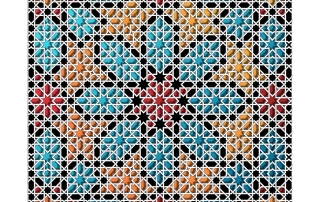
There is a silent melody emanating from the walls of the Royal Alcázar, a whisper that only the attentive eye can hear. 'Whispers of Orange Blossom and Stone' is the capture of that moment of revelation. José Cabrera Lozano delivers not just a pattern, but a fragment of Andalusian memory, where each interlaced line is a trace of the breeze crossing the courtyard. The work breathes through its colors: the blue that recalls the stagnant water in the pools and the warm tones that evoke the stone bathed by the afternoon sun. It is not just art; it is a portal to an era where beauty was the language of the sacred. In this artwork, complexity becomes a caress, inviting the viewer on an introspective journey where time seems to stand still among the shadows cast by centuries.

There is a silent music in the repetition of form, a melody that José Cabrera Lozano has rescued from the walls of the Royal Alcázar to project it into the future. In 'The Heartbeat of Stone', the Maiden’s Courtyard is liberated from its historical weight to become an ethereal dance. The eight-pointed stars are not just figures; they are pulsations of a civilization that understood the cosmos as a perfect fabric. The deep cyan evokes the night sky over Seville, while the solar reds and yellows act as sparks of light that breathe life into the structure. Each white line is a path inviting us to rediscover universal harmony, merging the master craftsmanship of the past with the digital purity of the present.
There is a silent music in the repetition of form, a melody that José Cabrera Lozano has rescued from the walls of the Royal Alcázar to project it into the future. In 'The Heartbeat of Stone', the Maiden’s Courtyard is liberated from its historical weight to become an ethereal dance. The eight-pointed stars are not just figures; they are pulsations of a civilization that understood the cosmos as a perfect fabric. The deep cyan evokes the night sky over Seville, while the solar reds and yellows act as sparks of light that breathe life into the structure. Each white line is a path inviting us to rediscover universal harmony, merging the master craftsmanship of the past with the digital purity of the present. Technically, the work is a feat of algorithmic precision. Based on the complex interlacing, the composition uses a layering system that generates a three-dimensionality enhanced by digitally calculated drop shadows. This visual relief emulates the depth of the original plasterwork, allowing the latticework to appear as if floating over the polychrome background. The chosen medium is the 310 gsm Fine Art Hahnemühle William Turner paper. This 100% cotton paper not only guarantees museum-grade longevity (ISO 9706), but its textured surface absorbs light uniquely, granting the blacks a velvety depth that makes the cyan, red, and ochre colors vibrate with an almost organic intensity. The absence of optical brighteners ensures that the warmth of the work remains unchanged over decades. Ambient Suggestions Given the chromatic richness and depth of the work, minimalist framing in dark wood or matte black with museum glass (anti-reflective and UV protection) is recommended. Ideal spaces:
- Luxury Yacht Salons: Complements fine wood finishes and marble.
- Boutique Hotel Lobbies: As a centerpiece evoking history and modernity.
- High-Level Corporate Offices: Provides an air of order, precision, and cultural sophistication.

In 'Patio de las Doncellas: The Reflection of the Eternal,' José Cabrera Lozano invites us to a visual introspection in the heart of Sevillian Mudejar art. This work is not merely a reproduction, but a luminous deconstruction of infinity. The network of interlacing stars—descendants of sacred mathematics—floats above an abyss of color that pays homage to the Andalusian heritage. The turquoise evokes the water flowing through the courtyard's canals, the orange captures the midday sun over the bricks, and the crimson pulses with the passion of a thousand-year history. The white lattice, suspended in an ethereal three-dimensionality, symbolizes the light of reason ordering the chaos of the sensible world. It is a dance of forms with no beginning or end, designed to inhabit silence and elevate the spirit towards the contemplation of universal order.
In 'Patio de las Doncellas: The Reflection of the Eternal,' José Cabrera Lozano invites us to a visual introspection in the heart of Sevillian Mudejar art. This work is not merely a reproduction, but a luminous deconstruction of infinity. The network of interlacing stars—descendants of sacred mathematics—floats above an abyss of color that pays homage to the Andalusian heritage. The turquoise evokes the water flowing through the courtyard's canals, the orange captures the midday sun over the bricks, and the crimson pulses with the passion of a thousand-year history. The white lattice, suspended in an ethereal three-dimensionality, symbolizes the light of reason ordering the chaos of the sensible world. It is a dance of forms with no beginning or end, designed to inhabit silence and elevate the spirit towards the contemplation of universal order. Technically, the work stands out for its vectorial rigor and depth of execution. The pattern is based on a mosaic A1 model from the Royal Alcázar, where the precision of the 'girih' interlacing is enhanced by a masterful calculation of drop shadows that separate the white lattice from the polychrome background. The choice of Hahnemühle William Turner 310 gsm paper is fundamental to the tactile experience: its matte and markedly granular surface absorbs light in a way that the blacks and shadows acquire an almost sculptural density. As a 100% cotton, acid-free paper (museum quality ISO 9706), it guarantees a longevity exceeding a century, maintaining the vibration of the turquoise and ochre pigments without chromatic alteration. The work is a perfect synthesis between the porosity of historical plasterwork and the absolute sharpness of the digital avant-garde. Ambient Suggestions A minimalist box frame in natural oak or satin white is recommended to highlight the purity of the lattice. Ideal spaces: Luxury yacht salons, where the turquoise dialogues with the sea; contemporary boutique hotel lobbies; or executive offices seeking to project order, sophistication, and intellectual rigor.
In 'Patio de las Doncellas: The Reflection of the Eternal,' José Cabrera Lozano invites us to a visual introspection in the heart of Sevillian Mudejar art. This work is not merely a reproduction, but a luminous deconstruction of infinity. The network of interlacing stars—descendants of sacred mathematics—floats above an abyss of color that pays homage to the Andalusian heritage. The turquoise evokes the water flowing through the courtyard's canals, the orange captures the midday sun over the bricks, and the crimson pulses with the passion of a thousand-year history. The white lattice, suspended in an ethereal three-dimensionality, symbolizes the light of reason ordering the chaos of the sensible world. It is a dance of forms with no beginning or end, designed to inhabit silence and elevate the spirit towards the contemplation of universal order. Technically, the work stands out for its vectorial rigor and depth of execution. The pattern is based on a mosaic A1 model from the Royal Alcázar, where the precision of the 'girih' interlacing is enhanced by a masterful calculation of drop shadows that separate the white lattice from the polychrome background. The choice of Hahnemühle William Turner 310 gsm paper is fundamental to the tactile experience: its matte and markedly granular surface absorbs light in a way that the blacks and shadows acquire an almost sculptural density. As a 100% cotton, acid-free paper (museum quality ISO 9706), it guarantees a longevity exceeding a century, maintaining the vibration of the turquoise and ochre pigments without chromatic alteration. The work is a perfect synthesis between the porosity of historical plasterwork and the absolute sharpness of the digital avant-garde. Ambient Suggestions A minimalist box frame in natural oak or satin white is recommended to highlight the purity of the lattice. Ideal spaces: Luxury yacht salons, where the turquoise dialogues with the sea; contemporary boutique hotel lobbies; or executive offices seeking to project order, sophistication, and intellectual rigor.

In 'The Weave of Paradise,' José Cabrera Lozano invites us to cross a threshold where time stands still. Inspired by the Patio de las Doncellas of the Royal Alcázar of Seville, this work is not a mere reproduction of Andalusian legacy, but a spiritual re-reading of its essence. Here, geometry acts as an echo of the divine; each white line is a thread of light searching for the infinite above a void of deep shadows. The author rescues the mysticism of the Mudejar, where horror vacui is not fear of the void, but a celebration of fullness. Observing the piece, the viewer is immersed in a hypnotic dance of star polygons that seem to pulse. The digital shadows, applied with a precision that only cutting-edge technique allows, endow the interlacing with an organic, almost tactile three-dimensionality. It is as if Mediterranean light had filtered through an invisible lattice, projecting the order of the cosmos onto matter. This work represents absolute balance: the meeting between mathematical rigor and aesthetic emotion, offering a visual sanctuary for introspection and peace within modern chaos.
In 'The Weave of Paradise,' José Cabrera Lozano invites us to cross a threshold where time stands still. Inspired by the Patio de las Doncellas of the Royal Alcázar of Seville, this work is not a mere reproduction of Andalusian legacy, but a spiritual re-reading of its essence. Here, geometry acts as an echo of the divine; each white line is a thread of light searching for the infinite above a void of deep shadows. The author rescues the mysticism of the Mudejar, where horror vacui is not fear of the void, but a celebration of fullness. Observing the piece, the viewer is immersed in a hypnotic dance of star polygons that seem to pulse. The digital shadows, applied with a precision that only cutting-edge technique allows, endow the interlacing with an organic, almost tactile three-dimensionality. It is as if Mediterranean light had filtered through an invisible lattice, projecting the order of the cosmos onto matter. This work represents absolute balance: the meeting between mathematical rigor and aesthetic emotion, offering a visual sanctuary for introspection and peace within modern chaos. The technical architecture of this work is based on perfect radial symmetry, where geometric tessellation reaches its highest expression. Cabrera Lozano utilizes advanced design algorithms to recreate the complexity of Sevillian interlacing, applying the 'rule of uncertainty' to ensure that, despite fractal repetition, the human eye always finds new depths. The chromatic palette is a study of cultural heritage: turquoises evoking the courtyard's water, reds reminiscent of the earth, and ochres capturing the setting sun. The chosen medium, 310 gsm Hahnemühle William Turner Fine Art paper, is fundamental to the experience. Its matte surface and markedly handcrafted texture allow the blacks to reach an abyssal depth, while the natural whiteness of the cotton (100%, without chemical brighteners) gives the colors a museum-like vibration. Each digital stroke rests within the paper's fibers, transforming a virtual creation into a physical object of weight and presence. The work is presented in dimensions ranging from the 100 cm unique piece to limited editions of 50 and 75 cm, ensuring its value as an artistic investment asset. Ambient Suggestions Given its structural sophistication, this work is ideal for main salons in luxury yachts, boutique hotel suites, or executive offices. A 'shadow box' framing in matte black oak is recommended to highlight the paper's relief.
In 'The Weave of Paradise,' José Cabrera Lozano invites us to cross a threshold where time stands still. Inspired by the Patio de las Doncellas of the Royal Alcázar of Seville, this work is not a mere reproduction of Andalusian legacy, but a spiritual re-reading of its essence. Here, geometry acts as an echo of the divine; each white line is a thread of light searching for the infinite above a void of deep shadows. The author rescues the mysticism of the Mudejar, where horror vacui is not fear of the void, but a celebration of fullness. Observing the piece, the viewer is immersed in a hypnotic dance of star polygons that seem to pulse. The digital shadows, applied with a precision that only cutting-edge technique allows, endow the interlacing with an organic, almost tactile three-dimensionality. It is as if Mediterranean light had filtered through an invisible lattice, projecting the order of the cosmos onto matter. This work represents absolute balance: the meeting between mathematical rigor and aesthetic emotion, offering a visual sanctuary for introspection and peace within modern chaos. The technical architecture of this work is based on perfect radial symmetry, where geometric tessellation reaches its highest expression. Cabrera Lozano utilizes advanced design algorithms to recreate the complexity of Sevillian interlacing, applying the 'rule of uncertainty' to ensure that, despite fractal repetition, the human eye always finds new depths. The chromatic palette is a study of cultural heritage: turquoises evoking the courtyard's water, reds reminiscent of the earth, and ochres capturing the setting sun. The chosen medium, 310 gsm Hahnemühle William Turner Fine Art paper, is fundamental to the experience. Its matte surface and markedly handcrafted texture allow the blacks to reach an abyssal depth, while the natural whiteness of the cotton (100%, without chemical brighteners) gives the colors a museum-like vibration. Each digital stroke rests within the paper's fibers, transforming a virtual creation into a physical object of weight and presence. The work is presented in dimensions ranging from the 100 cm unique piece to limited editions of 50 and 75 cm, ensuring its value as an artistic investment asset. Ambient Suggestions Given its structural sophistication, this work is ideal for main salons in luxury yachts, boutique hotel suites, or executive offices. A 'shadow box' framing in matte black oak is recommended to highlight the paper's relief.

There is a silent melody emanating from the walls of the Royal Alcázar, a whisper that only the attentive eye can hear. 'Whispers of Orange Blossom and Stone' is the capture of that moment of revelation. José Cabrera Lozano delivers not just a pattern, but a fragment of Andalusian memory, where each interlaced line is a trace of the breeze crossing the courtyard. The work breathes through its colors: the blue that recalls the stagnant water in the pools and the warm tones that evoke the stone bathed by the afternoon sun. It is not just art; it is a portal to an era where beauty was the language of the sacred. In this artwork, complexity becomes a caress, inviting the viewer on an introspective journey where time seems to stand still among the shadows cast by centuries.